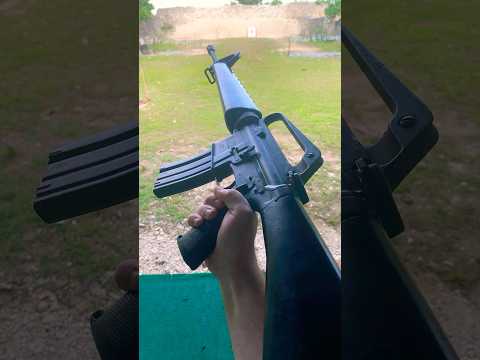
American Rifleman Television: Men and Guns of The Vietnam War, Part 1

Published on September 20, 2017
Duration: 11:04

This guide provides an overview of the M16A1 and CAR-15 firearms as discussed in the context of the Vietnam War. It covers their introduction, initial challenges, evolution into reliable service weapons, and specific technical details. The guide also touches upon special operations tactics developed for these platforms, emphasizing their role in counter-insurgency and small-unit engagements. Instruction is informed by experts like Martin K.A. Morgan and Wiley Clapp.

Quick Summary

The M16A1, a reliable service rifle by 1970, evolved from early M16 issues caused by poor training and incorrect ammunition. It's a gas-operated, direct impingement rifle weighing over 7 lbs, firing 5.56x45mm M193 with a 1:12 twist. The CAR-15 (XM177E2) offered enhanced maneuverability for special forces with its shorter barrel and retractable stock.

Chapters

  1. 00:00Vietnam War Context
  2. 01:06M16 Debut
  3. 02:06Initial Reliability Issues
  4. 03:36M16 Evolution
  5. 05:26M16A1 Technical Breakdown
  6. 07:21The CAR-15
  7. 08:57Special Ops Tactics

Frequently Asked Questions

What were the main issues with the early M16 rifles during the Vietnam War?

Early M16 rifles faced significant criticism due to inadequate soldier training and the use of incorrect gunpowder in ammunition. These factors contributed to catastrophic failures and frequent jamming of the rifles in combat situations, impacting their reliability.

How did the M16A1 become a reliable service rifle?

By 1970, the technical issues plaguing the early M16 models were addressed and resolved. This evolution led to the M16A1 becoming a dependable and reliable service rifle, solidifying its iconic status during the American involvement in Vietnam.

What made the CAR-15 (XM177E2) suitable for special forces?

The CAR-15 (XM177E2) was specifically developed for special forces operations. It featured a shorter barrel and a retractable stock, enhancing maneuverability in confined spaces, along with a significant flash suppressor/compensator.

What were some special operations tactics associated with the CAR-15?

Special forces units utilizing the CAR-15 often employed 30-round magazines and developed the 'double tap' shooting technique. This method was crucial for breaking contact with the enemy quickly in dense jungle environments.

More Training & Techniques Videos You Might Like

More from NRApubs

View all →