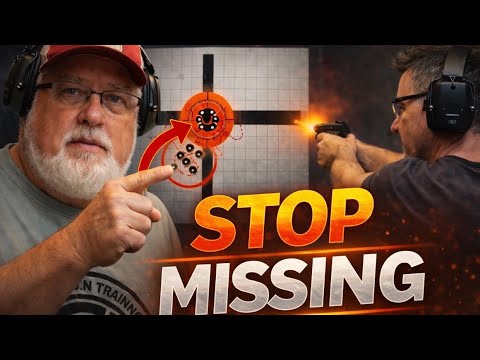
One Handed Pistol Shooting

Published on June 14, 2023
Duration: 13:04

This video provides expert instruction on one-handed pistol shooting, emphasizing the critical role of trigger control and finger placement when structural support is halved. The instructor highlights how deficiencies in these areas are masked in two-handed shooting but become pronounced when shooting one-handed. Key techniques include aligning the body's structure with the pistol's centerline and finding a natural hand angle for presentation.

Quick Summary

One-handed pistol shooting requires heightened attention to trigger control and finger placement because the reduced structural support from only one hand means any trigger manipulation errors are not masked. Aligning your body's structure with the pistol's centerline and executing a straight-back trigger pull are crucial for accuracy.

Chapters

  1. 00:00Introduction to One-Handed Pistol Shooting
  2. 00:31Trigger Control & Finger Placement Clarification
  3. 02:11Trigger Control Matters in Two-Handed Grip
  4. 03:24Challenges of One-Handed Pistol Shooting
  5. 03:59Two-Handed vs. One-Handed Grip Structure
  6. 04:48Drawing for a One-Handed Shot
  7. 05:37Presentation of One-Handed Grip
  8. 06:03Finding Your Natural Hand Angle
  9. 06:35Trigger Finger Placement & Control in One-Handed Shooting
  10. 07:10Two-Handed Grip for Recoil Management
  11. 07:25One-Handed Shooting Lacks Recoil Mitigation
  12. 07:42No Universal Trigger Finger Placement
  13. 08:25Recommended Trigger Finger Placement
  14. 08:51Proper Trigger Pull Technique
  15. 09:06Live Fire Demonstration: One-Handed Shot
  16. 10:11Faster One-Handed Shooting Attempt
  17. 10:45Off-Hand One-Handed Shooting Practice
  18. 11:08Loss of Isosceles Triangle in One-Handed Shooting
  19. 11:33Natural Point of Aim for One-Handed Shooting
  20. 11:48Dry Fire Practice for One-Handed Shooting
  21. 12:21Infinity Targets Mention

Frequently Asked Questions

What is the main difference between two-handed and one-handed pistol shooting regarding grip and recoil?

Two-handed shooting provides a stable isosceles triangle structure that helps manage recoil and grip pressure equally with both hands. One-handed shooting significantly reduces this structural support, making precise trigger control and grip even more critical for managing recoil.

Why is trigger control so important in one-handed pistol shooting?

In one-handed shooting, you lose the stabilizing effect of the second hand. Any deficiencies in trigger control, such as an improper pull or finger placement, are not masked and will directly cause the pistol to deviate, impacting accuracy.

What is the recommended starting point for trigger finger placement when shooting a pistol one-handed?

The recommended starting point is to use the center pad of your index finger on the trigger. You may need to adjust this placement slightly deeper or shallower depending on the specific pistol, your hand size, and finger length to achieve optimal control.

How should a shooter align their body for one-handed pistol shooting?

For one-handed shooting, it's generally advised to align your body's skeletal structure more directly with the pistol's centerline. This differs from a squared-up two-handed stance and helps facilitate a straighter recoil impulse.

Can trigger control deficiencies be hidden in two-handed pistol shooting?

Yes, an exceedingly good two-handed grip can mask minor deficiencies in trigger control and finger placement. However, these same deficiencies become much more pronounced and detrimental to accuracy when shooting with only one hand.

More Training & Techniques Videos You Might Like

More from RTT : Guns & Gear

View all →