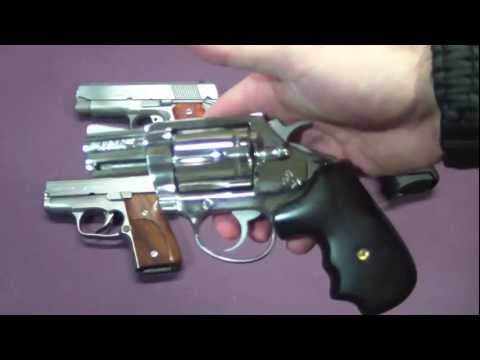
Proof That Shorter Guns = Less Muzzle Flip

Published on November 5, 2025
Duration: 1:37

Shorter-barreled handguns can exhibit less muzzle flip due to reduced reciprocating mass, leading to faster follow-up shots. While a subcompact like the Glock 29 (3.77" barrel) may have more felt recoil than a longer model like the Glock 40 (6.02" barrel) in 10mm Auto, its reduced muzzle rise aids in quicker target re-acquisition. The ideal carry configuration may combine a full-sized grip for control with a shorter slide and barrel.

Quick Summary

Shorter handgun barrels and slides generally exhibit less muzzle flip due to reduced reciprocating mass. This means less leverage pushing the muzzle upward during recoil, allowing for faster target re-acquisition and quicker follow-up shots compared to longer-barreled firearms.

Chapters

  1. 00:00Physics of Muzzle Flip Explained
  2. 00:20Glock 40 vs. Glock 29 Comparison
  3. 00:35Live Fire Demonstration: Muzzle Rise
  4. 00:57Ideal Carry Configuration for Faster Shots

Frequently Asked Questions

Does a shorter gun barrel mean less muzzle flip?

Yes, generally. Shorter handgun barrels and slides have less reciprocating mass. This reduced mass moving backward and upward during recoil creates less leverage, resulting in less muzzle flip compared to longer, heavier slides.

How does slide length affect follow-up shots?

Shorter slides contribute to less muzzle flip. Reduced muzzle rise allows the shooter's sights to return to the target faster after each shot, enabling quicker and more accurate follow-up shots, which is crucial for practical shooting scenarios.

Is a subcompact pistol better for recoil control than a full-size?

Not necessarily for felt recoil, but potentially for muzzle flip. While a subcompact might have more felt recoil due to less mass, its shorter slide can result in less muzzle flip, aiding in faster target re-acquisition. The ideal setup often balances grip size with slide length.

What is the physics behind muzzle flip in firearms?

Muzzle flip is caused by the forces of recoil acting on the firearm. The upward movement of the muzzle is influenced by the momentum of the reciprocating slide and barrel, the grip of the shooter, and the bore axis relative to the grip.

Related News

All News →

More Training & Techniques Videos You Might Like

More from SPN Firearms

View all →