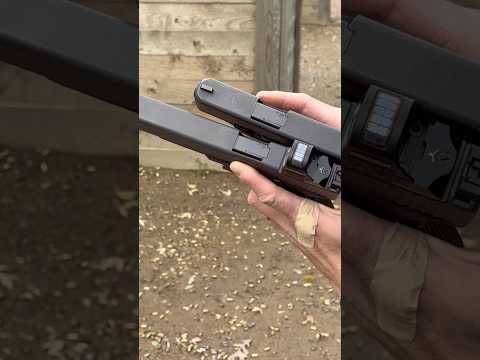
This video, presented by AT3 Tactical, breaks down the physics behind different AR-15 muzzle devices. It explains how flash hiders, muzzle brakes, compensators, hybrid devices, and linear compensators manage propellant gases to reduce muzzle flash, recoil, and muzzle rise, offering a guide to selecting the right device for specific shooting needs.
This video demonstrates a practical experiment to test if an AK-47 chambered in 7.62x39mm can generate enough recoil to push a shooter backward on an icy surface. The presenter, exhibiting experienced firearm handling, conducts the test with a Century Arms AK-47, concluding that the recoil is insufficient for significant displacement. The video also touches on basic firearm safety principles.
This video from Kentucky Ballistics explores the physics of firearm recoil by testing what happens when various guns fire without being held. The experiment demonstrates how different calibers and firearm designs react to recoil forces when unbraced, providing insights into muzzle flip and firearm movement. The presenter, Scott, uses a range of calibers from 9mm to 50 BMG to illustrate these principles.
This YouTube video focuses on the recoil characteristics of firearms, exploring a spectrum from mild to wild. Presented in slow motion, it allows viewers to observe and appreciate the mechanics of recoil in action across various firearm types. The title suggests a visual demonstration and analysis of how different firearms behave when fired, likely highlighting the forces and movements involved.
This guide, informed by SPN Firearms, explains the physics behind muzzle flip in handguns. It highlights how the reciprocating mass of a longer slide and barrel contributes to greater muzzle rise, impacting follow-up shot speed. The video demonstrates this by comparing the Glock 40 and Glock 29, both in 10mm Auto, showing that the shorter Glock 29, despite potentially more felt recoil, exhibits less muzzle flip, enabling faster target re-acquisition. The expert analysis suggests that for optimal carry, a full-sized grip paired with a shorter slide assembly is ideal.
This video explores the phenomenon of exploding ammunition when fired at supersonic speeds. It delves into the science and potential consequences of such an event, likely featuring visual demonstrations and explanations of the physics involved in ammunition failure at high velocities. The content aims to educate viewers on the extreme effects of supersonic ammunition under specific, likely destructive, conditions.
This guide details a demonstration of potential 'uncommanded discharge' in a Glock 19, using a cutaway model and a mechanical trigger stop. The expert instructor visually explains how jarring the slide can cause the striker to release due to specific sear engagement tolerances, a phenomenon also observed in other striker-fired pistols. The demonstration emphasizes understanding the mechanical function of striker-fired systems.
This guide, drawing from the expertise of a professional firearms retailer and educator, explains the concept of 'snappy' firearms. It details how muzzle flip occurs during recoil and highlights the critical role of slide mass in absorbing energy. The information compares the Smith & Wesson Bodyguard 2.0 and Walther PDP to illustrate how design, not just caliber, impacts shooting dynamics.
This YouTube Shorts video explores the phenomenon of bullets bouncing off cars, likely demonstrating and explaining the physics behind ballistic ricochet. The title and hashtags suggest a focus on military applications and general firearm mechanics. The content aims to answer the question of what happens when projectiles impact vehicle exteriors.
This video explains the basic physics behind how muzzle brakes reduce recoil on firearms like the AR-15. It details how burning gases are redirected outwards to counteract the backward force, making shooting more comfortable for various individuals.
This YouTube Short, titled 'How do bullets bounce off cars?', explores a common question in firearms and ballistics. While the description is minimal, the title and included hashtags like #pewpew and #military suggest the video will likely delve into the physics of projectile impact on vehicle materials. It may cover factors such as bullet construction, velocity, angle of impact, and the composition of car panels. The inclusion of #tip and #reels indicates a short, potentially informative clip.
This video delves into the physics of a bullet in flight, focusing on key metrics like velocity and time of flight, and how understanding these elements can be leveraged for improved shooting. It also promotes the creator's Patreon-like "Shooters Club," training events, classes, daily deals, and affiliate product directory, while providing discount codes for various firearm-related accessories and services. The content aims to offer no-BS training and connect with viewers through social media.
Gun Laws by State
Read firearms regulations for all 50 states + D.C.
Find Gun Dealers
Search licensed FFL dealers near you.