Channel: @kentuckyballistics
This video details a dangerous experiment demonstrating the catastrophic failure of a heavily modified 700 Nitro Express double barrel rifle. The rifle, originally a 10 gauge and exhibiting 'off face' issues, was deliberately over-pressurized to extreme levels (over 150,000 psi per barrel). The test resulted in significant destruction of the firearm and surrounding materials, highlighting the severe consequences of extreme pressure events in firearms.
This video reviews the Tromix AK-444, a prototype AK-47 variant chambered in .444 Marlin. Host Scott from Kentucky Ballistics compares its power and performance against a standard 7.62x39 AK-47. The review includes extensive testing of the .444 Marlin's ballistics, recoil, and penetration capabilities through various mediums, highlighting its significantly higher energy output compared to the standard AK round.
This video tests the effectiveness of rubber bullets in 9mm, .357 Magnum, and .44 Magnum calibers. The 9mm rubber bullets demonstrated surprising effectiveness, penetrating a glue block and cycling the firearm. The .357 Magnum and .44 Magnum rubber bullets performed poorly, with the .44 Magnum experiencing a squib load. The presenter concludes that while rubber bullets can be less lethal deterrents, lead ammunition remains superior for effectiveness.
This video from Kentucky Ballistics explores the recoil experienced by average individuals when firing some of the world's largest sporting rifles. Participants with limited experience, typically with 12-gauge shotguns, are subjected to cartridges like the 500 Nitro Express, 5.77 Tyrannosaur, 700 BMG, 4 Bore, and the 950 JDJ. The video highlights the significant difference in recoil compared to their usual firearms, emphasizing the physical challenge and the sheer power of these massive calibers.
This video reviews the Meligun MG-25 and MG-22, unique firearms disguised as knives. The presenter demonstrates their operation, loading mechanism, and firing. Testing includes shooting at various targets like water jugs, fruit, and a ballistic dummy to assess their effectiveness and accuracy. The review highlights the novelty of these firearms and their potential, albeit limited, applications.
This video from Kentucky Ballistics tests the bullet resistance of a 22-pound steel mug against a wide array of firearms, from .22LR to .577 Tyrannosaur and .50 BMG. The presenter, Scott, systematically fires each caliber at the mug, documenting the impact and penetration. While smaller calibers like .22LR and 5.7mm had no effect, larger handgun rounds like .44 Magnum and .460 S&W Magnum began to dent and deform the mug. Rifle calibers, particularly the 5.56mm and 277 Fury, caused significant damage and penetration. The most powerful rounds, the .500 Nitro Express, .577 Tyrannosaur, and .50 BMG, all inflicted substantial damage, with the .577 Tyrannosaur and .50 BMG penetrating the mug, though neither fully passed through. The test highlights the impressive durability of the heavy steel mug.
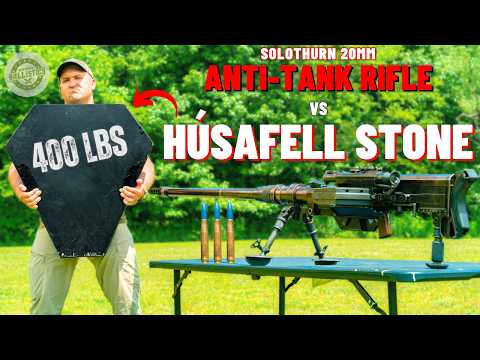
This video from Kentucky Ballistics features an extensive test of a 400-pound Husafell stone against a wide array of firearms, culminating with a Solothurn 20mm anti-tank rifle. The testing progresses from small caliber handguns to powerful rifle rounds, demonstrating the stone's impressive resistance. The Solothurn 20mm rifle, firing a 2,300-grain projectile, ultimately penetrates the stone, showcasing its significant destructive power compared to other calibers like 50 BMG.
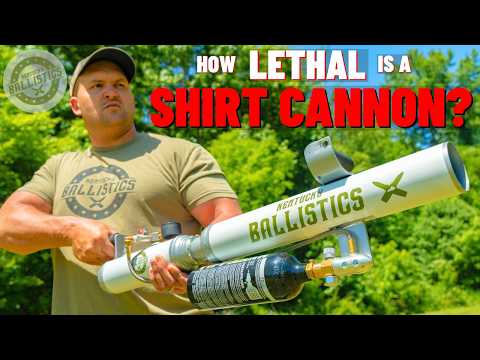
This video from Kentucky Ballistics tests the power and range of an Air Cannons LLC shirt cannon. The host, Scott, explores its capabilities by firing shirts at various pressures and then testing its impact on a ballistic dummy torso with different projectiles, including wet and frozen shirts, corn, potatoes, apples, and canned soup. The tests reveal significant blunt force trauma potential, especially with wet and frozen shirts, and demonstrate the cannon's ability to cause damage at close range.
This video provides an in-depth look at the Mauser 1918 Tankgewehr, the original anti-tank rifle. The presenter, Scott from Kentucky Ballistics, details its historical context, technical specifications, and demonstrates its capabilities through various tests. The content includes shooting steel plates, modern body armor, ballistic gel, and bulletproof glass, offering insights into the rifle's power and historical significance.
This video showcases custom-made .50 BMG RIP-inspired projectiles, designed to mimic the fragmentation of G2 Research's original RIP rounds. The host, Scott from Kentucky Ballistics, tests these rounds extensively in ballistic gel, refried beans, and against a zombie bust, demonstrating their extreme energy transfer and fragmentation capabilities. The tests confirm significant pedal separation and deep wound channels, with the projectiles proving stable at distance and capable of stopping in the fifth water jug.
This video from Kentucky Ballistics showcases the WASP CO2 Injector Knife, a unique device designed for underwater defense. The presenter, Scott, demonstrates its functionality by injecting CO2 gas into various targets, including a water jug, an egg, fruits, and a ballistic dummy torso. The tests highlight the significant pressure generated by the CO2 release, capable of causing substantial damage and disruption to organic matter. While presented with a humorous and hypothetical approach to shark attacks, the video provides a practical demonstration of the knife's potential effectiveness in incapacitating threats through rapid gas expansion.
This video from Kentucky Ballistics features a detailed test of various firearms against a life-sized Velociraptor replica to determine what it would take to defeat one. Host Scott, alongside Chris from Ballistic Dummy Lab, tests handguns from .22LR up to .500 Magnum, shotguns including a Spas-12, and rifles ranging from .45-70 to a .4 Bore. The experiment provides insights into the stopping power required for different threats, with a focus on practical application and the effectiveness of various calibers against a simulated large predator.