

Guns & Gadgets 2nd Amendment News
Channel: @gunsgadgets
Videos from Guns & Gadgets 2nd Amendment News

The ATF has proposed eliminating some bureaucratic requirements for firearms applications, including duplicate fingerprint cards and routine fingerprint submissions for NFA trust responsible persons. The agency admits these measures are used in a tiny percentage of background checks. This proposal aims to streamline the process, saving applicants time and money, but it is not a final rule and requires public comment. The ATF cites technological advancements and a lack of significant public safety benefit from current requirements as reasons for the proposed changes.

This video breaks down the U.S. Department of Justice's lawsuit against California's handgun restrictions, including the 'Glock ban.' Assistant Attorney General Harmeet Dillon's letter to Governor Newsom and AG Bonta is analyzed, highlighting the DOJ's argument that these laws violate the Second Amendment by prohibiting the acquisition of commonly used firearms for self-defense. The lawsuit is framed as a significant turning point in the fight for Second Amendment rights, with national implications for gun control legislation.

The Supreme Court has refused to hear Pennsylvania's appeal to revive its ban on 18-20 year olds carrying firearms. This decision upholds a Third Circuit ruling that found the ban unconstitutional, affirming that young adults are presumptively protected by the Second Amendment. The ruling emphasizes historical tradition and the Bruin framework, impacting age-based gun laws nationwide.

This video breaks down a federal lawsuit filed by the Department of Justice against Virginia, challenging the state's assault firearm ban. The DOJ argues the ban violates the Second Amendment, citing key Supreme Court precedents like Heller, Bruin, and Rahimi, and emphasizing the common use of AR-style rifles for lawful purposes. The lawsuit also critiques the terminology used in such bans and invokes a statute allowing the US to sue states for constitutional rights violations.

This video analyzes California Attorney General Rob Bonta's response to the Department of Justice's challenge of state handgun laws. It highlights the timing of Bonta's letter, coinciding with the Supreme Court agreeing to hear major Second Amendment cases, and details California's stance on defending its Unsafe Handgun Act and 'readily convertible' pistol ban. The analysis emphasizes the direct constitutional conflict emerging between California and the federal government.

This video provides an expert analysis of the Supreme Court's decision to hear two major Second Amendment cases challenging bans on AR-15s and similar semi-automatic rifles. It details the legal arguments, the historical context of Second Amendment jurisprudence, and the potential implications for firearms rights across the United States. The speaker, identified as an instructor from Guns & Gadgets, emphasizes the significance of the 'common use' doctrine established in Heller and Bruin, arguing that AR-15s, being widely owned for lawful purposes, should be constitutionally protected.

This video discusses CMMG's announcement to only sell firearms and accessories to state and local government agencies in configurations that are legal for their own citizens. The speaker, Jared from Guns & Gadgets, analyzes this decision through the lens of the U.S. Constitution, emphasizing the principle that all citizens are subject to the same rights and restrictions. The analysis highlights key Supreme Court cases like Heller, McDonald, and Bruen, and critiques the practice of governments restricting citizens while arming their own agencies with the same items.

A Virginia judge has issued a preliminary injunction halting the state's assault weapons and magazine ban before it took effect. Judge Jeffrey Campbell ruled that the ban likely violates constitutional protections, citing the Second Amendment and Article 1, Section 13 of the Virginia Constitution. The decision heavily relies on the Supreme Court's Heller and Bruin rulings, emphasizing that commonly owned firearms are protected and that the burden is on the government to prove historical tradition for restrictions. This ruling represents a significant early victory for gun owners in Virginia.

This video provides an expert breakdown of the Supreme Court's landmark decision in Chatry v. United States, which significantly impacts Fourth Amendment protections in the digital age. The ruling establishes that obtaining Google's location history via a geofence warrant constitutes a Fourth Amendment search, affirming a reasonable expectation of privacy in location data. The analysis emphasizes the importance of constitutional limits on government power, particularly as technology evolves, and highlights the interconnectedness of all Bill of Rights protections.
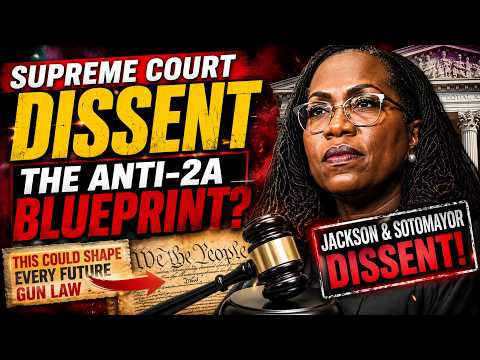
This video provides an in-depth analysis of Justice Ketanji Brown Jackson's dissenting opinion in a Supreme Court case concerning gun control. The presenter breaks down Jackson's argument that the case is primarily about property rights, not Second Amendment rights, and how she believes states have the authority to define consent for carrying firearms on private property. The video contrasts her reasoning with the majority opinion and discusses the potential implications for future gun control litigation.

This video provides an in-depth analysis of a significant legal challenge to the National Firearms Act (NFA), spearheaded by the Firearms Policy Coalition. It explores the argument that the NFA's constitutional foundation, primarily based on Congress's taxing power, has eroded, especially after taxes on certain NFA items were reduced to zero. The discussion delves into the potential reliance on the Commerce Clause for justification and the implications for federal power limits. Additionally, it examines a separate Second Amendment challenge, referencing the Bruin framework, arguing that NFA-regulated items like suppressors are in common use and protected by the amendment.

This video provides a breakdown of a Virginia court's temporary injunction blocking key provisions of the state's recent gun ban. It highlights the significance of this ruling as a victory for gun owners, emphasizing that while not a final decision, it halts enforcement of the ban on commonly owned semi-automatic firearms and related public carry restrictions. The analysis underscores the importance of swift legal action and the role of organizations like Gun Owners of America and the Virginia Citizens Defense League in defending constitutional rights.