
Videos tagged with James Madison

This video analyzes Federalist No. 54, highlighting how the founders' debate over slavery and representation, specifically the Three-Fifths Compromise, established a dangerous precedent of categorizing individuals to distribute power. The speaker argues this mindset, where 'who counts' dictates 'who has rights,' directly impacts the application and restriction of rights today, particularly the Second Amendment. The core message is that liberty is fragile when government decides who counts, emphasizing that rights are inherent, not granted by the state.

This video analyzes Federalist No. 53, arguing that the two-year election cycle for the House of Representatives is a critical balance. It prevents constant instability while allowing representatives time to gain knowledge and competence. The speaker connects this to the Second Amendment, suggesting that uninformed or reactive lawmakers, driven by frequent elections, are more likely to infringe upon constitutional rights.

This video breaks down Federalist 52, emphasizing James Madison's arguments for a House of Representatives designed to be accountable to the people. It highlights how the structure of the House, including election cycles and voter qualifications, aims to prevent government overreach and maintain popular sovereignty. The discussion draws a direct parallel between representative government and the Second Amendment, asserting both are rooted in the principle that citizens, not subjects, are the ultimate political authority.

This video breaks down Federalist No. 51, emphasizing James Madison's core argument that government must be designed to control itself due to human imperfection. It highlights the importance of divided power, checks and balances, and federalism as structural safeguards for liberty. The analysis connects these principles to the Second Amendment, positing that an armed citizenry serves as a crucial popular counterweight against potential government overreach and the concentration of power.

This video breaks down Federalist 50, explaining James Madison's warning against relying on periodic public reviews to correct government overreach. The speaker, Jared from Guns & Gadgets, emphasizes that liberty must be secured by the government's inherent design, with permanent internal controls, rather than relying on delayed or passion-driven external corrections. The analysis directly connects to the importance of the Second Amendment as a structural safeguard against consolidated power.

This video breaks down Federalist No. 49, highlighting James Madison's warning against frequent appeals to the people to resolve governmental disputes. Madison argued this practice undermines constitutional stability, empowers political factions, and favors the legislative branch. The content connects these historical arguments to modern political discourse and the importance of the Second Amendment as a safeguard for liberty against governmental overreach and instability.

This video analyzes Federalist No. 48 by James Madison, arguing that the legislative branch poses the greatest threat to liberty due to its inherent power to expand its authority. It highlights Madison's concept of 'parchment barriers' and warns that without enforcement mechanisms, constitutional limits are ineffective. The discussion connects these historical warnings to modern legislative actions, particularly concerning Second Amendment rights, emphasizing the importance of the right to bear arms as a final check against governmental overreach.

This video, presented by Jared from Guns & Gadgets, offers an expert analysis of Federalist 47, emphasizing James Madison's warnings about the concentration of government power. It connects historical principles of separation of powers and checks and balances to modern concerns about the administrative state and the enduring relevance of the Second Amendment as a bulwark against tyranny. The content is highly informative for those interested in constitutional law and the foundational principles of American liberty.

This video provides an expert analysis of Federalist 46, emphasizing its critical role in understanding the Second Amendment. It details how the founders viewed an armed populace as a cornerstone of liberty, a bulwark against potential government tyranny, and an integral part of American federalism. The discussion highlights the founders' intent that the Second Amendment is about the power to resist oppression, not merely for sporting purposes.

This video provides an expert analysis of Federalist 45, focusing on James Madison's original intent regarding the balance of power between the federal government and states. The speaker, demonstrating deep constitutional knowledge, argues that the federal government has significantly overstepped its defined boundaries, particularly concerning firearm regulation. The content connects historical principles to contemporary debates on Second Amendment rights and the role of states in protecting individual liberties against federal overreach.
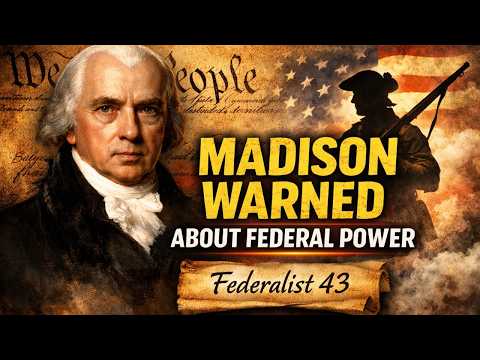
This video, presented by Guns & Gadgets, features an expert-level discussion on Federalist 43, authored by James Madison. The content delves into the historical context of the Constitution's ratification, emphasizing Madison's arguments for limited federal power and the crucial role of an armed citizenry as the ultimate safeguard against government overreach and potential tyranny. The discussion connects these foundational principles directly to the intent and necessity of the Second Amendment, highlighting the founders' skepticism of standing armies and their reliance on the militia. The video also includes a promotional segment for Blackout Coffee.

This video provides an expert-level analysis of Federalist Paper No. 42, authored by James Madison, to contextualize modern debates surrounding federal power and gun control. The speaker, demonstrating deep knowledge of constitutional history, explains how the principle of enumerated powers and the original intent of the Commerce Clause are critical for understanding Second Amendment jurisprudence and the limits of federal authority. The analysis highlights potential overreach in contemporary gun regulations by federal agencies.