Channel: @usccaofficial
This video provides an expert-level analysis of the Supreme Court's decision in Woollard v. Lopez, focusing on its implications for Second Amendment jurisprudence. It details how the ruling addresses 'sensitive locations' and the rights of private property owners regarding individuals carrying firearms. The analysis delves into the historical context of gun control laws, the Bruin two-step test, and the rejection of Hawaii's 'vampire rule,' which required businesses to proactively invite individuals with firearms. The speaker, identified as a firearms instructor, emphasizes the significant shift in legal interpretation and its potential impact on future gun control legislation.
This video analyzes the Supreme Court's decision in US v. Heneghan, clarifying its impact on firearm possession for marijuana users. It explains that the ruling does not legalize marijuana federally or create a blanket exemption for users. Instead, it reinforces the Bruin standard, requiring historical justification for firearm prohibitions and emphasizing the need for judicial determination before rights are stripped, particularly in cases involving restraining orders.
This video details a Lyft driver's self-defense incident that escalated into a jury trial. It highlights the importance of situational awareness, de-escalation techniques, and the legal ramifications of using a firearm in self-defense. The narrative emphasizes the emotional and legal challenges faced by individuals after a defensive shooting, underscoring the value of legal protection services like USCCA.
Following a self-defense shooting, prosecutors may use phone records, medical records, and social media posts as evidence against you. Police will seize your phone during arrest, and prosecutors can obtain search warrants for its data, including texts and location history. Medical records can be accessed due to HIPAA exceptions, and any statements made to medical personnel could be used in court. Social media activity is also scrutinized for content that could support the prosecution's case.
This review compares the Glock Gen 6 and Springfield Echelon, focusing on their design philosophies, modularity, ergonomics, and performance. The Glock emphasizes simplicity and reliability, while the Echelon prioritizes modularity and shooter ergonomics. Both pistols were tested with approximately 2,000 rounds, evaluating aspects like optic mounting, grip texture, slide serrations, trigger feel, recoil management, and reloading speed. The Echelon is noted for its superior modularity and ambidextrous controls, whereas the Glock offers a more traditional, reliable platform with a slightly faster reload due to its flared mag well. Accuracy is comparable between the two.
This video provides a practical comparison of three popular AR-15 optic setups: an LPVO with a piggybacked red dot, a standard red dot, and a 4-16x scope with a 45-degree offset red dot. Through speed drills, reload evaluations, and medium to long-range engagements, the video highlights the pros and cons of each system for different shooting scenarios. The analysis emphasizes target identification, speed of acquisition, and overall weight impact on performance, offering insights for users to select the best optic for their specific rifle setup and intended use.
This video, featuring instruction from a firearms expert, details crucial techniques for maneuvering a pistol effectively in confined spaces during home defense scenarios. It emphasizes adapting weapon retention and ready positions beyond standard full extension, introducing concepts like High Ready and compressed/nipple line retention for safer and more effective engagement in tight environments. The instructor stresses the importance of practicing these techniques to avoid common mistakes and maintain readiness.
This video introduces the Unit 9 pistol from Unit Solutions as a highly realistic training tool that bridges the gap between dry-fire and live-fire range sessions. The instructor emphasizes its close resemblance to a Glock 19 in weight, feel, and operation, making it ideal for practicing fundamental shooting skills, manipulation drills, and accessory use in a home environment. The Unit 9 offers a cost-effective and safe alternative to live ammunition for increasing training frequency and proficiency.
This video demonstrates the initial patterning of a Stevens model 5100 20 gauge side-by-side shotgun using slugs at 25 and 50 yards. The instructor aims to assess its potential as a 'poor man's double rifle' by evaluating slug performance with iron sights, with plans to add a peep sight and taller front sight for improved accuracy at medium distances for hunting medium-sized game.
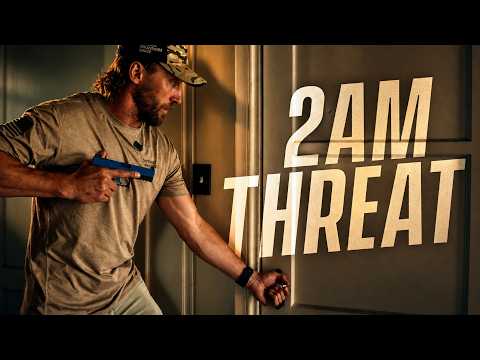
This video provides critical home defense strategies for responding to a late-night door threat. It emphasizes never opening the door to strangers, utilizing tactical positioning like 'attacking the crack' to maximize defensive advantage, and employing the home's structure for cover. The instruction, delivered by a firearms instructor, highlights the importance of pre-planning binary decisions for high-stress scenarios and maintaining a defensive posture without unnecessary retreat.
This review of the Springfield Echelon 4 FC highlights its versatility as a multi-purpose handgun suitable for concealed carry, home defense, and competition. The reviewer, a Navy SEAL, praises its shootability, ergonomics, and features like ambidextrous controls and a modular red dot mounting system. While acknowledging a slightly mushier trigger compared to some competitors, the overall performance and ease of shooting are emphasized.
This video discusses a case where a client was criminally charged after his car was stolen, with the charge stemming from an unsecured firearm found inside the vehicle. The incident highlights the Illinois Safe Storage Act, which mandates firearms be locked and stored in a locked container, even within a vehicle, to prevent access by unauthorized individuals like children, at-risk adults, or felons. The legal interpretation extends 'premises' to include vehicles, leading to charges even if the vehicle itself was locked.