Channel: @shatterthewicked
This guide details a concealed carry holster setup for the Bodyguard 2.0, focusing on minimizing printing and ensuring a secure grip. It highlights the use of specific holsters and attachments like a holster claw to tuck the grip into the body. The advice also covers magazine choices for better concealment and grip.
This video explains California's ban on the sale of Glock pistols and similar firearms, effective July 1st. The ban targets handguns with cruciform trigger bars, deemed by the state as easily convertible to machine guns. While existing owners are unaffected, new gun owners and those who haven't yet purchased a Glock will be impacted. The instructor highlights the reliability and extensive aftermarket support for the Gen 3 Glock, while also pointing to newer, potentially superior handgun options available on the market. Private party transfers remain a legal avenue for acquiring these firearms.
This review evaluates the Rise Armament Rave 140, a budget-friendly drop-in AR-15 trigger. The instructor highlights its straightforward installation process, suitable for beginners, and praises its crisp, light single-stage break with minimal creep and a short reset. Despite its affordable price point, the trigger offers a solid feel and improved finger placement, making it a significant upgrade from a standard mil-spec trigger.
This video explores the functionality and potential issues of pistol chassis systems, specifically the Strike Industries chassis for the Echelon. The instructor highlights how a chassis system, particularly with an attached brace, can improve stability and handling, making a handgun feel more like a carbine. He discusses practical applications like vehicle carry and home defense, while also detailing personal modifications made to adapt the chassis for a compact Echelon model, including rail trimming and magazine selection. The review also touches on potential challenges such as mag release accessibility and optic height, offering solutions like risers and grip enhancements.
This video discusses the complex legal and tactical considerations of using a firearm against an unarmed attacker. It emphasizes the importance of de-escalation and avoidance, clarifying that provoking a confrontation generally forfeits self-defense rights. The instructor highlights that responding to unarmed physical assault with deadly force is often excessive, unless there's a reasonable belief of imminent death or serious bodily harm. A key point is that if an attacker attempts to disarm you, the threat level escalates, potentially justifying defensive action.
This video explores the 'snappy' recoil impulse experienced with the Walther PDP and investigates recoil springs as a solution. The presenter tests ZR Tactical's V-Spec and Duty springs against the OEM spring, evaluating recoil reduction, accuracy, and reliability. While initial impressions favored the Duty and OEM springs, extended testing revealed the V-Spec as the preferred option for its significant recoil softening and flatter shooting characteristics, without compromising reliability.
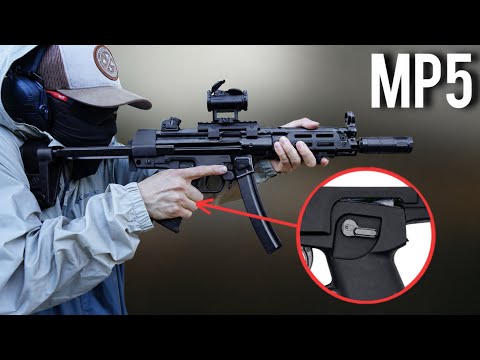
This guide details the installation and operation of the Radiata MP5 grip module, a California-compliant fixed magazine solution for MP5 clones. It highlights the redesigned internal mag lock mechanism, the compatibility with AR-style triggers, and the overall build quality compared to 3D-printed alternatives. The module aims to preserve the original MP5 aesthetic while offering enhanced functionality for users in restricted states.
This video demonstrates how to reload a California-compliant AR-15 that features a fixed magazine. Due to legal restrictions, standard magazine swaps are not permitted. The presenter showcases a side-loading mechanism from Cross Armory, which allows rounds to be fed into the rifle's internal magazine via a side port. The process involves loading rounds into the side loader, inserting it into the rifle, and then pushing the rounds into the magazine. The video also discusses the limitations of this method, potential jamming issues, and compares it to other compliant solutions like the AR Maglock and Kingpin system.
This video discusses the trade-offs of lightweight 1911 pistols, specifically highlighting the Kimber 1911 Custom LW. While an aluminum frame can reduce weight by nearly half a pound, making it more comfortable for everyday carry and training, it significantly increases felt recoil due to less mass to absorb energy. Heavier steel-framed 1911s offer a smoother shooting experience by soaking up more recoil.
This review examines a California-compliant Kimber 1911 Custom LW, highlighting its lightweight construction and the trade-offs associated with it, such as increased recoil. The reviewer discusses specific features like the iron sights, beaver tail, and thumb safety, noting a hot spot issue when riding the safety. The impact of California's firearm regulations, including the loaded chamber indicator and magazine disconnect, is also detailed.
This video explores the utility of LPVO (Low Power Variable Optic) and offset red dot combinations for civilian self-defense. The instructor, with experience testing gear, discusses two primary mounting positions: 12:00 (piggyback) and 45° offset. While acknowledging the benefits of the 12:00 position for night vision and barrier work, the focus shifts to the 45° offset for its speed in transitioning between magnified and 1x views. The instructor details potential scenarios where this setup might be beneficial, such as defending a high-ground position or in a hunting situation against a predator, while also addressing the cons like practice required, awkwardness around barriers, and reduced effectiveness with night vision. Ultimately, the instructor concludes that while the setup has advantages, it may not be essential for most civilian self-defense needs.
This video addresses common issues with the Springfield Echelon, specifically the slide failing to lock back due to thumb placement on the slide catch. It demonstrates how an aftermarket raised slide catch can resolve this. Additionally, it discusses trigger characteristics, noting a short takeup, firm wall, crisp break, and quick reset, with an average pull weight of 3.5-4 lbs suitable for carry. The video also covers replacing the factory magazine release for improved ergonomics.