This live stream discusses current gun news, including the Supreme Court's refusal to hear a challenge to Illinois' ban on carrying firearms on public transit. The speaker also delves into the controversial topic of allowing felons to own firearms, arguing for a case-by-case approach based on rehabilitation. Various firearms and self-defense tools are mentioned, including the Glock 29 in 10mm and the Springfield Echelon, alongside discussions on ammunition capacity, holster availability, and the legality of body armor. The stream emphasizes the importance of training and responsible firearm ownership.
This video explores the concept of battle rifles, primarily chambered in .308 Winchester (7.62x51mm NATO), contrasting them with intermediate cartridge rifles like those in 5.56x45mm NATO. It delves into the pros and cons, including increased power for barrier penetration and cover defeat, but also highlights significant drawbacks such as increased weight, reduced ammunition capacity, and higher cost. The discussion emphasizes that battle rifles are best suited for specific roles like Designated Marksman Rifles (DMRs) or squad support, rather than as a primary infantry weapon for every soldier, and stresses the importance of appropriate optics and understanding their limitations.
This video demonstrates a unique shotgun that fires two rounds simultaneously, effectively delivering 15 times more lead per shot than a standard repeating firearm. The instructor highlights the significant recoil generated by this double-shot capability and discusses how the firearm's weight helps mitigate it. The video also touches on ammunition management and a sponsorship from Emo Squared for ammunition storage and delivery.
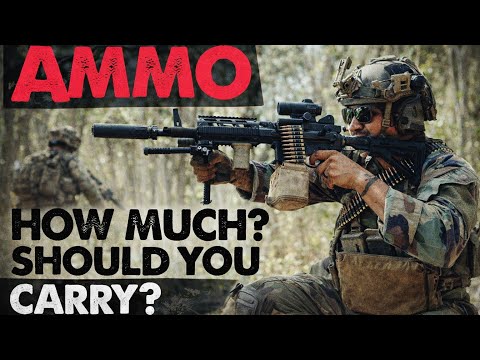
This video, featuring a former Army Ranger and law enforcement officer, delves into the critical factors determining ammunition loadout for various scenarios. It emphasizes that 'how much ammo is enough' is dictated by the mission, expected engagement duration, supply lines, and the specific role of the individual. The discussion highlights the difference between combat loads, patrol loads, and the needs of a prepared citizen, stressing that ammo provides time for maneuver, cover, and egress, and that underestimating ammunition needs can be a critical tactical error.
This video from GUNBROS features knowledgeable retail experts discussing the suitability of a 75-round drum magazine for home defense. They emphasize that while high capacity sounds appealing, reliability and maneuverability are paramount in a self-defense scenario. The experts advise against drum magazines due to potential reliability issues and bulkiness, favoring standard capacity magazines that are proven to function under stress.
The US military's transition to 9mm ammunition was driven by several key factors, primarily standardization with NATO allies who widely adopted the 9mm cartridge. Logistical benefits, including lighter ammunition and lower production costs, also played a significant role. Furthermore, increased magazine capacity and the ability for soldiers to achieve faster follow-up shots with 9mm handguns, particularly for less experienced shooters, were crucial considerations. This decision has persisted even with the adoption of new platforms like the SIG Sauer M17/M18.
This video provides an in-depth look at the Smith & Wesson M&P 2.0 equipped with a Freedom Fingers FRT (Forced Reset Trigger). The reviewer, who appears to have significant experience with firearms, demonstrates the trigger's function, compares its performance to other FRT systems, and conducts shooting tests. The content focuses on the technical aspects of the FRT modification and its impact on the firearm's operation and rate of fire.
This video explores the enduring relevance of pump-action shotguns, focusing on the Remington 870 Express. The presenter details modifications for home defense, including shortening the barrel and increasing magazine capacity with extensions and side saddles. It also discusses different ammunition types (slugs, buckshot, birdshot) and their suitability for various applications, while emphasizing the importance of practice and understanding potential over-penetration risks.
This video discusses weapon selection for a WROL (WithOut Rule of Law) bug-out scenario, focusing on community comments and expert analysis. The primary discussion revolves around choosing between a handgun with multiple magazines, a battle rifle, a Personal Defense Weapon (PDW), and an AR-15, considering factors like ammunition capacity, maneuverability, and effectiveness in a close-quarters, high-threat environment.
This video explores the concept of the Infantry Automatic Rifle (IAR) for civilian use, comparing it to traditional machine guns like the SAW. It details the technical aspects of building and outfitting an IAR for sustained fire, focusing on heat management, barrel selection, gas systems, and loadout strategies for carrying increased ammunition. The presenters emphasize the IAR's role as a force multiplier and a versatile platform for civilian applications.
This guide details how to attach shell cards to a shotgun receiver using industrial Velcro, a DIY modification discussed by James Reeves. This method increases on-gun ammunition capacity for home defense scenarios. The Maverick 88 is highlighted as a budget-friendly option suitable for such enhancements.
This video discusses the concept of 'capacity obsessive disorder' in concealed carry, arguing that while more rounds are generally better, a minimum acceptable standard of 10+1 rounds is sufficient for the vast majority of civilian self-defense situations. The speaker, with over a decade of military and concealed carry experience, shares his personal journey through various firearms and capacities, ultimately advocating for a balance between capacity and shootability, especially for new or smaller-statured shooters.
Gun Laws by State
Read firearms regulations for all 50 states + D.C.
Find Gun Dealers
Search licensed FFL dealers near you.