This guide details the operation of the BE Meyers MILR's unique 'disturbed pointer' feature, as explained by Ian McCollum. The system uses an integrated ranging laser to automatically adjust the IR pointer's aim point, compensating for ballistic drop on the fly. This allows for rapid and accurate engagement of targets at varying distances without manual reticle adjustments.
This guide, presented by Ryan Gresham of Gun Talk Media, focuses on simplifying hunting optics with the Leupold VX-5HD. It explains the benefits of Second Focal Plane (SFP) reticles, particularly the Duplex, for clarity and ease of use. The guide also details how to utilize Leupold's Custom Dial System (CDS) for precise long-range shooting by matching a custom turret to your specific ballistics.
This video reviews EOTech's new DCR (Dual Circle Reticle) in the EXPS3 optic, comparing it to the legacy reticle. The presenter finds the DCR offers improved target visibility by removing the top portion of the reticle, enhancing situational awareness downrange. While acknowledging the limitations of a 1x optic for extreme distances, the review demonstrates its effectiveness for hits up to 400-500 yards, praising its ruggedness and retaining all original EXPS3 functionality, including night vision settings and auto-off features.
This video introduces Burris Optics, highlighting its history and innovative product lines. Phil, the National Training Manager, discusses the company's founding in 1971 by Don Burris, who previously worked at Redfield and was instrumental in developing early widefield scope designs. The discussion touches on Burris's legacy of innovation, particularly in ballistic compensation with dual focal plane reticles, and previews upcoming product deep dives including the new Fullfield series, tech-enabled scopes like the XTRPS and Eliminator 6, and the enclosed emitter FastFire E.
This video demonstrates a practical technique for compensating for bullet drop at closer ranges when your optic is zeroed for a longer distance. The instructor, Naaming Kotchanok, explains how to identify the bullet's impact point and use the reticle's hash marks to adjust aim for accuracy. She emphasizes the importance of recording these adjustments for different distances to ensure consistent, precise shooting.
This video reviews the Vortex Razor HD Gen 3 1-10x LPVO, highlighting its exceptional durability and the accuracy of its first focal plane BDC reticle. The instructor emphasizes its effectiveness for engaging targets from 50 to 600 yards without manual turret adjustments when paired with a standard AR-15 platform and 55-grain FMJ ammunition.
This video provides an in-depth review of the Pulsar Thermion 2 XQ50 Pro thermal scope, highlighting its advanced features for hunting and tactical applications. The reviewer, an experienced firearms instructor, details the scope's user-friendly interface, exceptional image quality, and integrated laser rangefinder with ballistic compensation capabilities. The review emphasizes its suitability for extended use due to its swappable battery system and ease of integration with the Stream Vision app for recording and ballistic data input.
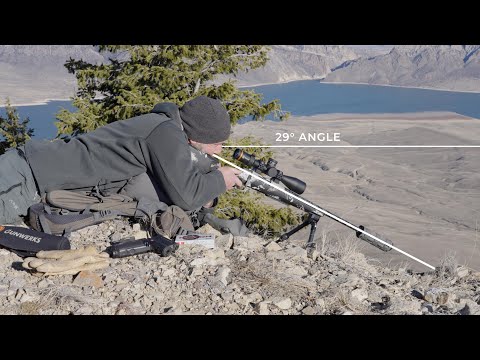
This guide details the technique for using a smart ballistic laser rangefinder for angled shots, as demonstrated by Brian Poor of Gunwerks Long Range University. It explains the physics behind angled shots, contrasts older rangefinder methods with modern smart devices, and provides steps for achieving accurate impacts by applying calculated ballistic solutions. The demonstration highlights the significant difference in accuracy between traditional and smart rangefinders on steep terrain.
This video demonstrates shooting at unknown distances in a natural environment, focusing on practical marksmanship techniques. The instructor utilizes a Ruger American Ranch rifle in .223 caliber and emphasizes the importance of estimating distances, observing wind conditions, and applying appropriate windage holds to achieve accurate hits. The content highlights the challenges and rewards of shooting in non-ideal conditions, offering insights into developing field shooting skills.
This video provides an expert-level comparison of Bullet Drop Compensating (BDC) reticles, Minute of Angle (MOA), and Mil Radian (MRAD) systems for firearm optics. The instructor, with extensive experience, argues for the superiority of MRAD for its mathematical simplicity, communication clarity, and adaptability in long-range shooting scenarios. The content details the pros and cons of each system, focusing on practical application, communication, and the mathematical underpinnings of ballistic calculations.
This video demonstrates two distinct methodologies for long-range precision shooting: dialing the scope's turrets versus using a hold within the reticle. Lucas Botkin from T.REX ARMS showcases rapid target engagement using both techniques with a Nightforce ATACR scope and a Vortex Impact 4000 rangefinder. The instruction highlights the importance of understanding ballistic compensation for consistent accuracy at extended distances.
This video provides an expert-level guide to engaging targets at extended ranges (up to 200 meters) using a .22 LR rifle and the NAAMING HD 4-16x44 SFIR scope. Naaming Kotchanok, demonstrating high authority, explains and demonstrates two key techniques: reticle holdover and turret dialing. The instruction covers zeroing at 50 meters and applying specific holdover points or turret adjustments for 100, 150, and 200 meters, emphasizing accuracy and proficiency.
Gun Laws by State
Read firearms regulations for all 50 states + D.C.
Find Gun Dealers
Search licensed FFL dealers near you.