This archive film details the intricate manufacturing process of the Sterling submachine gun at the Royal Ordnance Factory Fazakerley. It covers the detailed steps involved in producing key components like the barrel, breech block, casing, and magazine, highlighting specialized machinery and quality control measures. The film concludes with rigorous proof testing and final packing procedures, showcasing the comprehensive approach to producing this iconic firearm.
This entry details the specific differences between Winston Churchill's personal Patchett Machine Carbine and a standard Sterling L2A3 submachine gun, as explained by firearms expert Jonathan Ferguson of the Royal Armouries. Key distinctions lie in the sling swivel orientation, rear sight design, stock reinforcement, finger stop configuration, and the unique 'spackle' finish of the Patchett. Ferguson, Keeper of Firearms & Artillery, provides an expert analysis of these design evolutions.
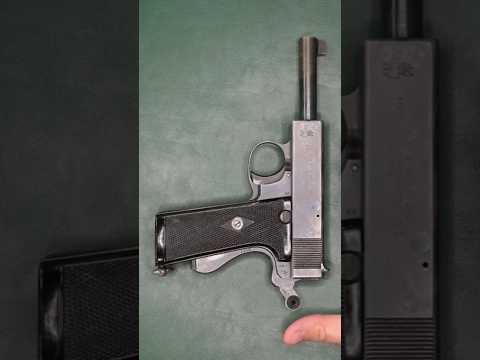
This guide details the disassembly process for the Webley Self-Loader Mark I Naval Pattern, as demonstrated by a firearms specialist. It covers the initial safety checks, removal of the guide rod, and separation of the slide and barrel from the frame, highlighting unique internal features like the V-spring mainspring. The instruction emphasizes a mechanically focused approach, suitable for those interested in the historical and technical aspects of early semi-automatic pistols.
Ian McCollum of Forgotten Weapons provides a critical review of the Enfield MkII revolver, detailing its design improvements over the MkI, such as a snag-free sight and simplified machining. He highlights its historical context, including markings for New South Wales and use by colonial forces, while also dissecting its mechanical flaws like cylinder locking issues and the 'bullet jumping' problem. The review concludes by noting its short service life and replacement by the Webley MkI.
This video details a practical accuracy test of the L1A1 SLR rifle fitted with a 4x Trilux SUIT scope, conducted by Henry Chan and Mike Burns (Bloke on the Range) at Eagle Lake, Texas. The test focuses on achieving hits on steel targets from 150 to 500 yards using 7.62x51mm NATO ammunition. The assessment highlights the rifle's capabilities and the SUIT scope's historical context, while critically evaluating its mounting system's limitations for maintaining zero.
This guide outlines a practical accuracy course for the L1A1 SLR, focusing on engaging targets from 150 to 650 yards. It highlights the importance of marksmanship, windage/elevation adjustments, and diagnosing/clearing malfunctions like failures to eject and feed. The instruction emphasizes practical application and understanding the rifle's operational nuances, drawing on the expertise of seasoned firearms instructors.
This Q&A session features Rob from BritishMuzzleLoaders and THIAS discussing various aspects of firearms, primarily focusing on historical British military arms. They delve into their YouTube channel origins, favorite firearms like the Enfield revolver and Lewis Gun, personal shooting habits, and the nuances of black powder firearms. The conversation also touches on firearm research, disappointing firearms, service rifle comparisons, and the challenges of content creation.
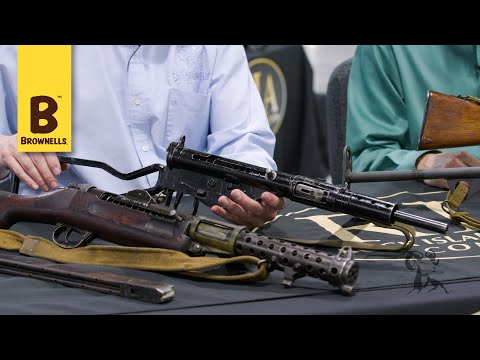
This video from Brownells' 'From the Vault' series, filmed at Rock Island Auctions, details the evolution of British submachine guns from World War II. It covers the Lanchester Mark I, the various Sten gun marks (Mark I, II, III, V, and IV), highlighting their design changes, production costs, and historical context. The presenters emphasize the Sten's role in equipping British forces and resistance fighters, noting its simplicity and cost-effectiveness compared to other contemporary submachine guns.
Firearms expert Jonathan Ferguson from the Royal Armouries clarifies the existence of two distinct Webley Mark IV revolvers. One is a .455 inch service revolver dating back to 1899, while the other is a smaller .380 inch pocket revolver adopted in 1932. The shared 'Mark IV' designation is a historical coincidence stemming from different product lines and military naming conventions, not indicating identical models.
This video provides a comprehensive historical overview of the bullpup rifle design, tracing its origins from early concepts to modern iterations like the SA80. It details the British military's long-standing interest in the bullpup configuration, exploring various prototypes and adopted firearms, while also discussing the technical challenges and design philosophies behind these compact weapon systems. The presentation highlights key figures and developmental milestones, offering insights into why the bullpup design has seen periods of significant adoption and subsequent decline in favor of conventional rifle designs.
This guide details the handling and specific design features of the Lee Metford and Lee Enfield Cavalry Carbines, as explained by firearms expert Ian McCollum. It covers techniques for drawing the carbine from a saddle, manipulating its action, safety, and magazine, emphasizing the carbine's snag-free profile and specialized cavalry adaptations. The instruction highlights the importance of understanding these historical firearms' unique operational characteristics.
This video discusses a unique bullpup rifle designed by Yuvraj Hanwant Singh of Jodhpur in 1944. Built from an Enfield rifle, it predates official British military bullpup development. The rifle, along with submachine guns and a .22 bolt-action rifle, was created in a workshop in Moranga. The content is part of a Kickstarter campaign for a book on British bullpup firearms.
Gun Laws by State
Read firearms regulations for all 50 states + D.C.
Find Gun Dealers
Search licensed FFL dealers near you.




![L1A1 🇬🇧 SLR [British FN FAL - Iron Sights] to 600yds (Feat. Bloke on the Range) Practical Accuracy](https://i.ytimg.com/vi/q0j3AAfte2w/hqdefault.jpg)