This video critiques the internet's tendency to promote numerous specialized rifle builds (CQB, GPR, SPR, Field Rifle) for various SHTF scenarios. The instructor emphasizes that most individuals would be better served by mastering one reliable rifle platform and focusing on practical training, understanding ballistics, and considering their actual use case and physical capabilities. The core message is to avoid falling victim to consumerism and instead prioritize proficiency with a single, well-understood firearm.
This video argues that the Trijicon ACOG TA31 remains the premier optic for 'doomsday' or 'no rule of law' scenarios due to its battery-free illumination, legendary durability, and proven reliability in extreme conditions. The instructor, with over 13 years of experience and extensive round count, details its performance in various environments and its set-and-forget simplicity. It highlights the importance of zeroing with M855 ammunition and the effectiveness of its bullet drop compensator.
This guide details the proper procedure for zeroing a rifle for combat engagements. It emphasizes correct optic mounting, grouping to confirm fundamentals, understanding bullet drop compensators, and choosing between a 25-meter or 50-meter zero based on expected engagement distances. The instructor stresses the importance of confirming the zero at range and avoiding common mistakes like resting the barrel on supports.
This video details the performance of the 20-inch PSA Sabre rifle after 3,000 rounds, focusing on optic selection and range experience. It highlights the advantages of magnified optics like the Trijicon ACOG for known distance shooting over red dots with magnifiers, particularly for identifying targets and making corrections. The PSA Sabre is presented as a reliable entry-level duty-rated rifle, with emphasis on proper maintenance and understanding optic limitations.
This guide details how to properly adjust and maintain a Trijicon ACOG optic, focusing on mitigating reticle bloom and ensuring proper mounting. It emphasizes hand-tightening adjustment knobs to prevent damage and suggests using tape to control tritium brightness for precise aiming, especially when utilizing the bullet drop compensator.
This guide details the installation and zeroing process for the Brownells reproduction Colt 4x20 AR-15 scope, based on original 1970s blueprints. It covers mounting the scope onto an AR-15 carry handle and performing range adjustments using the BDC turret. The information is presented with high authority by Ian McCollum, a recognized expert in historical firearms.
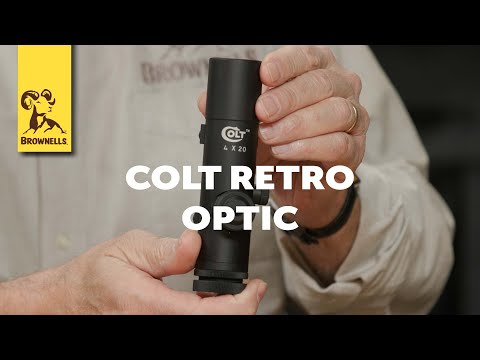
This video announces the return of the Colt Retro 4x Optic, a four-power carry handle scope designed for older AR-15 and M16 style rifles. The updated optic features improved optics and lens coatings compared to original models, addressing common issues like cloudiness and zero retention. It includes a built-in bullet drop compensator for .223/5.56 ammunition and is exclusively available through Brownells as a partnership with Colt.
This guide details the setup and usage of the Trijicon ACOG TA31, emphasizing its fixed magnification, short eye relief, and battery-free illumination. It covers mounting options for secondary red dot sights (RMR, SRO) like piggyback and 45-degree offset configurations, discussing their pros and cons for different scenarios. Techniques such as occluded shooting and utilizing the BDC reticle for long-range accuracy are also highlighted, drawing on the instructor's practical field knowledge.
This video focuses on a "Donation Friday" giveaway featuring a SIG Sauer Tango MSR LPVO. The host and viewers discuss the giveaway mechanics, the features of LPVOs (Low Power Variable Optics), including first and second focal plane reticles and bullet drop compensation, and the importance of understanding optic footprints for mounting. The discussion also touches on firearm events and legal challenges related to firearms.
This guide, drawing on the expertise of Clint, a firearms instructor, details how to properly utilize various firearm reticles. It covers specific reticle breakdowns for optics like the EOTech EXPS2-2, Trijicon ACOG, and Leupold Mark 5HD, explaining aiming points, Bullet Drop Compensators (BDC), and range estimation. The guide also addresses critical concepts such as 'height over bore' compensation and the differences between First and Second Focal Plane optics, emphasizing that the correct optic choice and understanding its reticle are crucial for effective shooting.
This video provides an expert-level overview of magnified optics, covering their historical development, terminology, and practical applications. Instructors Danny and Jason explain concepts like magnification levels, objective lens diameter, reticle types (duplex, mil-dot, BDC), focal planes (FFP vs. SFP), and parallax adjustment. They highlight the advantages of magnified optics for competition, target shooting, hunting, and tactical scenarios, emphasizing how they improve aiming accuracy and target acquisition at various distances.
This video provides an expert overview of the Trijicon ACOG optic, highlighting its durability, battery-free illumination system, and integrated range-finding and bullet drop compensation features. Ryan from Trijicon explains how the forged 7075 aluminum housing and prismatic design contribute to its ruggedness, while the dual illumination from fiber optics and tritium ensures constant reticle visibility. The discussion also details how the reticle's BDC lines can be used for accurate long-range shots by compensating for bullet drop without complex calculations.
Gun Laws by State
Read firearms regulations for all 50 states + D.C.
Find Gun Dealers
Search licensed FFL dealers near you.