This video compares the terminal ballistics of supersonic airgun pellets, specifically Edgun West exploding pellets and RWS Hypermax, against .22 LR Federal Punch self-defense rounds using clay blocks. The airgun, an Edgun West Epic 2, achieved velocities well over the speed of sound, with some pellets exceeding 1500 FPS. The .22 LR Federal Punch rounds also demonstrated significant expansion and penetration.
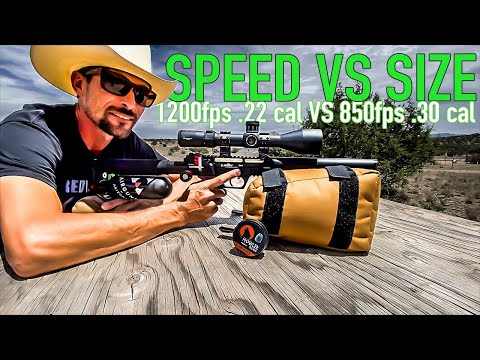
This video compares the terminal ballistics of a high-velocity .22 caliber slug versus a larger, slower .30 caliber slug using a block of clay as a medium. The .22 caliber slug achieved significantly higher velocities (around 1200 fps) with a 21-grain H&N slug, causing fragmentation. The .30 caliber slug, fired at approximately 846 fps with a 49.5-grain projectile, exhibited significant mushrooming and less fragmentation, resulting in a wider but shallower wound channel. While the clay test results were comparable, the instructor suggests the higher velocity of the .22 caliber may induce more shock, while the larger .30 caliber projectile creates a larger wound. The video highlights the trade-offs between speed and projectile mass in terminal ballistics.
This video compares the terminal ballistics of a .22LR subsonic hollow point round against a specialized exploding pellet from an airgun. Both were tested for penetration and cavitation in a clay block. The .22LR demonstrated significant expansion, while the exploding pellet showed impressive internal cavity creation due to its explosive charge.
This video demonstrates the ballistic performance of the 7.5 FK cartridge fired from an FK Brno PSD-C pistol. Expert analysis focuses on the projectile's impact within a clay medium, showcasing its significant energy transfer and wound cavity creation. The demonstration highlights the specialized nature of this high-performance caliber and its capabilities when fired from a 6-inch barrel.
This video demonstrates the terminal ballistics of Winchester Defender Elite .410 Gauge ammunition fired from a Taurus Judge revolver. The demonstration utilizes a clay block as a medium to visualize projectile performance, showcasing the impact and cavity created by the specialized defensive load. The content highlights safe firearm handling and the visual effects of this unique ammunition type.
This video provides a visual, action-oriented demonstration of terminal ballistics for 9mm FMJ versus Hollow Point ammunition using a Sig Sauer 1911. High-speed slow-motion footage clearly illustrates the distinct performance characteristics of each bullet type upon impact with a clay medium. The FMJ shows a clean pass-through, while the Hollow Point exhibits significant expansion and energy transfer, leading to the disintegration of the target.
This video provides a visual demonstration of terminal ballistics using a clay block as a medium. It showcases the differing effects of .22 LR, 9mm Luger, and 5.56mm NATO rounds fired from distinct firearms, including a Trailblazer Firearms LifeCard, a Canik pistol, and an AR-15 equipped with a Primary Arms optic. The expert instruction highlights the comparative damage and expansion characteristics of each caliber.
This YouTube video compares the performance of Hornady Critical Defense ammunition in .357 Magnum against a clay block. The title and description highlight the specific caliber and brand, as well as its relevance to everyday carry (EDC) and revolvers. The video likely demonstrates terminal ballistics and penetration characteristics of the ammunition.
This YouTube video features a ballistics test comparing the performance of a .357 Magnum Jacketed Soft-Point (JSP) round against a clay block. The video likely aims to demonstrate terminal ballistics, projectile expansion, and penetration capabilities of this specific ammunition type, potentially in the context of self-defense or general handgun performance. The title and description hint at its relevance for firearm enthusiasts interested in ammunition performance and handguns, particularly revolvers like those from Smith & Wesson.
This video appears to be a ballistic test comparing the performance of 38 Special FMJ ammunition against a clay block. It directly references common firearms topics such as EDC (Everyday Carry) and revolvers, and also includes a comparison to 357 Magnum, suggesting an evaluation of different calibers or loads. The use of FMJ (Full Metal Jacket) ammunition indicates a focus on its penetration and expansion characteristics.
This video conducts a comparative test of .22LR defensive ammunition, focusing on Federal Punch, CCI Stinger, and Winchester Velocitor. The tests involve shooting through 25-pound clay blocks and water jugs to assess penetration and expansion. The Federal Punch, despite its lighter weight and flat nose, demonstrated significant expansion and penetration, leading the instructor to consider it a top carry option. The CCI Stinger also showed good energy dump but less penetration than the Punch in the water jug test. The Winchester Velocitor was noted for its effectiveness but was edged out by the others in this specific comparison.
This entry details a test conducted by 704 TACTICAL host, an experienced firearms content creator, evaluating the terminal ballistics of a .50 Beowulf round fired from an AR-15 platform. The test involved shooting through a car door into a 25 lb clay block, captured in slow motion, to demonstrate the round's energy dump and fragmentation upon impact. The analysis highlights the effectiveness of the .50 Beowulf for penetration and energy transfer.
Gun Laws by State
Read firearms regulations for all 50 states + D.C.
Find Gun Dealers
Search licensed FFL dealers near you.



![Claymation: 7.5 FK [FK Brno PSD-C]](https://i.ytimg.com/vi/s9U0tSKrsNY/hqdefault.jpg)


