This guide details how to identify if a Cutts compensator on a Remington Model 11 was factory-installed, based on barrel markings and the absence of traditional choke designations. It also touches on military markings and potential historical uses as an aerial gunner trainer. The information is presented with high authority, drawing on detailed technical understanding of firearm provenance.
This video demonstrates the operation of a semi-automatic shotgun equipped with a Cutts Compensator, featuring a live-fire demonstration at an outdoor range. An experienced shooter showcases proper loading techniques and muzzle discipline. The content highlights the functionality of the vintage Cutts Compensator and the reliable cycling of the semi-automatic action with Federal Field & Target 12 Gauge ammunition.
This video, presented by firearms expert Brandon Herrera, investigates the theory surrounding Kurt Cobain's death and the Remington Model 11 shotgun. Herrera provides a detailed mechanical explanation of the firearm, identifies the specific ammunition used, and conducts a practical test to debunk ergonomic theories about reaching the trigger. The analysis includes ballistic testing on a dummy to examine the effects of the ammunition.
This video provides an expert-level comparison of two primary Thompson submachine gun variants: the ornate pre-war 'Gangster' model and the simplified, cost-effective wartime production version. The instructor, demonstrating high authority, highlights key mechanical and aesthetic differences, including barrel types, grips, magazine compatibility, and charging handle locations, emphasizing the production efficiencies gained in the wartime variant.
This video provides a concise overview of the Thompson Model 1928A1 submachine gun, highlighting its key features and historical context. The presenter, demonstrating high authority, explains the Blish lock system, the finned barrel for cooling, and the Cutts compensator for muzzle control. It also touches upon the differences between the 1928A1 and the M1A1 variants, and its aesthetic ties to earlier models.
This guide details the operation and handling of the Thompson M1928A1, drawing on expert insights from Larry Vickers. It covers safety checks, control identification, grip considerations due to its weight and design, and awareness of its firing characteristics. The information is presented with a high level of authority, reflecting Vickers' deep knowledge of historical firearms.
This video from Iraqveteran8888 features expert Eric from Drive Tanks at Ox Ranch, Uvalde, Texas, demonstrating and discussing several iconic World War II submachine guns. The review covers the 1928 Thompson, M3 Grease Gun, German MP40/MP38, and the Russian PPSh-41, highlighting their historical context, design differences, and live-fire performance. Eric provides detailed insights into their mechanics, ammunition types, and manufacturing techniques, emphasizing the evolution from complex designs to mass-produced, stamped firearms.
Ian McCollum, demonstrating high expertise, provides an in-depth comparison of three Thompson submachine gun variants: the M1921, 1921/28 Overstamp, and M1A1. He analyzes how design changes, particularly to the rate of fire and ergonomics, impacted shootability and controllability, concluding with his personal preference for the M1921's shooting experience.
This guide details the production evolution of the M1928A1 Thompson SMG during World War II, as explained by Ian McCollum of Forgotten Weapons. It covers historical context, manufacturing shifts, design simplifications for mass production, and key modifications like the 'Dulite' finish and sight changes. Expert insights highlight the transition from early patterns to cost-effective military versions.
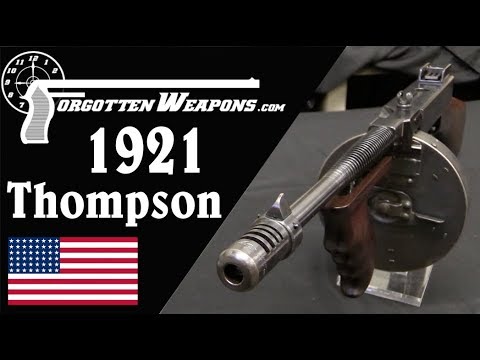
The Thompson 1921, also known as the 'Chicago Typewriter,' was the first production submachine gun from Auto-Ordnance. Despite its innovative design, including the flawed Blish Principle, its high price point limited early sales primarily to law enforcement and banks. The Model 1921AC featured a Cutts Compensator and offered various magazine options, though the 100-round drum was cumbersome.
This video provides an in-depth look at the Colt R80 Monitor, a rare variant of the Browning Automatic Rifle (BAR) developed for law enforcement. Expert Ian McCollum details its history, mechanical features, and limited production, highlighting its adoption by the FBI as their first official fighting rifle. The analysis emphasizes its unique design elements like the Cutts compensator and its historical context in 1930s law enforcement.
You've reached the end! 11 videos loaded.
Gun Laws by State
Read firearms regulations for all 50 states + D.C.
Find Gun Dealers
Search licensed FFL dealers near you.