This video from Tática Civil demonstrates a unique ballistic test using 12 Gauge shotgun shells loaded with Jawbreaker candies. The instructor, showing experienced firearm handling, tests their impact on a water jug and a Clear Ballistics gel head, comparing the spread to standard birdshot. The results indicate these candy rounds deliver significant energy and wider spread than conventional shotgun shells, posing a greater threat than their composition might suggest.
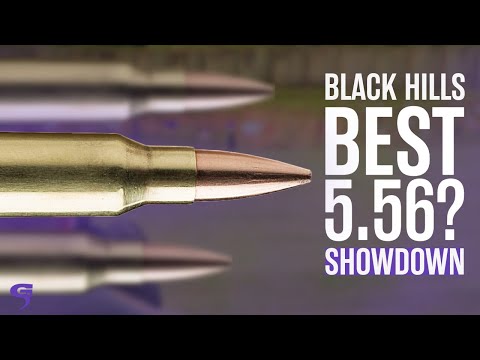
This video from Gun Talk Media compares three Black Hills 5.56/.223 ammunition loads: the 77gr TMK for long-distance shooting, the 60gr V-MAX for varmint hunting, and the 62gr Dual Performance, a newer load noted for accuracy and terminal performance. The presenter highlights Black Hills' innovation and consistency, emphasizing maintained velocities for predictable trajectories and impacts. Testing includes shooting on paper at 100 yards and gel blocks to assess terminal ballistics.
This video from Brass Facts explores the performance differences between various 300 Blackout barrel lengths (9-inch, 7.5-inch, and a 5-inch clone) focusing on sound, external ballistics, and terminal effects. The presenter, Brassfax, aims to find a versatile 300 Blackout setup that balances different roles, concluding that barrel length significantly impacts performance, especially with supersonic ammunition and at range.
Ted from Line45 reviews Lehigh Defense's Controlled Fracturing (CF) ammunition, highlighting its unique design where the bullet splits into multiple 'petals' upon impact while the core continues to penetrate. This creates multiple wound channels, offering enhanced tissue disruption without sacrificing terminal ballistics. The ammunition is CNC machined from solid copper, lead-free, and demonstrates consistent performance across various calibers in gel tests.
This video tests Liberty Civil Defense, G2 Research Telos, and Liberty Overwatch ammunition through pork rib bones and gel. The Liberty Civil Defense 9mm and G2 Research Telos showed similar penetration depths, with the Liberty Civil Defense achieving 12 inches. The 10mm Liberty Overwatch also penetrated bone, with its base found only about an inch into the block, indicating high velocity. The speaker notes that bone had less impact on bullet performance than anticipated, with fragmentation being randomized rather than uniform.
This video tests the Hornady Critical Defense 90-grain FTX .380 ACP ammunition using two different barrel lengths: a 2.75-inch S&W Bodyguard 2.0 and a 3.8-inch M&P EZ. The testing involved chronograph readings and ballistic gel tests with a four-layer clothing barrier. Results showed inconsistent performance, with the shorter barrel failing to expand the projectile while the longer barrel achieved expansion but fell slightly short of the desired 12-inch penetration minimum.
This video provides a detailed comparison of Buffalo Bore and Grizzly 10mm Auto 180-grain ammunition through ballistic gel testing. The instructor, with clear expertise in firearms and ballistics, demonstrates a rigorous testing protocol using a chronograph and gel blocks with clothing barriers. The results highlight the exceptional performance of both brands, with Buffalo Bore slightly edging out Grizzly in retained weight and overall expansion, though both offer superior 10mm performance.
This video critically examines the 8.6 Blackout cartridge, questioning its purported advantages, particularly the emphasis on a 1:3 twist rate. The presenter argues that while the cartridge offers more energy than 300 Blackout, its significant bullet drop and limited effective range make it less ideal for hunting compared to other alternatives. The analysis delves into the physics of rotational energy, suggesting its contribution to terminal ballistics is often overstated and that faster twist rates can lead to increased barrel and component wear.
This video provides a detailed ballistic test comparing 5.7x28mm and 9mm ammunition against various Level 3A armor panels. The instructor demonstrates that while some 5.7x28mm rounds can penetrate soft aramid fiber Level 3A, higher quality UHMWPE panels effectively stop both 5.7x28mm and 9mm rounds. The test suggests that for general purposes, 9mm may offer comparable or superior performance to 5.7x28mm against common armor types.
This video conducts a ballistic gel test comparing Hornady's 9mm 138gr Backcountry Defense and Underwood's 9mm 147gr Hard Cast Plus P ammunition. The test measures velocity, penetration, and projectile integrity. The presenter, an experienced shooter, highlights the performance characteristics of each round for potential dangerous game defense scenarios, emphasizing penetration and lack of expansion.
This video from Shot Show 2025 introduces Shell-Tech Ammunition, a brand under Shellshock Technologies, highlighting their innovative NAS3 two-piece ammunition cases. The cases are made from a nickel-stainless alloy, offering significant weight reduction (up to 25% lighter than brass) and increased strength capable of handling extreme pressures (tested to 85-95,000 PSI). The presentation includes on-range testing of 300 Blackout, 223 Remington, and 9mm Luger ammunition, demonstrating accuracy, gel penetration, and wound cavity effects. The company emphasizes consistency, reduced recoil, and improved accuracy as key benefits of their technology.
This video from Gun Talk Media features Jeff Hoffman of Black Hills Ammunition discussing and demonstrating their Honey Badger ammunition. The discussion focuses on the unique design of the monolithic copper projectile with flutes, which is engineered to provide terminal performance comparable to hollow points without the risk of expansion failure. The video includes gel tests comparing the 160-grain .44 Magnum Honey Badger to a traditional 300-grain hollow point, both from a handgun and a carbine, highlighting significant velocity and terminal effect differences when fired from a carbine.
Gun Laws by State
Read firearms regulations for all 50 states + D.C.
Find Gun Dealers
Search licensed FFL dealers near you.