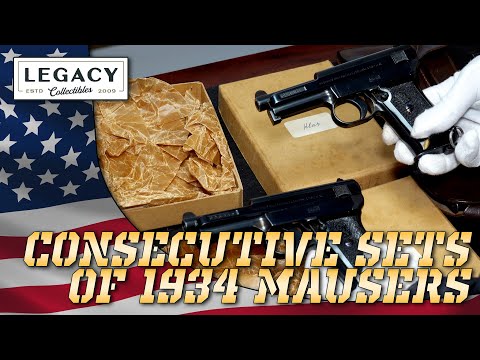
This video showcases two consecutively numbered Mauser 1934 pistols, highlighting their pristine condition and original packaging. It then transitions to discussing rare 1934 Navy Mausers, detailing their unique property markings, including the 'funky chicken' eagle over M stamp. The presenter educates viewers on the historical context, manufacturing variations between the 1914 and 1934 models, and the evolution of Navy markings through different eras.
The Mauser 1914 is a compact 9x17mm Browning Court (also known as .380 ACP) semi-automatic pistol weighing 1.3 pounds and measuring just over six inches in length. It offers a comfortable grip for single-handed shooting and features a cocking indicator. Despite its weight, recoil is manageable, attributed to the full grip. The sights are described as tall and clean, aiding in quick realignment. The safety mechanism is noted as somewhat unnatural, with a push-down lever and a separate button for disengagement. The trigger is praised for its smooth action. While not achieving Mauser's ideal of a universal handgun, the 1914 served as a capable pocket pistol for both military personnel and civilians.
This video provides an expert-level breakdown of the German Jäger Pistol, a unique WWI-era firearm. Ian McCollum, with high authority, details its unconventional multi-part frame construction, striker-fired mechanism, and the specific disconnector design that prevents full-auto fire. The analysis highlights the blend of stamped and machined parts, challenging the notion of it being purely a stamped pistol. Production is estimated between 12,000-15,000 units, with few surviving today.
You've reached the end! 3 videos loaded.
Gun Laws by State
Read firearms regulations for all 50 states + D.C.
Find Gun Dealers
Search licensed FFL dealers near you.