This video explores the growing trend of shooters replacing 9mm with alternative handgun calibers in 2025 and beyond. The presenter, Ted from Line 45, details the advantages of calibers like .30 Super Carry for capacity, 5.7x28mm for speed and flat trajectory, 10mm for power, .357 SIG for barrier penetration, and .22 TCM for rifle-like velocity in a pistol platform. The discussion highlights how these newer options address specific needs that 9mm may not always meet, driven by advancements in ammunition and firearm design.
This video from Kentucky Ballistics features a detailed test of various firearms against a life-sized Velociraptor replica to determine what it would take to defeat one. Host Scott, alongside Chris from Ballistic Dummy Lab, tests handguns from .22LR up to .500 Magnum, shotguns including a Spas-12, and rifles ranging from .45-70 to a .4 Bore. The experiment provides insights into the stopping power required for different threats, with a focus on practical application and the effectiveness of various calibers against a simulated large predator.
This video from Yee Yee Life tests the penetration capabilities of various firearms against a stack of baking sheets, culminating with a .50 BMG round. The experiment demonstrates the relative stopping power of different calibers, from .22 LR to .50 BMG, and includes a 12-gauge slug, AK-47, .308, and .30-06 rifle rounds. The results highlight significant differences in penetration, with the .50 BMG ultimately piercing all 34 baking sheets.
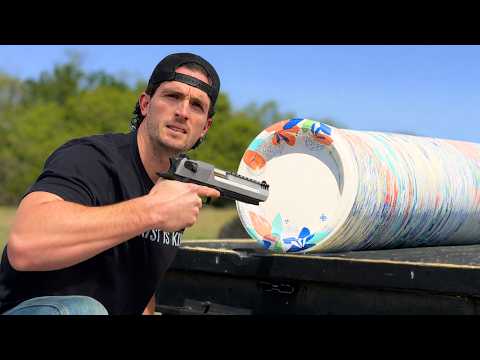
This video tests the penetration capabilities of various firearms, from .22 LR to a .50 BMG, through stacks of paper plates. The experiment aims to determine how many plates each caliber can stop before the projectile is fully arrested. The results show a significant increase in penetration with larger calibers, with the .30-06 Springfield ultimately outperforming the .50 BMG in this specific test due to projectile deflection.
This video discusses a shift in handgun caliber popularity, moving away from the dominant 9mm Luger towards more powerful options like 10mm Auto and higher-velocity rounds like 5.7x28mm. The trend is driven by increased firearm availability in these calibers and a consumer desire for greater power in carry guns.
This video details three common ammunition calibers likely to disappear first during a shortage: 5.56 NATO/.223 Remington, 9mm Luger, and .22 LR. It explains the technical reasons, pros, and cons of each, emphasizing how high ownership, government contracts, and specialized manufacturing contribute to rapid depletion. The speaker advises proactive stocking to avoid being caught unprepared.
This video argues that the .45 ACP remains superior to the 9mm in terms of stopping power and impact, despite the 9mm's popularity. It details the historical development of both calibers, compares their ballistic performance, and discusses practical applications in self-defense and home defense scenarios. The .45 ACP is highlighted for its larger diameter, slower velocity, and resulting wider wound channels, especially when expansion fails.
This video explains why 9mm ammunition is the first to disappear during demand surges. It details how its status as a busy market lane, NATO standardization, and overwhelming popularity among new and experienced shooters create a unique vulnerability. The explanation covers production bottlenecks, especially primer supply, and how experienced shooters' consistent purchasing habits deplete stock before panic buying even begins.
Ted from Line45 advises stockpiling specific ammunition calibers before anticipated shortages in 2026. He details why .22 LR, 9mm Luger, .223/5.56 NATO, 12-gauge slugs and buckshot, 7.62x39mm, and .308/7.62 NATO are critical, citing historical patterns, production limitations, and demand pressures from various user groups. The guide emphasizes maintaining separate stashes for training and defensive use across all firearm types.
This video, presented by an expert firearms instructor, explores emerging handgun calibers that are beginning to challenge 9mm's dominance. It details the ballistics, performance advantages, and specific firearm platforms for calibers like .30 Super Carry, 5.7x28mm, 10mm Auto, .357 SIG, and .22 TCM, offering insights into why shooters might choose these over the traditional 9mm for specific applications.
This podcast episode features The Yankee Marshal discussing various firearms topics, including the effectiveness of ported barrels, comparisons of handgun calibers like .357 SIG and .40 S&W, and firearm maintenance. He emphasizes the need for rigorous testing to prove the efficacy of modifications like porting and shares personal experiences with different firearms and calibers. The discussion also touches on firearm accessories, legal rulings, and personal preferences for self-defense tools.
This video from GFG (God Family & Guns) identifies five budget-friendly ammunition calibers to stock up on before an anticipated price increase in 2026. The instructor highlights .22 LR, 9mm, .223/5.56 NATO, 12 Gauge Birdshot, and 7.62x39mm, providing cost-per-round estimates and use-case recommendations for each. The expert advice focuses on affordability, availability, and suitability for training, self-defense, and hunting.
Gun Laws by State
Read firearms regulations for all 50 states + D.C.
Find Gun Dealers
Search licensed FFL dealers near you.