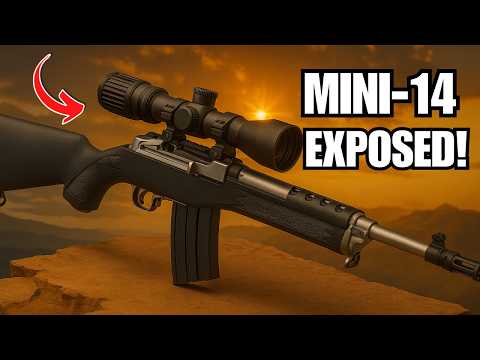
This comprehensive review of the Ruger Mini-14, presented by an expert instructor from Line45, delves into its often-overlooked history, design evolution, and controversial legacy. It highlights key mechanical features, compares early and later models, and discusses its adoption by military and law enforcement, while also addressing its association with tragic events. The expert provides insights into why the rifle remains relevant despite competition from modern platforms.
This expert-level entry details the Ruger Mini-14's unique mechanical features, drawing from an authoritative instructor's analysis. It covers the rifle's design origins by Bill Ruger and Jim Sullivan, its short-stroke gas piston system, Garand-style rotating bolt, and investment cast receiver, highlighting how these elements contribute to its classic appeal and functionality.
This expert guide, drawing on the insights of an experienced firearms instructor, details the history and evolution of the Ruger Mini-14. It covers the rifle's design origins, key mechanical features, and significant variants like the Mini-30 and AC556. The guide also touches upon the Mini-14's historical use, its refinement for improved accuracy, and its enduring appeal in the civilian market, contrasting it with modern platforms.
This expert-level guide delves into the Ruger Mini-14, moving beyond its classic aesthetics to explore its unique design philosophy, mechanical intricacies, and historical evolution. It highlights Ruger's quiet refinements that significantly improved accuracy in later models, making it a relevant and reliable option even in 2025, distinct from its AR-platform counterparts.
This video provides an in-depth comparison between the Ruger Mini-14 and the AR-15, highlighting the Mini-14's advantages in reliability, durability, and low-profile appearance. The presenter, Ted from Line45, emphasizes the Mini-14's design origins as a working man's rifle, contrasting it with the AR-15's military combat roots. Key points include the Mini-14's piston-driven operating system for cleaner function, its robust build quality with cold hammer-forged barrels, and its less 'tactical' aesthetic which offers practical benefits in certain jurisdictions.
This video provides an in-depth look at the Ruger Mini-14, dispelling common myths and highlighting its unique history and mechanical design. It details the rifle's development, its evolution from a civilian-friendly carbine to a tool used by law enforcement and military, and the significant accuracy improvements made over the years. The presenter emphasizes that despite its 'cowboy' image, the Mini-14 possesses a robust design and a legacy that extends beyond its perceived role.
This comprehensive review delves into the history, design, and evolution of the Ruger Mini-14, presented by an expert instructor. It covers the rifle's origins, mechanical nuances, accuracy improvements over different generations, and its varied use by law enforcement and military. The video also touches upon related models like the Mini-30 and AC-556, and addresses the rifle's controversial legacy linked to tragic events.
This video delves into the often-overlooked aspects of the Ruger Mini-14, revealing its unique design philosophy, historical variants, and surprising military/law enforcement applications. It highlights how the Mini-14, designed by Jim Sullivan and Bill Ruger, was intended as a civilian-friendly carbine, distinct from a scaled-down M14, featuring an M1 Garand-inspired short-stroke gas piston and rotating bolt. The discussion covers lesser-known variants like the .222 Remington export model and the Mini-30, its role in law enforcement and foreign military units (like the Royal Bermuda Regiment), and its controversial legacy due to its use in high-profile tragic events. Finally, it details Ruger's quiet improvements to the Mini-14's accuracy, particularly from the 580 series onwards, explaining why the rifle continues to sell despite the prevalence of more modern platforms.
This video provides an in-depth look at the Ruger Mini-14, detailing its design philosophy by Jim Sullivan and Bill Ruger, its mechanical operation, and historical context. It addresses common criticisms regarding accuracy, highlighting Ruger's improvements in the 580 series, and discusses its modern relevance as a less 'tactical' appearing, yet reliable, firearm. The expert analysis covers its use in various incidents and its unique place in the firearms market.
This entry details the internal mechanics of the Ruger Mini-14, focusing on its short-stroke gas piston and rotating bolt system, inspired by the M1 Garand. It highlights design choices made by Jim Sullivan and Bill Ruger, emphasizing how the action differs from platforms like the AR-15 and contributes to its operational characteristics. The information is presented with high authority, drawing from deep technical and historical knowledge.
This video provides an in-depth look at the Ruger Mini-14, dispelling common misconceptions and exploring its design, history, and variants. It highlights the rifle's mechanical features, including its short-stroke gas piston system and monolithic investment cast receiver. The content also covers less-known aspects like the .222 Remington export variant, challenges with the Mini-30, and its surprising military and law enforcement applications. Finally, it addresses the historical accuracy issues and Ruger's improvements, explaining the Mini-14's continued relevance in 2025 due to its classic appeal and legal advantages over 'scary black rifles'.
This video provides a comparative overview of the Ruger Mini-14 and the AR-15, highlighting the Mini-14's advantages in specific scenarios. The speaker, demonstrating high authority, details the Mini-14's robust gas piston system, its lower profile for social acceptance, superior stock options like true folding stocks, and better long-term value. It's presented as a reliable alternative to the AR-15 for certain users.
Gun Laws by State
Read firearms regulations for all 50 states + D.C.
Find Gun Dealers
Search licensed FFL dealers near you.