This short video showcases a 1941 Johnson rifle, a World War II U.S. Marine firearm that competed with the Garand. The presenter highlights its unique recoil-operated action, contrasting it with gas-operated systems, and describes its smooth operation. The video mentions the high cost of acquiring one (around $6,000) and the enjoyable shooting experience. It prompts viewers to share their own experiences with Johnson rifles.
The Johnson Model R prototype, developed by Melvin Johnson, showcases an early iteration of his semi-automatic rifle design, featuring a unique rotary magazine to address reliability issues encountered in trials. Despite its innovative short-recoil action and attempts to meet military bayonet requirements with a reciprocating handguard, the Model R ultimately failed to secure a military contract, paving the way for the later M1941 Johnson rifle.
This video provides an in-depth review of Bruce Canfield's comprehensive book, 'U.S. Small Arms of World War II.' Expert Ian McCollum highlights the book's extensive scope, covering everything from edged weapons to heavy ordnance, and its value as both a historical overview and a collector's guide. The review emphasizes the book's detailed information on standard and experimental firearms, combat accounts, and its significant expansion from previous works.
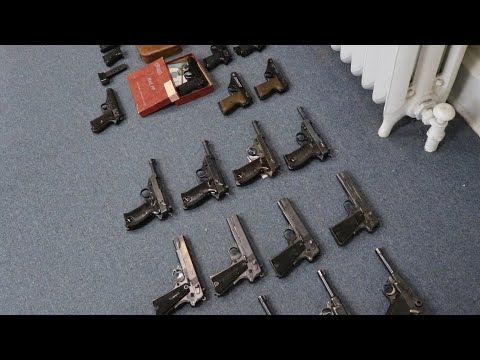
This video provides a post-Show of Shows 2020 recap, showcasing firearms acquired by Legacy Collectibles. The presenter details various rare and collectible pistols and rifles, including Walther PPK/S models with specific historical markings, rare Persian and late-war PPK variants, P38s with unique proofs, and Cri Off Lugers. It also highlights a presentation engraved Walther, an early Japanese Nambu, a WWI Luger, a Union Switch & Signal M1911, and a police-marked CZ. The video touches on significant sales, including a full-auto MP40 and a Johnson rifle.
The Johnson M1941 rifle, designed by Melvin Johnson, was an alternative to the M1 Garand, featuring a unique short-recoil operation and a 10-round rotary magazine. Despite limited US adoption, it was used by Dutch forces and US Para-Marines. Its design, particularly the rotating bolt, influenced later AR-15 development.
This guide details the simple field stripping procedure for the M1941 Johnson rifle, as demonstrated by Alex C. of TFBTV. The process primarily involves disengaging a lever under the barrel to remove it from the receiver. This minimal disassembly is recommended for cleaning due to the rifle's recoil-operated system, which prevents excessive gas buildup in the receiver.
This video reviews Bruce Canfield's book 'Johnson Rifles and Machine Guns,' detailing the prolific but often overlooked work of firearms designer Melvin Johnson. It covers his 1941 semi-automatic rifle, its competition with the M1 Garand, its recoil-operated system, and its multi-lug rotating bolt. The book also explores Johnson's light machine gun, experimental Gatling guns, the 5.7mm Spitfire conversion, and other post-war projects, offering valuable insights for firearms enthusiasts and collectors.
You've reached the end! 7 videos loaded.
Gun Laws by State
Read firearms regulations for all 50 states + D.C.
Find Gun Dealers
Search licensed FFL dealers near you.