This video discusses the Supreme Court case Gnome v. Pradomo, focusing on how its interpretation of reasonable suspicion for immigration stops could impact Fourth Amendment rights. It highlights Justice Kavanaugh's reasoning that factors like location, job type, and language proficiency can contribute to reasonable suspicion, even if ethnicity alone is insufficient. The analysis warns that this precedent could be weaponized against lawful gun owners in the future.
This video discusses the Supreme Court case Vera Montes v. Cook County, which challenges local and state bans on firearms commonly referred to as 'assault weapons,' such as the AR-15. Petitioners argue these bans are unconstitutional, citing the Second Amendment and the common use of these rifles for lawful purposes. The case seeks to clarify Supreme Court precedent on firearm bans and potentially overturn existing restrictions nationwide.
This panel discussion at Gun Con 2025 features representatives from various Second Amendment advocacy groups discussing recent legislative and legal developments. Key topics include the National Firearms Act (NFA), the role of the Senate Parliamentarian, ongoing litigation concerning firearm regulations like assault weapons bans and pistol braces, and strategies for engaging younger generations in firearm ownership and advocacy. The speakers emphasize the importance of grassroots support and continuous engagement in the long-term fight for Second Amendment rights.
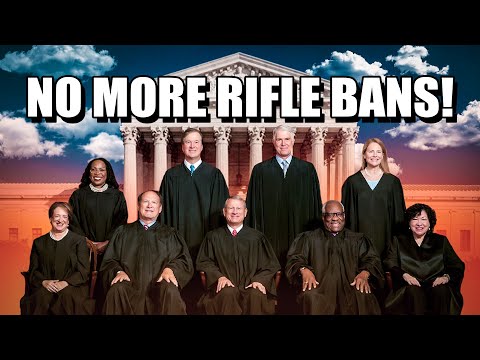
The US Supreme Court declined to hear cases challenging Maryland's assault weapon ban and Rhode Island's magazine ban. This decision, with only Justices Thomas, Alito, and Gorsuch reportedly voting to accept review, indicates a lack of interest from the majority of the court in addressing these Second Amendment issues. Justice Kavanaugh's concurring memorandum suggests the court is deferring these matters to lower courts and may revisit them in future terms.
The Supreme Court denied review for cases challenging assault weapon and magazine bans, specifically Snoke v. Brown and Ocean State Tactical. This decision, with a 3-3 split among conservative justices, means lower court rulings on these bans stand for now. Justice Thomas dissented, arguing the court is treating the Second Amendment as a "second-class right," while Justice Kavanaugh's statement suggested the issue of AR-15s in common use may be addressed in future cases.
The Supreme Court declined to hear a case regarding Maryland's "assault weapons" ban. However, Justice Kavanaugh indicated that similar petitions are likely to be reviewed soon. Justice Thomas emphasized the critical importance of addressing the legality of banning the AR-15, the most popular rifle in America, noting that this issue has been avoided for a decade. Gun Owners of America (GOA) is actively involved in legal battles against such bans and encourages vigilance in protecting Second Amendment rights.
This video provides an expert analysis from William Kirk, President of Washington Gun Law, on the Supreme Court's denial of certiorari in key Second Amendment cases concerning AR-15s. Kirk critically examines the statements and dissents from Justices Thomas and Kavanaugh, highlighting the perceived weakening of Second Amendment protections and the Court's avoidance of definitive rulings on popular firearms. The content emphasizes the implications for ongoing gun control debates and future legal challenges.
The Supreme Court denied certiorari in two key cases, Snope and Ocean State, concerning firearms bans. Justice Kavanaugh's denial statement argued that AR-15s are in common use for lawful purposes and thus protected by the Second Amendment, suggesting lower courts erred. Justice Thomas's dissent strongly criticized the denial, asserting that the Second Amendment would become a 'second-class right' if such cases are not heard, and that AR-15s clearly fall under the 'arms' protected by the amendment.
The US Supreme Court denied certiorari in two significant Second Amendment cases: Snope v. Brown (AR-15 ban) and Ocean State Tactical v. Rhode Island (magazine ban). While this is a setback, Justice Kavanaugh's statement suggests the Court will likely address AR-15 bans in the next term or two, drawing parallels to a 2020 statement that preceded the Bruen decision. The path forward involves creating a circuit split, potentially through favorable rulings in the Third or Seventh Circuits.
This video analyzes Justice Brett Kavanaugh's concurrence in the Rahimi case, interpreting it as a potential 'Easter egg' signaling the Supreme Court's future engagement with Second Amendment cases, particularly those concerning assault weapon bans. Host Mark Smith, a constitutional attorney, draws parallels to Kavanaugh's past predictions and his unique approach to legal analysis, suggesting a forthcoming significant ruling.
This video discusses a significant development in the Supreme Court's bump stock case, Cargill. The author highlights that Justice Brett Kavanaugh's recent decision in a separate case, Bank of America, narrows down the justices likely to author the Cargill opinion to Justices Thomas, Alito, Barrett, and Gorsuch. This is viewed as positive news for Second Amendment advocates, particularly noting Justice Barrett's prior engagement with the issue and Justice Gorsuch's expertise in statutory interpretation and holding regulators accountable.
This video discusses the Supreme Court case Murthy v. Missouri, focusing on arguments about whether government pressure on social media companies to censor speech violates the First Amendment. It highlights differing judicial perspectives, particularly from Justices Alito and Jackson, on the line between government advocacy and coercion, and references the Bantam Books case as a precedent for unconstitutional government pressure.
Gun Laws by State
Read firearms regulations for all 50 states + D.C.
Find Gun Dealers
Search licensed FFL dealers near you.