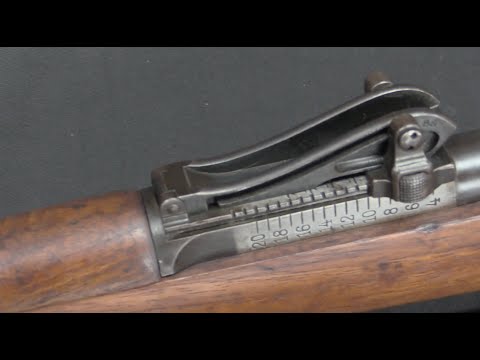
This guide details the unique 50-meter adjustment mechanism of the Gewehr 1898's Lange Visier sight, often referred to as a 'rollercoaster sight'. Expert instruction highlights how alternating button presses allow for precise, incremental adjustments without major repositioning, a feature often found on German-made Mausers. The video emphasizes understanding the sight's range from 400 to 2000 meters and its utility in varying conditions.
This guide details the operation and features of the Wehrmannsgewehr, a German sporting rifle converted from military Mauser 98 actions after WWI. It highlights the rifle's single-shot nature, the 8x46R caliber, and modified sights, all developed to comply with post-war German firearms regulations. The information is presented with the authority of Ian McCollum of Forgotten Weapons, a recognized expert in historical firearms.
This video revisits the G98 Mauser rifle, offering insights into its historical context, action mechanics, and comparison to the K98k. Expert instruction from John Hickok demonstrates practical shooting techniques and a unique penetration test using 8mm Mauser ammunition in loose soil. The session highlights the rifle's collectibility and craftsmanship, including its distinctive Lange Visier rear sight.
This guide details the disassembly and functional overview of the rare Friberg/Kjellman Prototype Rifle, a Swedish design from the late 1890s/early 1900s. It highlights the innovative flapper-locking mechanism, short-recoil operation, and manual disconnect for dual firing modes. The information is presented with high authority by Ian McCollum, a recognized expert in historical firearms, based on detailed mechanical examination and historical context.
This video provides an expert-level review of the Gewehr 98, a pivotal WWI German infantry rifle. Hickok45, a recognized firearms authority, details its historical significance, mechanical intricacies, and performance. The review covers the rifle's robust Mauser action, the unique 'Lange Visier' sight, and its reliability in harsh conditions, offering valuable insights for collectors and historical firearms enthusiasts.
This guide provides essential information for handling and understanding the Gewehr 98, the standard German WWI rifle. It covers safety precautions, identification of key features like the Lange Visier sight and Mauser claw extractor, and notes on original finishes and markings. The information is presented with a high level of historical and technical detail, suitable for intermediate enthusiasts.
This guide details a 'Run and Gun' training drill using the Mauser Gewehr 98, emphasizing efficient stripper clip loading and bolt action cycling under movement. It highlights the rifle's historical significance and practical application in tactical scenarios, drawing on the expertise of a seasoned firearms instructor. The drill focuses on accuracy and speed, with a post-action analysis of performance.
You've reached the end! 7 videos loaded.
Gun Laws by State
Read firearms regulations for all 50 states + D.C.
Find Gun Dealers
Search licensed FFL dealers near you.