This guide details the operation of the BE Meyers MILR's unique 'disturbed pointer' feature, as explained by Ian McCollum. The system uses an integrated ranging laser to automatically adjust the IR pointer's aim point, compensating for ballistic drop on the fly. This allows for rapid and accurate engagement of targets at varying distances without manual reticle adjustments.
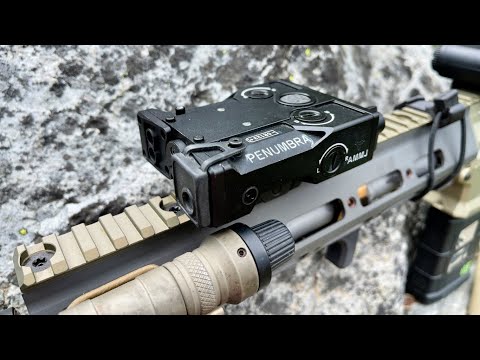
This video reviews the AMJ Penumbra laser aiming module, detailing its features including visible green and infrared lasers, an infrared illuminator, and adjustable beam divergence. The presenter, Ivan from kitbadger.com, discusses its mounting options, including an Aimpoint footprint and RMR compatibility, and provides insights into its performance in low-light and night vision scenarios. He also offers critical feedback on aspects like the laser's offset zeroing and button ergonomics, while acknowledging its utility for experimentation with elevated optic/laser setups.
This guide details a precision zeroing technique for laser aiming devices, emphasizing their role as a primary optic, especially at night. The method involves aligning the laser dot directly over the primary optic's aiming point for a "dot over dot" zero. Instruction comes from an experienced firearms instructor, as indicated by the demonstration of a specific technique and familiarity with multiple optic brands.
This review of the SMS Laser XK68 and Amazonian XYH-Win laser aiming modules highlights their powerful but poorly implemented features. The video details issues with non-co-aligned lasers, unreliable turrets, an overly flood-patterned IR illuminator that can blind night vision, and a non-user-serviceable battery. While powerful, the design flaws make these units largely impractical for serious use.
This guide details the process of achieving a parallel zero for lasers to rifle optics, a technique developed by Chris Roberts of CR2 Shooting Solutions. The method ensures the laser remains aligned with the reticle at all distances, crucial for long-range accuracy. It involves precise measurements and marking a target to establish a repeatable zero point, minimizing divergence and enhancing engagement effectiveness.
This review covers the CVLIFE 800 Lumen Green Laser Light Combo, highlighting its features like rechargeability, adjustable rail mount, and dual functionality. The video demonstrates its performance in daylight and darkness, including a practical guide on how to zero the green laser for accurate aiming on a pistol.
This guide details the installation and zeroing process for the G35 laser designator. It covers mounting the unit onto Picatinny or M-LOK rails, connecting the pressure switch or tail cap, and the procedure for aligning the laser dot with the firearm's sights. The designator's form factor is similar to a weapon light, and it includes a Torx wrench for secure mounting.
This video provides an in-depth review of the Streamlight TLR-VIR II, highlighting its suitability as an entry-level night vision accessory. The instructor details its features, including visible light, infrared laser, and illuminator, while comparing it to higher-end options like the DBAL-A3 and other budget lights such as the SureFire X300V. Key considerations like battery replacement, laser zeroing, and beam patterns are discussed, positioning the TLR-VIR II as a cost-effective solution for those entering the night vision space.
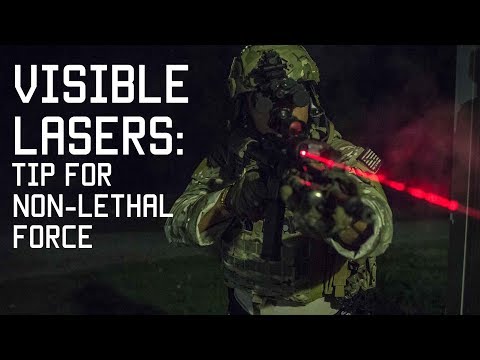
This entry details the tactical application of IR and visible lasers in combat, drawing from the experience of a retired US Special Forces operator. It covers the evolution of laser aiming devices, their use in night targeting, and a critical incident in Mosul where a visible laser served as a non-lethal communication tool to de-escalate a dangerous situation. The importance of proper zeroing and avoiding 'target fixation' are emphasized.
This guide details how to properly sight in a Crimson Trace laser sight on a firearm, as demonstrated by Chris Cerino. It covers the principles of windage and elevation adjustment, the use of the provided tool, and the importance of live-fire testing to confirm zero. Proper alignment ensures the laser dot accurately indicates the point of impact, crucial for effective aiming.
This guide details a practical method for sighting in a Crimson Trace Laser Guard on a Springfield XD-45, emphasizing a preferred placement behind the front sight. The technique involves establishing a baseline with iron sights at 20 feet and then confirming laser accuracy by focusing solely on the laser dot, ensuring point of aim, point of impact. This approach is presented as a smarter way to zero your handgun laser for effective target acquisition.
This guide details the installation and zeroing process for the NcSTAR Green Laser & LED Weapon Light. It covers mounting on firearms with standard rails using its quick-release system and adjusting the green laser for accurate aiming. The light offers 150 lumens and multiple modes, powered by CR 123 batteries.
You've reached the end! 12 videos loaded.
Gun Laws by State
Read firearms regulations for all 50 states + D.C.
Find Gun Dealers
Search licensed FFL dealers near you.