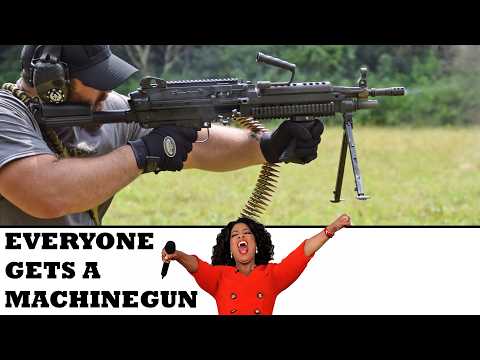
The US government is considering legislation, the 'Stop Militarization of Our Streets Act of 2026,' aimed at halting US Army sales of 50 BMG ammunition to civilians. This move is partly attributed to concerns about Mexican cartels using this caliber. While the bill faces low odds of passing due to the required Senate votes, its discussion highlights the potential for future restrictions on civilian ammunition access, especially during times of conflict or political shifts.
This video from the NRA discusses the political landscape of gun control in Virginia, highlighting recent legislative actions by Democrats and the potential for these measures to spread nationally. It emphasizes the importance of individual action, such as contacting lawmakers and sharing personal stories, to combat gun bans and protect Second Amendment rights. The content is presented with an authoritative tone by an NRA Director of Public Affairs, offering strategic insights into legislative battles.
This WGL AM episode, hosted by William Kirk on March 23, 2026, provides an expert analysis of critical Second Amendment legal and legislative developments in Washington State. It details the implications of HB 1240 (Semi-Automatic Rifle Ban) and SB 5078 (High-Capacity Magazine Ban), discusses a significant federal court case in the 9th Circuit building on the Bruen decision, and urges listeners to contact legislators and support advocacy groups like FPC and GOA.
This video, presented by an experienced firearms instructor knowledgeable in US firearm laws and policy, discusses the Hughes Amendment and its impact on machine gun ownership. It explores a potential legislative loophole in West Virginia (SB 1071) that could allow for the sale of post-86 sample machine guns to residents, effectively circumventing the ban. The instructor urges viewers to contact West Virginia senators to support this bill, highlighting its potential to make West Virginia a champion of the Second Amendment.
This video discusses potential legislation in New York and California aimed at controlling the manufacturing of firearms and firearm parts using 3D printers. The speaker, with an authoritative tone, expresses concern over what they term 'gun control overreach' and 'tool control,' suggesting these measures could extend to other manufacturing tools. The video concludes with a call to action, urging viewers to participate in elections to voice their opposition.
This video features Frank Miniter of America's 1st Freedom interviewing Billy Wilson, President of the Iowa Firearms Coalition (IFC), regarding the banning of IFC's videos and website by YouTube. Wilson details how automated AI flagging led to strikes and eventual permanent channel deletion, despite IFC's content being purely educational and not for sale. The discussion highlights the challenges 2A organizations face with platform censorship and explores legislative solutions in Iowa and the move to alternative platforms like Rumble.
This video discusses a proposed bill in Minnesota that aims to ban all semi-automatic firearms. The speaker, with an authoritative and experienced tone, highlights concerns that the bill infringes upon Second Amendment rights and established case law. It details requirements for firearm registration and warrantless home visits for storage checks, warning that non-compliance could lead to severe penalties, potentially criminalizing law-abiding citizens without enhancing public safety.
Braden Langley, an experienced instructor, details how Republicans are leveraging the RICO Act through proposed legislation like 'The Stop Funders Act' to target and prosecute individuals and organizations financing anti-ICE riots. The analysis highlights the potential impact of these measures on disrupting funding networks and holding financiers criminally responsible for riot-related chaos. Langley emphasizes the organized nature of these protests, citing evidence of coordinated tactics and funding streams linked to various foundations and individuals.
This video critically examines the ATF's record-keeping practices, particularly concerning Form 4473 data from out-of-business gun shops. The speaker, demonstrating high authority in firearms law commentary, argues that the digitization and storage of these records, even if not directly searchable by name, effectively create a de facto registry. This practice raises significant privacy concerns for law-abiding gun owners and is presented as a driver for interest in unregulated 'ghost guns' and private firearm builds. The video calls for legislative action to limit the ATF's record-keeping mandate.
This video from Gun Owners of America (GOA) details how they successfully influenced Congress to cut the ATF's budget, halting its projected growth. The speaker, identified as Deputy Director of Federal Affairs, critically analyzes federal appropriation documents and legislative funding cycles, arguing that budget reductions negatively impact the ATF's operational capacity and debunking the notion that increased funding is necessary for public safety. GOA views these cuts as a step towards eventual agency abolition.
This video from Gun Owners of America (GOA) details the ATF's alleged illegal gun registry, focusing on the digitization of Form 4473 records and the implications for Second Amendment rights. GOA's investigation, including FOIA requests and a published report, is highlighted, alongside congressional testimony and historical parallels to confiscation. The video advocates for legislative solutions like the 'No Registry Rights Act' to combat these developments.
This video highlights the effectiveness of organized public action in opposing unfavorable legislation. It demonstrates that when a community mobilizes, it can exert significant force to stop bills, even those with national implications. The CRPA's efforts, supported by diverse groups across the country, successfully prevented a bill from advancing.
Gun Laws by State
Read firearms regulations for all 50 states + D.C.
Find Gun Dealers
Search licensed FFL dealers near you.