This video from Washington Gun Law TV, hosted by William Kirk, explores the legal ramifications of self-defense during protests, particularly when individuals appear to be armed. It uses hypothetical scenarios involving fake vests or toy guns to illustrate the legal principles of necessary, reasonable, and proportional force. The discussion emphasizes that a reasonable belief of imminent threat of death or serious bodily injury, even from perceived fake threats, can legally justify the use of lethal force.
This entry analyzes a police bodycam incident, highlighting the tactical implications of a suspect reaching for their waistband. Nikko Ortiz, a high-influence military/tactical commentator, assesses the situation, emphasizing that such actions can justify a lethal force response based on established police use-of-force protocols. The analysis focuses on threat identification and the critical decision-making process during high-stress encounters.
This video analyzes a police traffic stop in Arlington, Texas, that escalated to a fatal encounter. The driver initially failed to pull over, then resisted commands, and ultimately retrieved a handgun from his glove compartment. The instructor emphasizes that retrieving a firearm, even without pointing it, constitutes an act of aggression and a lethal force situation for the officer. The driver's status as a felon prohibited from possessing firearms is highlighted as a critical factor.
This video from Washington Gun Law TV explains how engaging in YouTube pranks, particularly those that terrorize or simulate violent crimes, can lead to lawful self-defense actions against the prankster. It details the legal principles of self-defense, emphasizing necessity, reasonableness, and proportionality, and how pranksters often forfeit their right to self-defense by being the initial aggressor.
This video analyzes a carjacking scenario, emphasizing the legal justifications for using lethal force. It clarifies that carjacking is legally considered robbery, a violent felony, and can justify lethal force if there's an imminent threat of death or serious bodily injury to oneself or others. The presenter, William Kirk of Washington Gun Law, highlights the importance of situational awareness and understanding the rules of engagement for self-defense.
This video analyzes a tragic armed robbery in Tupelo, MS, highlighting that victim compliance does not guarantee safety. Instructor John Correia emphasizes the importance of preparedness and resistance, citing statistics that show a significantly reduced risk of injury when a victim can land the first shot. The analysis focuses on identifying 'windows of opportunity' during a confrontation and stresses the need for a rapid draw-to-first-hit time, ideally under 1.5 seconds.
This video analyzes a self-defense incident in Greenwood, Seattle, focusing on Washington State law regarding the use of force. It clarifies that while a homeowner can use reasonable force to remove a trespasser, lethal force is only justified when there's an imminent threat of death or serious bodily injury, or if a felony is being committed inside the home or upon a person. The analysis highlights the critical distinction between defending property and defending life.
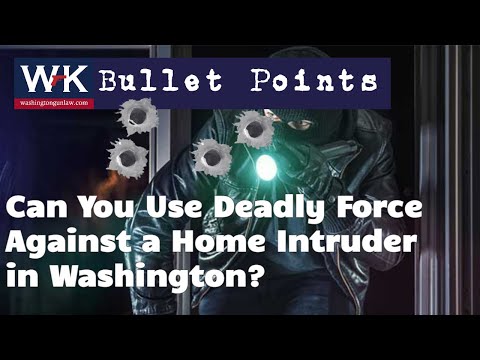
This video explains Washington State law regarding the use of deadly force against a home intruder. It clarifies that while RCW 9.81.020 allows for reasonable and proportional force, lethal force is generally not permitted solely for property defense under RCW 9.81.050. However, the law allows for lethal force if a felony is being committed in one's home, such as residential burglary, even if the intruder's initial intent was theft.
This discussion emphasizes the critical mindset required for responsible firearm ownership and self-defense. John Holschen and Jeff Maehl outline three core principles for civilian deadly force: the primary purpose of a defensive firearm is to save human life, the responsibility to avoid harming innocents, and that deadly force is a last resort. They stress the importance of understanding legal and moral implications, avoiding the 'punisher' mentality, and the necessity of comprehensive training that addresses legalities, moralities, and practical skills. The conversation also touches on the emotional and psychological aspects of carrying a firearm and the profound responsibility that accompanies it.
This video, presented by TheFirearmGuy with a somber and analytical tone, emphasizes the critical importance of avoidance and de-escalation for daily firearm carriers. It analyzes a tragic incident in Abilene, Texas, where a dispute over trash escalated to a fatal shooting involving neighbors John and Michael Miller against Aaron Howard. The expert highlights that while 'Stand Your Ground' laws exist, the smartest action is always to walk away, as the consequences of using lethal force, even if justified, can be devastating for all involved.
You've reached the end! 10 videos loaded.
Gun Laws by State
Read firearms regulations for all 50 states + D.C.
Find Gun Dealers
Search licensed FFL dealers near you.