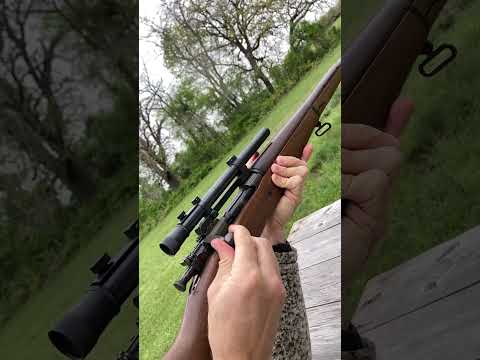
This video demonstrates the live fire procedure for the U.S. Rifle, Caliber .30, M1903, featuring expert handling and the use of period-correct surplus ammunition. The demonstration includes manual loading of the internal magazine, aiming through a telescopic sight, firing a single shot at a steel target, and cycling the bolt. The presenter exhibits a high level of authority and expertise in firearms manipulation.
This review tests the practical accuracy of the Springfield M1903A4 sniper rifle at ranges up to 800 yards. Despite the rifle's inherent accuracy (around 2 MOA), the limited magnification and adjustment capabilities of its original Weaver 330C optic (or the K2.5 substitute) proved to be a significant bottleneck, especially at longer distances. High winds further challenged marksmanship, leading to a 'C-minus' or 'D' tier ranking for the rifle's WWII sniper effectiveness.
This video delves into the M1903A4 sniper rifle, a crucial firearm for the U.S. Army during World War II. It highlights the rifle's development from the M1903A3, focusing on modifications made to accommodate optics, such as the split receiver markings and the removal of the rear peep sight. The description details the specific Weaver scopes used (Model 330/330C, later standardized as M73/M73B1), their magnification, and limitations like a narrow field of view and lack of waterproofing. It also touches upon barrel selection and rifling variations. Despite its widespread use across all theaters of operation by the US Army and USMC, the video acknowledges critiques regarding its adequacy as a sniper rifle, particularly its effective range and scope performance, and mentions the eventual switch to Unertl scopes.
This analysis of 'Saving Private Ryan' highlights inaccuracies in Private Jackson's sniper rifle setup. The initial 2.75x scope is deemed low magnification, and the subsequent swap to an 8x Unertl scope is problematic. The Unertl was a Marine Corps scope, not Army issue, and its mounting system is physically incompatible with the M1903A4 rifle, making the field swap impossible.
The M1903A4 WWII sniper rifle's accuracy is heavily dependent on ammunition quality. While vintage military loads like M2 Ball and M72 Match showed poor performance (4.313" and 6.332" groups respectively), modern Remington Core-Lokt 150gr ammunition achieved a respectable 2.960" group. The rifle itself features a pleasant action, but its historical accuracy potential is best realized with carefully selected modern ammunition.
This video critically examines the M1903A4 sniper rifle's portrayal in 'Saving Private Ryan,' highlighting significant historical inaccuracies in its optics and usage. Key errors include the use of a Lyman Alaskan scope not available for D-Day and an Unertl scope belonging to the Marines, incorrectly mounted and adjusted. The film also misrepresents scope recoil mechanics and magazine capacity.
The M1903A4 was the US Army's interim World War II sniper rifle, based on the M1903A3 Springfield and fitted with a Weaver 2.5x scope. Remington converted approximately 28,635 rifles between 1943-1944, modifying the bolt handle and stock, and omitting iron sights. Despite its service in WWII and Korea, its effectiveness was limited by the scope's low power and lack of waterproofing, and a general absence of formal sniper training.
This video announces the release of 'Small Arms of WWII - United States' by Ian McCollum and Headstamp Publishing. The comprehensive 500-page book covers a wide array of American small arms from the era, including pistols, rifles, submachine guns, and heavy machine guns, with detailed photography and historical context. It is available for pre-order directly from the publisher.
This video showcases the 1903 Springfield Sniper rifle, demonstrating its loading process with vintage 7.62mm S-Patronen/GM1 ammunition. It highlights the rifle's smooth bolt action and accuracy through slow-motion replays of shots impacting a steel silhouette target. The presenter's expertise is evident in safe handling and detailed operational insights.
This video delves into the historical evolution of rifle stocks, specifically focusing on how the National Match competitions at Camp Perry significantly influenced firearm design during the interwar years. It highlights Springfield Armory's shift from production rifles to dedicated National Match variants with features like heavy barrels and pistol grip stocks. The discussion then extends to how these design changes, particularly the adoption of the pistol grip stock for improved accuracy and controllability, led to the development of the M1903A1. The video also touches upon the logistical challenge of leftover WWI stock blanks and the subsequent creation of the 'Scant' stock for the M1903A3 and M1903A4.
This review covers the M1903A3 Springfield, a bolt-action rifle adopted in 1905 and a standard issue until 1937. It highlights the rifle's historical significance through WWI, WWII, and Vietnam, its improved aperture sights compared to earlier models, and its design influences from Mauser rifles. The review also touches on the M1903A4 sniper variant and practical features like the buttstock cleaning kit trapdoor.
You've reached the end! 11 videos loaded.
Gun Laws by State
Read firearms regulations for all 50 states + D.C.
Find Gun Dealers
Search licensed FFL dealers near you.