This video advises against stockpiling large caliber hunting rifle ammunition, arguing that typical hunting usage requires very few rounds annually. The speaker emphasizes prioritizing ammunition for primary carry weapons, backup carry guns, defensive rifles, and shotguns due to potential shortages and practical considerations. For hunting, a small quantity (40-100 rounds) is deemed sufficient.
This video details the 30-year development of the M1 Garand, the standard US service rifle during World War II. It explores the reasons for the delay in adopting a semi-automatic rifle, the selection process, and its performance in combat. The narrative highlights the challenges of chambering a semi-automatic in the powerful .30-06 cartridge and the eventual adoption of the M1 Garand despite initial skepticism.
This video from Kentucky Ballistics features a detailed test of various firearms against a life-sized Velociraptor replica to determine what it would take to defeat one. Host Scott, alongside Chris from Ballistic Dummy Lab, tests handguns from .22LR up to .500 Magnum, shotguns including a Spas-12, and rifles ranging from .45-70 to a .4 Bore. The experiment provides insights into the stopping power required for different threats, with a focus on practical application and the effectiveness of various calibers against a simulated large predator.
This review of the US Springfield 1903 rifle highlights its key features and handling characteristics. The rifle weighs 8.7 lbs with an overall length of 43.2 inches. It features a smooth bolt action, a clean two-stage trigger pull, and a simple flag safety with clear markings. The Buffington-style ladder sights with a front blade are noted for quick target acquisition and windage adjustment. The reviewer also mentions the substantial recoil from the 30-06 cartridge and the rifle's historical significance as the official US rifle during WWI.
This video from Yee Yee Life tests the penetration capabilities of various firearms against a stack of baking sheets, culminating with a .50 BMG round. The experiment demonstrates the relative stopping power of different calibers, from .22 LR to .50 BMG, and includes a 12-gauge slug, AK-47, .308, and .30-06 rifle rounds. The results highlight significant differences in penetration, with the .50 BMG ultimately piercing all 34 baking sheets.
This video provides a practical accuracy test of the FN49 rifle, specifically the Luxembourg variant chambered in .30-06 Springfield, out to 500 yards. The hosts discuss its historical context as a precursor to the FN FAL, its design features including an adjustable gas system, and its reliability. While acknowledging its limitations in precision compared to modern firearms, the FN49 demonstrates surprisingly capable performance with iron sights under windy conditions, making it suitable for its intended role as a battle rifle.
This video analyzes the unsealed ATF ballistic report concerning the Charlie Kirk assassination case. The instructor clarifies that the report contains no groundbreaking information and debunks online misinterpretations. Key findings include the identification of a Mouser 98 rifle in .30-06 Springfield caliber, a fired cartridge case matching the rifle, and Remington-headstamped unfired cartridges. The report notes tool marks on the cartridge case consistent with a rotary tool, and an inconclusive match for a bullet jacket fragment due to fragmentation on impact. The instructor emphasizes the limitations of traditional ballistic analysis with fragmented rifle bullets and highlights the upcoming metallurgical analysis.
This video advises against stockpiling large caliber hunting rifle ammunition, citing low annual usage rates for most hunters. The speaker suggests focusing stockpiling efforts on ammunition for primary carry weapons, backup carry guns, defensive rifles, and shotguns. For hunting ammunition, a maximum of 100 rounds is recommended, with most individuals using far fewer.
This video analyzes the ATF ballistic report related to the Charlie Kirk assassination, clarifying what the findings mean and don't mean. The speaker, with experience in ballistics testing and 2A advocacy, explains that the report confirms a 30 caliber class projectile fragment was recovered. However, it does not definitively match the fragment to the specific Mouser 98 rifle found at the scene, only to the caliber class. The report also identified a fired cartridge case from the scene as originating from the Mouser 98 rifle and noted tool marks on casings consistent with a common rotary tool.
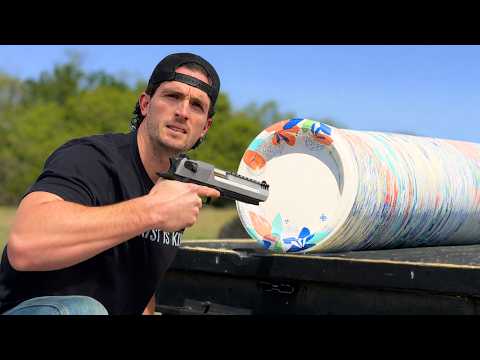
This video tests the penetration capabilities of various firearms, from .22 LR to a .50 BMG, through stacks of paper plates. The experiment aims to determine how many plates each caliber can stop before the projectile is fully arrested. The results show a significant increase in penetration with larger calibers, with the .30-06 Springfield ultimately outperforming the .50 BMG in this specific test due to projectile deflection.
This video discusses the ballistics of a bullet fragment found in Charlie Kirk's body, which was allegedly fired from a converted Mouser K98 rifle in .30-06. The ATF analysis was inconclusive, leading the defense to argue for a second shooter. The instructor explains that bullet fragmentation upon impact, especially with bone or spinal cord, is normal and can affect ballistics analysis.
This video explains the technical implications of a bullet not matching a recovered firearm in a forensic context. It details how bullet composition, velocity, and impact can affect recovery and ballistic analysis, highlighting the difference between land and groove impressions and elemental analysis. The speaker emphasizes the importance of available evidence and the limitations of current analysis without official reports.
Gun Laws by State
Read firearms regulations for all 50 states + D.C.
Find Gun Dealers
Search licensed FFL dealers near you.