This entry details the disassembly of the MAS Mle 1948 prototype SMG, focusing on its unique lever-delayed blowback mechanism and internal components. Expert Ian McCollum highlights the process of removing the grip frame and fire control group, and explains the two-part bolt assembly with its integrated firing pin safety. The video also touches upon the historical context and development of this French submachine gun series.
Mark Serbu, a gun designer, details the condition of a MAT-49 parts kit he acquired for over $2000. He discusses plans to repair a damaged barrel by pressing in pins and reaming, and addresses a bent receiver. He also notes unusual markings on the trigger group, suggesting a potential undocumented modification or variant.
This video explores rare firearms brought back from the Vietnam War, showcasing historical pieces like the K98, MAT-49, MAS-36, Type 58 AK, SKS, M16A1, Makarov, Tokarev TT-33, M1935A, and P210. Experts Tim and Jamin discuss their provenance, historical significance, and collector value, emphasizing the importance of proper documentation for these unique artifacts.
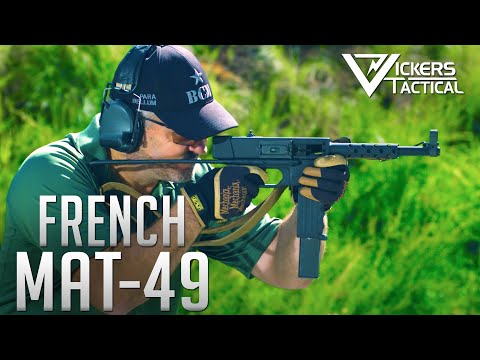
This guide provides an overview of the French MAT-49 submachine gun's operational features and design, drawing from expert analysis by Larry Vickers. It covers the weapon's compact configuration, unique folding magazine well, sight system, and feeding mechanism. The MAT-49, notable for its use in conflicts like the Battle of Dien Bien Phu, is presented with its historical context and practical design elements.
This video demonstrates the Hotchkiss Universal SBR rebuild during a Pistol Caliber Carbine (PCC) course of fire, as presented by Ian McCollum. The firearm, originally designed for extreme compactness, presents significant challenges in precision shooting due to its 'iconically French' low-mounted iron sights. Despite a DNF result, the video highlights the weapon's unique mechanics and historical context, offering insights into its performance limitations and design intentions.
This entry details the MAT 49-54 Police submachine gun, a specialized variant of the French MAT 49. Expert Ian McCollum highlights its key modifications for police use, including a fixed wooden stock, semi-automatic capability, and a unique dual trigger system. The video provides a close examination of its markings and compares it to the standard military version.
This guide provides an overview of the MAT-49 and S&W-76 submachine guns, focusing on their operational features and historical context during the Vietnam War. It highlights unique design elements like the MAT-49's folding magazine well and grip safety, and the S&W-76's select-fire capability and quick-detach barrel. The information is presented with high authority, drawing on detailed mechanical breakdowns and historical provenance.
This guide details the field stripping process for the MAT 49 submachine gun, as demonstrated by Ian McCollum of Forgotten Weapons. The process is described as straightforward, emphasizing the weapon's robust and soldier-proof design. The MAT 49 is highlighted for its heavy-gauge stamped sheet metal construction and its significant role in post-WWII conflicts.
You've reached the end! 9 videos loaded.
Gun Laws by State
Read firearms regulations for all 50 states + D.C.
Find Gun Dealers
Search licensed FFL dealers near you.