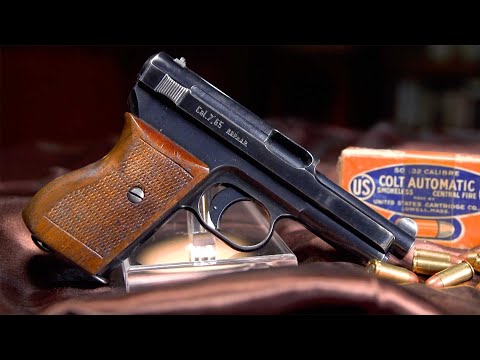
This video provides a comprehensive review of 15 notable .32 ACP pistols, highlighting their historical significance, design features, and suitability for concealed carry and collection. It details specific models from manufacturers like Beretta, Colt, Walther, and others, discussing their reliability, ergonomics, and price points, offering insights for both collectors and those seeking compact self-defense options.
This guide details the safe loading and safety engagement procedure for the Mauser Model 1914 pistol, as demonstrated by a firearms enthusiast. It covers magazine loading, chambering a round, and the unique lever lock safety with button release. Proper firearm handling and safety checks are emphasized throughout.
This video provides an in-depth look at the Mauser Model 1914 and its successor, the Model 1934. It details their development from earlier Mauser designs, focusing on the blowback action and the shift from 9mm to smaller calibers like 25 ACP and 32 ACP. The presenter highlights unique design features, control mechanisms, and the historical context of these pistols, noting their popularity and military/police adoption.
This video showcases the Mauser Model 1914, chambered in .32 ACP (also known as 7.65mm Auto). The footage features live-fire demonstrations of the historical pistol, highlighting its operation and performance. The content focuses on the practical aspects of shooting and experiencing this classic firearm.
This guide details the operation and live-fire demonstration of the Mauser Model 1914 pistol. It covers visual inspection, safety mechanism engagement, loading procedures, and live fire from a first-person perspective. The video highlights the pistol's blowback action and reliable cycling with .32 Auto cartridges at an outdoor range, emphasizing proper firearm handling and safety gear usage by a firearms enthusiast and collector.
This video announces the channel's first "Virtual Gun Show," a new feature for viewers. A key highlight of the showcased items is an exceptionally rare Mauser Model 1914 Humpback pistol. The video also promotes the channel's Patreon for early access and monthly raffles, and directs viewers to their "Flak & Fubar" podcast and Legacy Twitter account.
This video showcases two interesting veteran bring-back firearms. The first features a Mauser Model 1914 and a rare G Date Mauser Luger, accompanied by Leslie Bersch's original capture papers from his service in the 81st Chemical Mortar Battalion. The second highlight is an unusual Walther PPK brought back by Captain Spivak. The video also promotes the channel's Patreon for early access and a monthly raffle, as well as their podcast "Flak & Fubar".
This video provides a comprehensive review of all pistols issued to the Navy of the Third Reich. It covers various models including all iterations of the Luger P.08, Mauser Model 1914, Mauser Model 1934, Mauser HSC, and the rare Navy Radom VIS P35. The content focuses on showcasing and detailing these historical firearms.
This video from the WWI Primer series provides a detailed explanation of how the German Mauser Model 1914 operates. It covers its technical features, including its unlocked blowback action, single-action trigger, striker-fired mechanism, and single-stack detachable magazine. The content is aimed at viewers interested in historical firearms and their internal workings.
This guide details the field stripping process for the Mauser Model 1914 semi-automatic pistol, presented by firearms expert Larry Potterfield. It covers the steps for disassembly, emphasizing safety and component identification. The Mauser Model 1914, manufactured in Oberndorf, Germany, is chambered in .32 ACP and features a unique cocking indicator and heel magazine release.
You've reached the end! 10 videos loaded.
Gun Laws by State
Read firearms regulations for all 50 states + D.C.
Find Gun Dealers
Search licensed FFL dealers near you.