This video provides an expert-level analysis of the landmark District of Columbia v. Heller Supreme Court decision, delivered by Justice Antonin Scalia. It delves into the historical interpretation of the Second Amendment, emphasizing originalism and the individual right to keep and bear arms for self-defense, particularly concerning handguns in the home. The decision's legal reasoning, historical precedents, and its impact on gun rights are thoroughly examined.
This guide, presented by firearms instructor Colion Noir, breaks down the Second Amendment into easily understandable terms. It clarifies that the amendment protects the individual right of 'the people' to 'keep and bear arms,' meaning to own and carry firearms, and that this right 'shall not be infringed' by the government. The historical context of 'militia' is explained as a justification for the right, not a restriction to it.
This video argues that the Second Amendment remains relevant as a safeguard against potential government tyranny, countering the idea that it's obsolete due to the absence of threats like the British Redcoats. The speaker, identified as a Second Amendment advocate, emphasizes the historical context of the Revolution and the role of armed citizens in protecting constitutional rights and democracy.
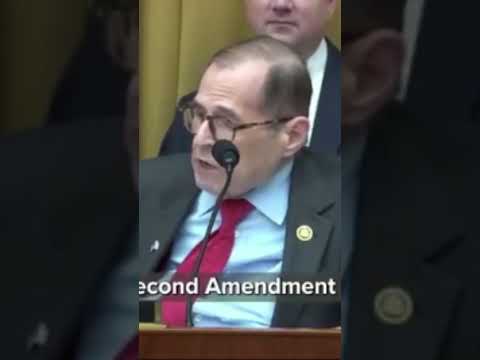
This video discusses the interpretation of the Second Amendment, specifically referencing comments made by Representative Jerry Nadler. It highlights the full text of the amendment, emphasizing the 'well-regulated militia' clause and contrasting it with the 'right to bear arms shall not be infringed' clause. The speaker notes the framers' opposition to standing armies and their view of militias as a safeguard against tyranny.
This video features a discussion with Professor Robert Krol about his book, 'To Trust the People with Arms,' which examines the historical understanding and legal interpretation of the Second Amendment. Krol argues that the prevailing narrative of the Second Amendment being solely a militia right is a myth, supported by historical case law and the framers' intent. The conversation highlights the significance of Supreme Court decisions like Heller, McDonald, and Bruen in establishing the Second Amendment as an individual right and discusses the ongoing challenges in its application and public perception.
This video provides a detailed breakdown of the Second Amendment's text and its legal interpretation by the US Supreme Court. Constitutional attorney Mark Smith explains that the 'operative clause' is an unqualified command against government infringement. He emphasizes that key terms like 'the people,' 'arms,' 'keep,' 'bear,' and 'infringed' have established legal definitions based on 18th-century dictionaries and Supreme Court rulings, shifting the burden of proof to the government in legal challenges to gun control laws.
This video discusses the interpretation of the Second Amendment, arguing that it protects an individual's right to keep and bear arms for self-defense, including against tyrannical government, and that this right is not solely contingent on militia service. The speaker emphasizes that the 'people' refers to individuals who, by being armed and trained, naturally form the militia.
This video analyzes a common argument made by anti-gun advocates that the Militia Clause in Article I of the US Constitution justifies modern gun control laws. Professor Mark Smith of Four Boxes Diner breaks down the historical context and the text of the Second Amendment to argue against this interpretation. The video aims to educate viewers on the constitutional basis of Second Amendment rights beyond militia service, differentiating between militia obligations and individual gun ownership. It references a Fourth Circuit opinion and encourages viewers to understand the "four boxes" of American liberty.
This video discusses the legal fight in the Sixth Circuit Court of Appeals regarding Oakland Tactical's challenge to Howell Township's restrictions on building a 1,000-yard shooting range. It delves into the concept of ancillary rights, arguing that the right to train with firearms is protected under the Second Amendment, even if not explicitly stated in the text. The discussion draws parallels to First Amendment ancillary rights and historical interpretations of 'infringed' from 1791 dictionaries.
This video debunks the argument that the Second Amendment only protects individuals in militias. It cites the Supreme Court's decision in District of Columbia v. Heller, which affirmed an individual right to keep and bear arms unconnected with militia service. The presentation also references numerous state constitutions to further illustrate this individual right.
This video analyzes a Mercury News article that misinterprets the Second Amendment, arguing it does not grant individuals the right to own guns. The speaker refutes this by examining the text, referencing Supreme Court interpretations, and explaining the grammatical structure of the amendment, particularly the role of the comma in separating the militia clause from the individual right of the people to keep and bear arms.
This video explores public opinions on gun control and the Second Amendment through street interviews in Atlanta. Participants discuss the right to bear arms, the historical context of the Second Amendment, and concerns about government overreach and potential tyranny. The conversations highlight a spectrum of views, from support for stricter background checks to the belief that an armed populace is a check against government overreach.
Gun Laws by State
Read firearms regulations for all 50 states + D.C.
Find Gun Dealers
Search licensed FFL dealers near you.