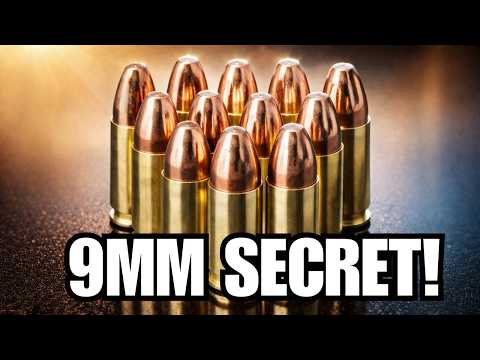
This video explains why 9mm ammunition is the first to disappear during demand surges. It details how its status as a busy market lane, NATO standardization, and overwhelming popularity among new and experienced shooters create a unique vulnerability. The explanation covers production bottlenecks, especially primer supply, and how experienced shooters' consistent purchasing habits deplete stock before panic buying even begins.
This review of the Styer AUG A3 M2 NATO focuses on its resurgence in popularity, often referred to as 'Die Hard cool.' The video highlights its combat-proven design, modularity with quick-change barrels, and impressive Austrian quality. While acknowledging its excellent form factor and handling, the review points out a heavy trigger pull as a significant downside. It concludes that the AUG remains a capable and desirable firearm, especially for those appreciating its iconic status and robust construction.
This video argues that 9mm is the premier caliber for ammunition investment due to its abundance, affordability, and widespread desirability among civilians, law enforcement, and militaries globally. The speaker highlights its status as the NATO sidearm caliber and its prevalence in the civilian market, suggesting it will remain in high demand for decades. The video also touches on the potential for ammo prices to fluctuate, particularly around elections, but asserts that 9mm will always be a sound investment.
This video argues that 9mm Luger is the premier caliber for ammunition investment due to its widespread adoption by civilians, law enforcement, and militaries globally. The speaker highlights its affordability, abundance, and enduring demand, suggesting it will remain the most sought-after caliber for decades. Proper storage, as per US Army recommendations, can extend its lifespan up to 99 years, making it a practical long-term asset.
This video details the historical development and global adoption of the 5.56x45mm NATO caliber. It covers the initial military requirements for a lighter, higher-velocity round to replace the 7.62x51mm, focusing on weight savings, flat trajectory, accuracy, and incapacitation. The evolution from .223 Remington and the distinction between the two calibers are explained, along with NATO's standardization and the subsequent advancements in projectile technology to address effectiveness concerns.
This video from Garand Thumb provides an expert-level analysis of the 5.7x28mm cartridge's lethality, utilizing professional ballistic testing equipment and dummies. The assessment, led by Mike Jones, compares the 5.7x28mm to 9mm Luger and 5.56x45mm NATO, offering insights into recoil, terminal ballistics, and practical effectiveness for self-defense scenarios. The conclusion suggests that while the 5.7x28mm is an effective round, its "legendary" status may be overhyped for civilian applications compared to modern 9mm loads.
This entry details the HK P11, NATO's standard underwater pistol, highlighting its unique pepperbox design, electronic firing mechanism, and specialized ammunition for underwater operations. The P11 is designed for extreme stealth and reliability in aquatic environments, utilizing a sabot system to suppress noise and bubbles. Its development and adoption by various NATO forces underscore its critical role in special operations.
This video provides an expert analysis of current ammunition market trends, highlighting five calibers with exceptionally competitive pricing. The host, demonstrating high authority and market knowledge, explains how global production surges, particularly for NATO-standard rounds like 9mm and 5.56, have created a civilian surplus. The discussion also covers popular rifle calibers like 7.62 NATO/.308 and handgun rounds like .45 ACP, noting the impact of platform popularity on price. Finally, .22 LR is discussed as a caliber returning to pre-2019 price levels due to robust industry output.
This video provides a review of the Fabarm Martial 12 Gauge shotgun, highlighting its Italian origin and pump-action system. The presenter discusses its construction, including the composite stock with rubber recoil pad, aluminum alloy receiver, and polymer forend. Key features like the 18-inch Tribore barrel, designed for strength and improved range, and the aggressive muzzle for breaching are detailed. Shooting impressions emphasize its robust performance, though recoil is noted, particularly for smaller-statured individuals.
This review of the FN Five-seveN MRD by Classic Firearms highlights its evolution from the original model, focusing on its lightweight polymer construction, 20-round capacity in 5.7x28mm, and the new optics-ready MRD system. The assessment emphasizes the pistol's suitability for defensive use and its competitive positioning against newer market entries like the Ruger 57, with a verdict favoring the MRD for optic users.
This video explains the 17S mounting interface, a NATO standard originally designed for optics and lasers, but now commonly used for bipods. It highlights the interface's channel dimensions and its versatility in allowing bipods to be mounted on various platforms like ARCA rails and Picatinny (1913) rails using adapters. The presenter emphasizes the importance of checking compatibility, as some 1913 mounts with varied hole spacings are not designed for bipod attachment.
This video, presented by an instructor with high authority and expertise in firearms, outlines the top 5 essential ammunition calibers to stockpile for survival scenarios. The focus is on readily available, affordable, and standardized (NATO) rounds, emphasizing their utility for bartering, scavenging, and self-defense. Key calibers discussed include .22 LR for small game and mass stockpiling, 12-Gauge for its versatility, 9mm NATO as the standard pistol round, 5.56mm NATO/.223 Remington for AR-15 platforms, and 7.62mm NATO/.308 Winchester for long-range precision and barrier penetration.
Gun Laws by State
Read firearms regulations for all 50 states + D.C.
Find Gun Dealers
Search licensed FFL dealers near you.




![Lady Sharpshooter EP.26 | Fabarm Martial 12 Gauge Shotgun [ ENG/CHN/KRN/JPN SUB ]](https://i.ytimg.com/vi/KfHgdnLTzJw/hqdefault.jpg)