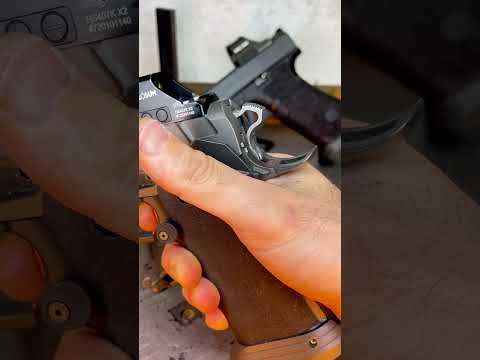
This video features a detailed technical discussion and debate regarding the internal mechanics of the Sig Sauer P320, specifically focusing on its sear mechanism, trigger bar, and disconnector. The participants explore the potential for malfunctions, particularly concerning the sear's interaction with other components when the firearm is out of battery. The conversation delves into the physics of inertia, spring tension, and momentum as they relate to firearm safety and reliability, with a strong emphasis on the scientific principles governing firearm operation and the rigorous testing required to ensure safety.
This guide details an experimental test conducted by Civilian Tactical to assess the functionality of a Beretta-style pistol when lubricated with Loctite 243 threadlocker. The experiment involved applying the threadlocker to internal components, allowing it to set, and then attempting to fire the weapon. The results indicated a complete failure to cycle, rendering the firearm inoperable due to the adhesive properties of the threadlocker. This highlights the critical importance of using appropriate firearm-specific lubricants.
This video demonstrates a critical advantage of revolvers in self-defense: their ability to reliably fire during "contact shots" where the muzzle is pressed against an attacker. Unlike semi-automatic pistols, which can malfunction by going "out of battery" in such scenarios, revolvers maintain their firing capability due to their fixed barrel and cylinder design. The presenter, an EDC enthusiast, highlights that given most self-defense encounters occur at very close range, this reliability factor makes revolvers a superior carry option for many.
This video, featuring insights from Vampire Guns, delves into the concept of 'disconnection' in pistols, a theoretical self-defense tactic involving retracting the slide to prevent firing. It explains the mechanics of disconnection in both striker-fired (like the Glock 47) and hammer-fired (like the R/V Custom 2011) systems. The expert assessment highlights the unreliability of this tactic due to variations in firearm design and the potential for the weapon to still fire even when out of battery.
This guide details a crucial handgun operation technique: ensuring the slide is properly seated after a press check. The GUNBROS instructor emphasizes that a slide not fully forward (out of battery) renders the firearm inoperable and prone to malfunctions. The recommended practice is to firmly bump the slide forward after a press check to guarantee it's fully seated, preventing potential issues.
This video dissects the "out of battery" firearm malfunction, using a real-life robbery scenario as an example. It explains what the malfunction is, why it happens, and its consequences, emphasizing the importance of firearm maintenance, proper handling, and training for responsible gun ownership. The content aims to raise awareness about critical firearm safety issues and potential operational failures.
This video demonstrates multiple techniques for safely chambering a round in a firearm. Key principles include maintaining muzzle discipline, a high grip, and a finger off the trigger. The instructor presents the 'slingshot' method, the 'over the top' method using slide serrations, and a technique utilizing chest muscles for increased leverage. A critical point emphasized is to release the slide fully to allow the recoil spring to properly seat the round, preventing malfunctions like being out of battery.
This analysis, led by expert John Correia of Active Self Protection, breaks down a tragic Houston restaurant robbery. It highlights critical defensive concepts like the 'initiative deficit' and the '5Ds + 1' framework for weapon disarms. The video also provides a detailed look at a common firearm malfunction, the 'stovepipe', and emphasizes the vital importance of carrying trauma medical supplies.
This guide details the experimental process of firing a 5.56x45mm NATO round through a 7.62x39mm AK-103s rifle, as demonstrated by Polenar Tactical. It covers the mechanical predictions, the live-fire testing, and the post-firing analysis of the casing and target. The experiment highlights built-in safety features of the AK platform and the consequences of firing undersized ammunition in an oversized bore, including bullet tumbling and altered ballistic performance.
Instructor Mike demonstrates a critical close-quarters technique using a Glock 19 equipped with a Streamlight TLR-1 HL. The video highlights how to use the weapon-mounted light to maintain control and prevent the firearm from going out of battery when pressed against a threat. This technique is vital for ensuring weapon function in extreme close-range engagements.
This analysis breaks down an officer-involved incident in Miami, Florida, focusing on suspect non-compliance and the escalation of force. It highlights the tactical dangers of a suspect disarming an officer of a Taser and details the technical aspects of an 'out of battery' firearm malfunction, emphasizing the correct 'tap-rack' clearance technique. The content draws on expert analysis from John Correia of Active Self Protection, incorporating insights into human performance during critical incidents.
This video highlights the critical importance of using an ammo checker for firearm reloaders. The creator emphasizes that this tool is essential for preventing dangerous malfunctions such as gun blow-ups and hand injuries. By ensuring rounds chamber correctly, an ammo checker helps avoid jams and out-of-battery ignitions, making it a vital safety device for anyone involved in reloading ammunition. The video also promotes the creator's Amazon store and social media channels.
Gun Laws by State
Read firearms regulations for all 50 states + D.C.
Find Gun Dealers
Search licensed FFL dealers near you.