Channel: @cajunboyjake
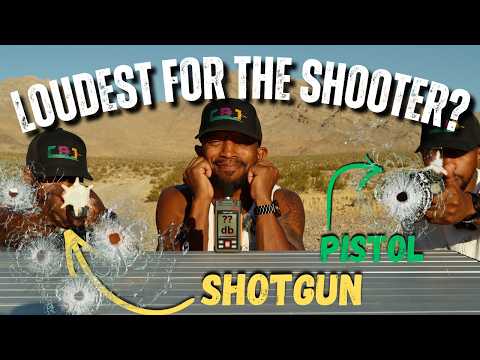
This video explores why a 9mm pistol might seem louder and cause more ear ringing than a shotgun, despite shotguns being perceived as more dangerous for home defense. The presenter hypothesizes that the closer muzzle proximity to the shooter's ears with a handgun, compared to a shotgun, is the primary factor. While decibel meter readings were inconclusive due to equipment limitations, the personal experience of the presenter and his associates consistently indicates that handguns cause more immediate ear ringing than shotguns, even without hearing protection.
This video investigates the common belief that .22LR bullets 'bounce around' inside a target, causing more damage than larger calibers. Through high-speed footage of ballistic tests on pork shoulder, the presenter compares .22LR (CCI subsonic and Mini Mag) with 9mm hollow point, 5.56x45mm FMJ, and 00 buckshot. The tests suggest that while .22LR may not always exit, it doesn't exhibit significant ricocheting or tumbling behavior within the medium, unlike some larger calibers which show more energy transfer and fragmentation.
This review examines Olight's Osight XE and SE red dot sights, highlighting their features and performance. The XE offers an enclosed RMR footprint with a removable battery and multiple reticle options (2 MOA dot, 6 MOA dot with 32 MOA circle). The SE features an enclosed RMR footprint with a 6 MOA dot and a removable battery. Both optics lack auto-brightness adjustment, relying on 10 manual settings. The XE includes unique pop-up rear sights. Durability testing suggests they hold zero, though the reviewer notes personal shooting errors impacted accuracy. The reviewer prefers enclosed emitters for their resistance to sun glare.
This video provides an expert-level guide to selecting the best home defense firearm, emphasizing reliability, accuracy, and stopping power. The instructor, CajunBoyJake, advocates for the Beretta 1301 shotgun, detailing why it outperforms handguns and rifles for home defense scenarios. The guide includes practical demonstrations of stopping power and accuracy, alongside discussions on ammunition choices and wall penetration concerns.
This video tests the ballistic resistance of a mini-fridge using various firearms and ammunition. It demonstrates that a standard mini-fridge offers no significant protection against common firearm rounds, including .22LR and 12-gauge buckshot. The experiment highlights the importance of understanding what materials are truly bulletproof for self-defense considerations.
This video highlights the often-overlooked self-defense advantage of using a weapon-mounted light. The primary tactic discussed is how a bright light can initially disorient an intruder and conceal the firearm itself, potentially de-escalating a confrontation by presenting a less immediately threatening visual than a drawn weapon. The speaker shares a personal anecdote about accidentally employing this tactic.
This video clarifies the common misunderstanding of firearm caliber, explaining that it primarily refers to the diameter of the bullet. The instructor emphasizes that caliber does not directly equate to a gun's power or size, providing examples of different calibers used in both rifles and handguns. The explanation highlights the actual measurement differences between calibers like 9mm and .45 ACP, and notes that even within the same caliber designation (e.g., .45), different cartridge types exist.
This video demonstrates how hollow point ammunition performance can be significantly degraded when passing through barriers like a car door. It highlights that material buildup within the hollow point cavity can prevent proper expansion, negating its intended effect. The test uses a high-speed camera to visualize bullet behavior after impacting water and a simulated car door.
This video explores the phenomenon of bullets skipping off a water surface, utilizing high-speed camera footage to analyze the trajectory of .22 LR, 9mm, and 12 gauge slugs. The experiment demonstrates that while some projectiles can briefly interact with the water surface and rebound, achieving a true skip that maintains significant forward momentum and stability is challenging, especially with larger calibers and slugs. The footage reveals that smaller calibers like the .22 LR are more likely to exhibit a brief surface interaction before tumbling, while the 12 gauge slug's mass and design make a skip highly improbable under these conditions.
This video explores whether ChatGPT can effectively guide individuals through the process of selecting and acquiring a firearm for self-defense. The instructor tests ChatGPT's advice on firearm choice, legalities, and purchasing procedures, finding it surprisingly competent for beginners, though lacking the depth of human expertise. Key recommendations include starting with a 9mm handgun like the Glock 19, understanding local laws, and prioritizing safe storage.
This video demonstrates the impact of barrel length on muzzle velocity using .38 Special ammunition. A 1.8-inch barrel Ruger LCR and a 6-inch barrel Ruger GP100 were tested. The results show a significant velocity difference between the two barrel lengths, highlighting how barrel length affects projectile speed.
This video demonstrates the significant advantage of a shotgun over a handgun for home defense, particularly at close range. Using a high-speed camera, it visually compares the impact of a 9mm hollow point bullet against a double-aught buckshot shell fired into a watermelon. The buckshot, containing nine 8mm pellets, shows a dramatically more destructive effect.