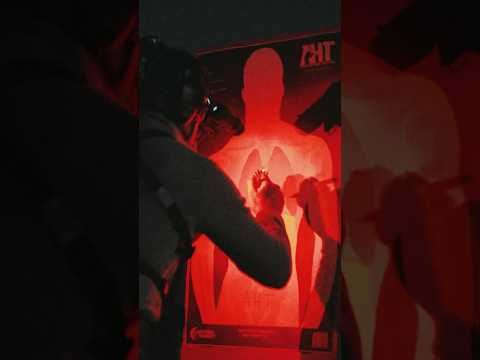
This video provides a comprehensive guide to setting up and zeroing the Tango Fire4000 laser rangefinder ballistic computer. It covers downloading the necessary app, physical installation, Bluetooth pairing, ballistic profile configuration, and a detailed method for achieving a parallel zero between the rangefinder's laser and the rifle's optic. The instructor emphasizes the importance of proper mounting and calibration for accurate long-range engagements.
This video features Jim Foreman, a retired Navy SEAL, discussing the H&K 416's operational advantages, particularly its short-stroke gas piston system which enhances reliability over direct impingement systems, especially when suppressed or in harsh conditions. Foreman shares insights on its adoption by elite military units and his personal setup preferences, including optics and laser systems, emphasizing its robust design and dependability in the field.
This guide details the process of achieving a parallel zero for lasers to rifle optics, a technique developed by Chris Roberts of CR2 Shooting Solutions. The method ensures the laser remains aligned with the reticle at all distances, crucial for long-range accuracy. It involves precise measurements and marking a target to establish a repeatable zero point, minimizing divergence and enhancing engagement effectiveness.
This video delves into the intricacies of zeroing lasers for night vision (NVG) applications, specifically comparing the 'Parallel' and 'Convergent' zero methods. It aims to educate new shooters on the point of aim (POA) and point of impact (POI) differences, offering a step-by-step explanation of each method's advantages and disadvantages. The description highlights that both methods are viable but require an understanding of ballistics and holds, similar to red dot sight (RDS) zeroing. Key takeaways include convergent zero's quick setup and pre-check benefits, while parallel zero offers consistent holds mirroring RDS zeroing. The content is geared towards practical application in NVG courses and tactical training.
This review covers the Steiner OTAL-C Class 1 IR laser, highlighting its suitability for budget-conscious night vision users. The laser is invisible to the naked eye, operating in the infrared spectrum and usable with night vision devices. It offers a Class 1 power output of 0.7 milliwatts, significantly lower than military-grade lasers, prioritizing eye safety. The review emphasizes its compact size, minimal offset from bore, and rugged construction, making it a practical option for various shooting applications, especially at closer to medium ranges.
You've reached the end! 5 videos loaded.
Gun Laws by State
Read firearms regulations for all 50 states + D.C.
Find Gun Dealers
Search licensed FFL dealers near you.