This video announces the exciting news of winning a patent for a unique firearm design. While the specifics of the design or the firearm family are not revealed in the title or description, the "won a patent" and trophy emoji strongly suggest a focus on innovation and development within the firearms industry. This patent likely pertains to a new mechanism, component, or even a complete firearm system. Further details about the patented design would be crucial for a deeper analysis.
This Royal Armouries lecture by former research engineer Derek Putley delves into the history of UK experimental electromagnetic railgun work from the 1980s and 1990s. It covers the scientific principles, engineering challenges, and specific projects like the RARDE experimental program and the Hyperlocity Test Facility. The lecture also highlights the origin story of a wooden railgun model now housed at the Royal Armouries. While not a demonstration of a functional firearm, it explores the theoretical and experimental development of a weapon system, referencing its fictional portrayal in 'The Expanse'.
This video features Jonathan Ferguson from the Royal Armouries examining the Hermann's Patent Revolver, a firearm notable for its ergonomic challenges and difficulty to fire. The episode delves into the design's impact on handling and usability, offering insights into historical firearm development and user experience. The Royal Armouries, the UK's national collection of arms and armour, encourages viewer engagement through comments and support for their preservation efforts.
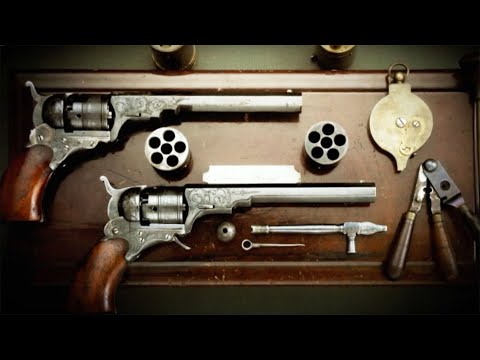
This video explores the early history of Samuel Colt and his groundbreaking innovations in firearm design. It delves into his initial business failures, the alleged inspiration for his revolver from a ship's capstan, and the development of the first Colt revolvers, known as 'Paterson' Colts. The video highlights the challenges faced by these early models, such as cylinder gap issues and awkward loading mechanisms, and details the improvements made in later iterations. The narrative touches upon the financial struggles that led to Colt's bankruptcy and the subsequent production of 'Ehlers Patersons'.
The Alofs Shotgun Conversion, patented in 1924, transforms a single-shot break-action shotgun into a 4+1 capacity repeater for $6. It uses a complex mechanical system to feed shells, requiring precise alignment and specific shell lengths for reliable operation. While faster than a single-shot for the first four rounds, magazine reloading is slow compared to modern repeaters, making it a fascinating but impractical piece of firearms history.
The Hill SMG/Pistol, designed by John L. Hill, served as a crucial inspiration for the FN P90's unique feeding system. Despite its innovative horizontal magazine and downward ejection, the design was not adopted by the military. H&B Enterprises later produced semi-automatic pistol versions, showcasing a novel rotary turntable mechanism for cartridge alignment and a follower that prevents rounds from falling out.
This video examines a rare Gardiner/Scott prototype grip safety designed for the early 1903 Springfield rifle. The mechanism, patented by Orlando Scott and assigned to Robert Gardiner, functions as a support-hand grip safety that blocks the sear. While innovative for preventing accidental discharges in sporting contexts, its complexity makes it impractical for military use.
This episode features Bill Rogers discussing the invention and patenting process of the earliest Kydex holsters. He shares insights with Tommy Campbell from Safariland, detailing the development of this innovative firearm accessory. The video delves into the history and technical aspects of Kydex holster creation, highlighting its significance in the firearms community.
This video explores Ross Rudd's unique AR180 prototype, which utilizes a custom delayed blowback system instead of the standard direct impingement. The design features an angled wedge on the bolt that locks into the upper receiver, similar in principle to roller-delayed systems. The prototype showcases innovative firearm engineering, though it never reached commercial production due to manufacturing challenges.
The Nichols & Childs revolving rifle, patented in 1838, was a contemporary of the Colt Paterson but proved less practical due to its manual cylinder rotation and gas seal mechanism. While the patent suggested auto-indexing, production models often lacked it. With a heavy barrel and chambered in .36 caliber, only about 100-150 were produced before the partnership dissolved, overshadowed by Colt's superior designs.
The Ferguson Rifle, patented by Captain Patrick Ferguson and manufactured by Durs Egg, was an early breech-loading flintlock designed for the British military. It demonstrated a rapid fire rate of six rounds per minute with good accuracy, offering a tactical advantage over muzzle-loaders. Despite its innovation, production costs and fragile stocks limited its widespread adoption, and the experiment concluded after Ferguson's death.
This video delves into the Merrill-Jenks Navy Carbine Conversion, a fascinating modification patented by inventor James Merrill in 1858. The patent focused on an improved locking lever designed for paper or linen cartridges. The video discusses the initial conversion of 300 Navy Jenks carbines, the subsequent issues with weak springs, and Merrill's redesign. It also touches upon the unknown loss of 60 carbines and Merrill's later production of a new-manufacture carbine for the Army during the Civil War. The content also promotes the Forgotten Weapons Patreon and merchandise.
Gun Laws by State
Read firearms regulations for all 50 states + D.C.
Find Gun Dealers
Search licensed FFL dealers near you.