This entry details the examination of a Walther PPK lacking standard proof marks. The speaker, a hobbyist, suggests this could indicate it was never issued, possibly due to factory completion at war's end, refinishing, or being a 'Lunchbox Special' – a firearm smuggled from the factory by an employee. The PPK in question is dated 1934.
This video from Legacy Collectibles showcases a collection of rare and historically significant German firearms, including Mauser C96 variants, Luger P.08 models, and engraved Walther pistols. Expert insights are provided on proof marks, serial numbers, and historical context, highlighting the provenance and collector value of these pieces. The presentation is informative and enthusiastic, reflecting deep knowledge of historical military firearms.
This guide details the examination of a rare Walther PP pistol featuring a unique 'Shark Fin' grip extension. It covers the analysis of its construction, potential purpose as a prototype or custom modification, and the interpretation of its historical markings and dating. The information is presented with the authority of a recognized expert in collectible firearms.
This guide details how to approach and understand mystery Walther PPK contracts from WW2, drawing on expert analysis of serial numbers, proof marks, and production variations. It emphasizes comparing these unique firearms to known models and considering historical context for potential identification. The information is presented with the authority of an experienced collector and researcher of German military sidearms.
This guide, drawing from an expert with high authority and deep archival knowledge of WWII-era European sidearms, details how to identify and understand various collectible pistols. It emphasizes the importance of specific markings like manufacturer codes (S/42), military/police proofs (Eagle F, DRP, PDM), and property marks (N, O) to determine a firearm's history, contract, and unit assignment. The instruction covers Lugers, P.38s, Polish Radoms, and Walther models, highlighting variations in calibers, materials, and production details relevant to collectors and historians.
This guide details how to examine Walther PPK pistols assembled by American GIs from parts found at the factory at the end of WWII. It covers identifying key features such as caliber, slide finish, frame material, and the significant absence of standard markings, highlighting these as characteristics of late-war, non-standard production. The information is presented with the authority of a recognized expert in historical firearms.
This video delves into the complexities of identifying late-war Walther PPK production, focusing on serial number variations, proof marks, and finishing techniques. The presenter, an experienced collector, highlights how to distinguish between standard production and potentially assembled or souvenir firearms from the WWII era, referencing expert books and personal database findings.
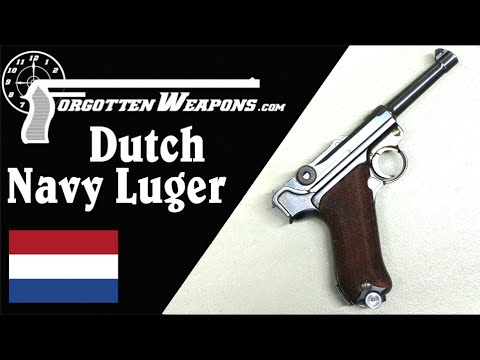
This guide provides expert-level insights into identifying and performing basic maintenance on the Dutch Navy Luger, drawing from the detailed analysis by firearms expert Ian McCollum. It covers essential checks for markings, features, and general condition, emphasizing safe handling practices throughout. The information is crucial for collectors and historians interested in this specific variant of the Luger pistol.
This guide details the identification and assembly theories surrounding a pair of consecutively numbered KU Lugers. The video, presented by Legacy Collectibles, highlights the significance of the 'KU' prefix, Mauser manufacturer codes ('42', 'byf'), 1939 date stamps, and Krieghoff proof marks. The expert-level analysis suggests these pistols may have been assembled by Krieghoff using earlier Mauser parts for Luftwaffe issue.
This video presents a quiz about a 1939 commercial Walther PPK, focusing on its proof marks. The presenter highlights the anomaly of a 'Waffen 63' proof, typically associated with Mauser, instead of the expected Walther proof (Eagle 359) for an Army-issued weapon. The quiz explores potential reasons for this discrepancy, ultimately revealing that the presence of the Mauser proof on this specific pistol indicates it is a fake, likely an attempt to increase value.
This video examines a unique, un-marked rimfire revolver built on a Colt-pattern frame. A key feature is an unusual hammer safety mechanism that requires pressing a lever on the hammer itself to allow it to be cocked, preventing it from catching on the frame. The revolver exhibits high-quality engraving but lacks manufacturer identification, bearing only a 'Crown over MR' proof mark.
This guide details the handling and identification of the FP-45 Liberator pistol, a unique WWII-era weapon. Drawing on the expertise of a specialist in historical firearms, it covers proper handling techniques using collector gloves, identification of key features like its single-shot bolt-action mechanism and stamped serial numbers, and interpretation of proof marks. The information is crucial for collectors and historians interested in this specific artifact.
Gun Laws by State
Read firearms regulations for all 50 states + D.C.
Find Gun Dealers
Search licensed FFL dealers near you.