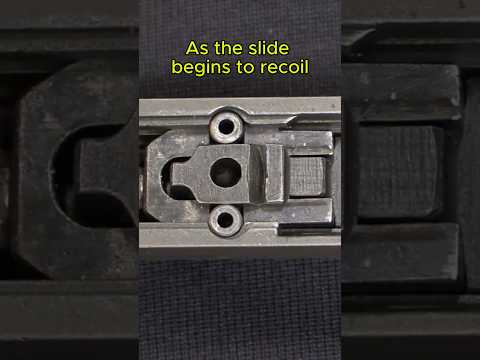
This video explains the roller locking mechanism, differentiating it from roller delay systems. It details how symmetrical rollers are forced outward into the slide by a central block, locking the barrel and slide together. The explanation covers how angled surfaces during recoil cause the rollers to retract, unlocking the barrel for cycling.
This video details a comprehensive custom build of a Heckler & Koch G3 rifle, specifically tailored for left-handed shooters. Key modifications include relocating the charging handle, upgrading to ambidextrous controls, a custom trigger job by Bill Springfield, and the integration of Magpul and Spuhr furniture for improved ergonomics and optics mounting. The build addresses common G3 deficiencies like poor recoil management and length of pull, resulting in a significantly more user-friendly platform.
Roller locking is a fully locked firearm action, distinct from roller-delayed blowback. It functions by rollers resting against a central block, forcing them outward to lock the barrel assembly. Unlike roller-delayed systems, roller locking requires an external force, like short recoil, to unlock. This mechanism is exemplified in firearms such as the CZ 52 pistol and the MG42 machine gun.
The HK G41, an attempt by Heckler & Koch to blend their roller-locking system with M16 ergonomics, suffers from significant reliability issues. Despite a smooth shooting experience due to its weight, the G41 experienced multiple malfunctions, including damaged casings from extraction failures. These performance problems likely explain its lack of commercial success compared to other HK platforms.
This video clarifies the distinction between a firearm's operating system and its locking system. The locking system ensures the breech is sealed during firing, while the operating system cycles the action. Examples like the Martini-Henry illustrate this, with its falling block as the lock and lever as the operator. Different firearms can share operating styles but have distinct locking mechanisms, such as rotating versus tilting bolts.
This review compares the HK93 with its clones, the Century Arms C93 and Zenith Z43P. It highlights the historical context of the HK93, its roller-delayed blowback system, and specific features like barrel twist and sights. The C93 is noted for significant quality control issues, while the Zenith Z43P, made with original HK tooling, is presented as the highest quality clone.
The Spanish AMELI LMG, a 5.56mm roller-locked weapon, shares lineage with the MG45 and CETME LMG. Despite an aggressive design featuring a quick-change barrel and bipods, its reputation was severely damaged by poor quality control stemming from Spanish government cost-cutting. Spanish Marines found it unreliable, preferring the heavier MG3 due to frequent malfunctions and parts breakage.
TFBTV's Paul interviews with Zenith Firearms at SHOT 2017, focusing on their imported MKE roller-locking rifles. The discussion highlights MKE's production of MP5 and HK93 clones in 9mm and 5.56mm/.223 respectively. These firearms are manufactured in Turkey under license from H&K, utilizing original H&K machinery. The video also acknowledges support from Ventura Munitions and Proxibid, and encourages viewer support through Patreon.
The POF-5 is a 9mm semi-automatic pistol from Pakistan Ordnance Factories, presented as an identical pistol-form clone of the MP5. It features a roller-locking mechanism, tri-lug barrel, and 1/2x28 threads for suppressor compatibility. The review demonstrates its use as a handgun, with and without an arm brace, and covers unboxing, features like the paddle magazine release, and field stripping.
You've reached the end! 9 videos loaded.
Gun Laws by State
Read firearms regulations for all 50 states + D.C.
Find Gun Dealers
Search licensed FFL dealers near you.