This guide provides an overview of the FN CAL's disassembly and maintenance, highlighting its complex internal mechanics and proprietary features. The FN CAL, developed by FN Herstal, is presented as a mechanically intricate rifle with reliability issues, making it challenging for armorers. The guide details key components and the disassembly process, emphasizing the need for expert knowledge due to its complexity.
This video discusses the development of German roller-locked select-fire rifles in 8x33mm Kurz, specifically the Gewehr 06 (G06) and Gewehr 06H (G06H). It highlights the use of stamped receivers and developmental magazines, differentiating the G06H by its gas-operated system and distinct handguard.
This entry details the rare Samostril Netsch, a 1920s Czech prototype automatic rifle designed by Jozef Netsch. It features a unique gas trap system and select-fire capability, intended to bridge the gap between rifles and machine guns. Despite failing military trials, 25 were produced, with many remaining in historical collections.
This video from Forgotten Weapons, hosted by Ian McCollum, delves into the complex history of the Sturmgewehr 44 (StG 44) program. McCollum, a recognized expert in historical firearms, meticulously details how Hitler's initial rejections of the intermediate cartridge rifle were overcome through strategic renaming, combat trials, and the intervention of figures like Heinrich Himmler. The program ultimately succeeded due to its effectiveness on the Eastern Front and its role in countering Soviet submachine gun proliferation.
This video provides an in-depth look at the Beretta AR70/90, an Italian military rifle. It details the rifle's development post-WWII, its technical specifications, and a comprehensive disassembly and reassembly process. The presenter highlights key features like its stamped receiver, long-stroke piston system, and its evolution from earlier Italian designs to its eventual replacement by the ARX160.
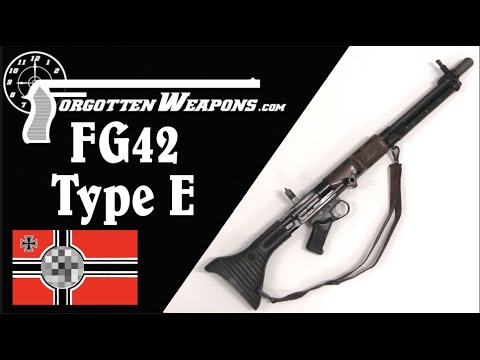
This guide details the field stripping and reassembly of the FG-42 Type E, a complex German paratrooper rifle from WWII. Expertly demonstrated by Ian McCollum, the process involves removing the stock to access the recoil buffer and bolt carrier group. Proper maintenance is crucial for this rare and historically significant firearm.
This review of the FN SCAR 16 highlights its design as a predecessor to modern combat rifles, featuring a one-piece aluminum upper, adjustable short-stroke piston system, and a modular stock. While acknowledging its excellent performance with minimal recoil and ergonomic controls, the reviewer expresses a personal preference for the AK platform due to the SCAR's perceived lack of character. The SCAR's influence on contemporary weapon systems is noted, with a brief mention of the CZ Bren 2 as a potential evolution.
This expert-level review by Jonathan Ferguson of the Royal Armouries details the FN Model 1949 AFN, exploring its features as a potential early British assault rifle. It covers its Belgian origins, unique operational aspects like the cocking indicator and selector lever, and its place in the evolution towards modern assault rifles, contrasting it with contemporary designs like the EM-1/EM-2 and early FAL prototypes.
This expert-level entry details the Krieghoff FG 42 Type 1 rifle, as presented by Brownells representatives at Rock Island Auction Company. It highlights the rifle's unique select-fire mechanism (open bolt for full-auto, closed bolt for semi-auto), its 8mm Mauser caliber, and its innovative features like a side-fed 20-round magazine, integrated bipod, spike bayonet, and ZFG 42 optic rail. The presentation emphasizes the FG 42's status as a pinnacle of German WWII engineering, particularly for paratrooper use, and distinguishes the early Type 1 model by its slanted grip and machined receiver.
This video provides an in-depth look at the rare Johnson Model 1941 Light Machine Gun, highlighting its unique design features and historical context. The presenters, Keith and Steve Ostrom from Rock Island Auction, discuss its select-fire capability, short recoil rotating bolt system, and adjustable rate of fire. They also touch upon its competition with the Browning BAR and its limited service with US forces, particularly in the Pacific Theater.
This video reviews the "Vickers Guide - WWII Germany, Volume 2" book, a coffee-table style publication focusing on German semi-automatic and select-fire rifles, machine guns, and last-ditch arms from WWII. It also covers presentation pistols. The reviewer highlights the book's exceptional photography and mentions their own contribution as an author. Specific rare firearms noted include various FG-42 patterns, a Grossfuss StG, an StG45(H), MG-30, MKb42(W), and a folding-stock G33/40. The book is presented as a visually appealing and informative resource for enthusiasts of German WWII small arms, rather than a strict reference manual.
This video provides an in-depth review of the Colt LE901-16S, a modular rifle designed to chamber both 7.62x51mm NATO and 5.56x45mm NATO. The presenter details the rifle's history, technical specifications, and unique convertible design. A step-by-step guide is provided on how to convert the rifle from its 7.62mm configuration to 5.56mm by swapping the buffer, buffer spring, and installing a specific magazine well block, allowing the use of standard AR-15 upper receivers and magazines.
Gun Laws by State
Read firearms regulations for all 50 states + D.C.
Find Gun Dealers
Search licensed FFL dealers near you.