This comprehensive guide, drawing on the expertise of GUNMEN Host, details a comparison of leading Low Power Variable Optics (LPVOs). It emphasizes performance and personal preference, covering models from Nightforce, Sig Sauer, Primary Arms, Leupold, Trijicon, and EOTech, with price points ranging from $400 to $3,000. The review highlights key features like glass clarity, eye relief, reticle design, and illumination systems, offering insights for selecting the best LPVO for various applications.
This comparison evaluates the Sig Sauer Tango6T, an LPVO chosen by the US Army, against the budget-friendly Monstrum Panzer. While the Tango6T offers superior optical clarity, detail, and daylight illumination, the Panzer provides a surprisingly capable performance for its price point, making it a viable option for budget-conscious buyers. The Tango6T excels in discerning fine details at range and offers a more forgiving eyebox, whereas the Panzer's main advantage is its significantly lower cost.
This guide covers the installation and initial testing of the SIG Sauer Tango6T LPVO, a military-grade optic adopted by the US Army. It details unboxing, mounting, and performing essential checks like turret tracking and magnification adjustments. The expert-level instruction emphasizes the optic's robust build quality and performance for designated marksman roles.
This video demonstrates a tactical training drill focusing on engaging targets at 320 meters with the M110A1 SDMR rifle. Instruction from professional tactical instructor Lucas Botkin highlights rapid target acquisition, effective weapon manipulation, and positional shooting techniques using a barricade. The drill emphasizes recoil management and consistent accuracy with the 7.62x51mm platform and SIG Sauer TANGO6T optic.
This video compares the Sig Sauer Tango6T 1-6x LPVO, adopted by the US Army, with the Trijicon VCOG 1-8x LPVO, selected by the US Marines. It details their features, specifications, and performance during range testing, highlighting differences in reticles, build materials, weight, and user interface. The comparison aims to determine which optic is superior for military applications.
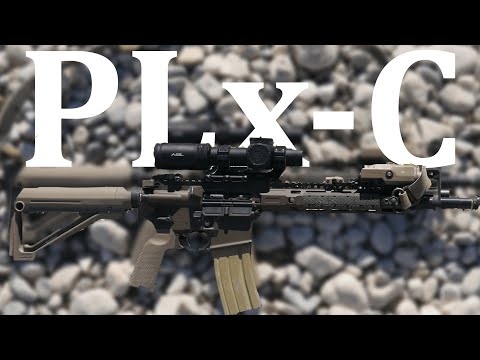
This expert review of the Primary Arms PLX-C 1-8x LPVO, delivered with high authority by Brass Facts, highlights its strong 1x performance and manageable weight as key advantages. While acknowledging its premium price point and 'standard' glass quality, the review critically examines the ACSS Raptor M8 reticle's complexity, deeming it potentially 'feature-crept' for rapid target acquisition in certain conditions. The PLX-C is positioned as a top-tier option, balancing its strengths against its reticle's drawbacks for the discerning user.
This guide details the installation and initial setup of the Sig Sauer Tango6T 1-6x LPVO, a popular optic for modern sporting rifles like the Sig Sauer MCX Spear LT and LWRC M6IC-DI. It covers proper mounting procedures using the Alpha4 mount, emphasizing torque specifications and eye relief, and touches on zeroing and reticle usage. The information is presented with the authority of experienced firearms instructors familiar with military-grade equipment.
This review of the Sig Sauer MCX Spear, presented by Sean of Pew Pew Tactical, offers an in-depth look at its features, ergonomics, and performance. The rifle, a civilian variant of the M7, excels in accuracy, achieving sub-MOA groups with specific ammunition. The review highlights its adjustable gas system, ambidextrous controls, and effective trigger, while also noting potential gas blowback when suppressed.
Larry Vickers provides an expert overview of the HK MR308 A3-28 rifle, detailing its features and military relevance. He highlights the 20-inch barrel, RAL 8000 finish, ambidextrous controls, and the Sig Sauer Tango6T optic, noting its use on the U.S. military's M110A1 SDMR. The discussion emphasizes technical specifications and historical context from a recognized firearms authority.
This video provides an expert-level analysis of the Sig Sauer Tango6T 1-6x LPVO, recently adopted by the DoD for M4A1 carbines under a $77 million contract. The review details the differences between First Focal Plane (FFP) and Second Focal Plane (SFP) configurations, highlighting the Hellfire M855A1 and Horseshoe Dot reticles. It assesses the optic's performance, including reticle scaling, illumination limitations in bright conditions, and overall ruggedness for combat applications, concluding that LPVOs now offer essential target identification capabilities beyond traditional red dots.
This review covers the Sig Sauer Tango6T FDE optic, highlighting its adoption by the US military and its competitive price point under $1300. The scope features a 1-6x24mm magnification range, a second focal plane Hellfire reticle, and HD glass with full multi-coating. Key features include low-profile turrets with tactile, non-audible clicks (0.1 Mil adjustments), a locking illumination knob, fiber optic magnification indicators, and a submersible design up to 20 meters indefinitely. The reviewer emphasizes its clarity, durability, and suitability for both close-quarters and mid-range engagements.
This video provides a post-SHOT Show 2019 recap, highlighting new tactical gear and firearms. Key discussions include the Zev OZ9 pistol's modularity and grip angle, SIG Sauer's Tango6T optic and ROMEO2 reflex sight, Coyote Tactical Solutions' pouches and cummerbund, and the Aimpoint Acro's potential advantages. The presenters also touch on less impressive products and industry trends, offering insights into the firearms market.
You've reached the end! 12 videos loaded.
Gun Laws by State
Read firearms regulations for all 50 states + D.C.
Find Gun Dealers
Search licensed FFL dealers near you.