This video delves into the experimental and often unconventional firearms developed under the US Army's SPIW (Special Purpose Individual Weapon) program. While specific details on the firearms are not provided in the description, the title suggests a focus on unique and potentially groundbreaking weapon designs that didn't necessarily see widespread adoption. The video likely explores the historical context, technical aspects, and the reasons behind the SPIW program's outcomes, offering insights into military small arms development.
The Colt XM-148 was the US military's first under-barrel grenade launcher, developed from the SPIW program for the M16 rifle. Despite its innovative design, it suffered from significant flaws, including a snagging trigger bar, high cocking force, and mechanical complexity. These issues led to its replacement by the simpler and more reliable M203, making the XM-148 a notable but ultimately unsuccessful footnote in firearms history.
This Q&A session for Desert Brutality 2020 covers a wide range of topics related to competitive shooting, including the use of Pistol Caliber Carbines (PCCs) in various divisions, specific division rules for Retro, Armored+P, and Classic/Manual categories. It delves into gear recommendations, such as holsters and optics, and discusses registration logistics and event planning. The conversation also touches on match design philosophies, training methodologies for limited ranges, and humorous hypothetical scenarios. The overall aim is to clarify rules, address competitor questions, and foster engagement within the shooting community.
This review delves into the AAI 2nd Gen SPIW flechette rifles, prototypes from 1966-1967 designed to replace traditional rifles with high-velocity flechette ammunition. Despite impressive muzzle velocity (4,585 fps) and a unique primer-activated operating system, the program faced significant reliability and accuracy issues during trials, particularly with mass-produced ammunition. The 1967 model introduced improvements like a barrel radiator to address cook-off problems.
The Winchester 1964 SPIW was a prototype developed for a 1962 U.S. military program seeking a multi-purpose combat rifle. It featured flechette ammunition for point targets and an integrated 40mm blow-forward grenade launcher. Despite innovative concepts like a soft recoil system, the SPIW suffered from poor balance and reliability issues, ultimately failing to be adopted.
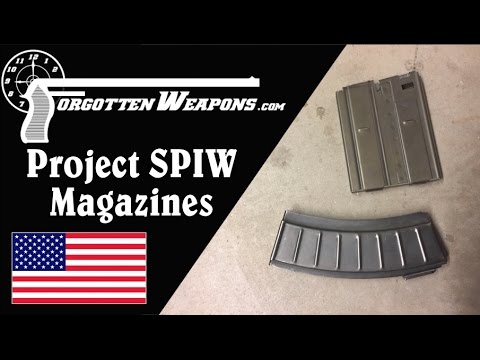
This video delves into the unique magazine designs for the US Project SPIW program, focusing on the Springfield 1964 and AAI XM19 experimental rifles. It highlights the challenges of high-capacity feeding for flechette rounds, showcasing Springfield's dual-stack 60-round magazine and AAI's innovative 50-round design with constant-force springs. The discussion underscores the program's goal of improving infantry hit probability through advanced ammunition and high rates of fire.
You've reached the end! 6 videos loaded.
Gun Laws by State
Read firearms regulations for all 50 states + D.C.
Find Gun Dealers
Search licensed FFL dealers near you.