This video details the ongoing legal battle surrounding the ATF's pistol brace rule. While the rule itself has been vacated nationwide, the DOJ is attempting to enforce its underlying legal theories, arguing that certain braced pistols are still considered Short Barreled Rifles (SBRs) under the National Firearms Act (NFA) based on statutory interpretation alone. The Gun Owners of America (GOA) lawsuit seeks a permanent injunction to block this enforcement theory.
This video explains the legal principle of purposivism, which allows courts to interpret laws based on legislative intent rather than strict textualism. It argues that this approach is crucial for public safety, citing US Supreme Court and Florida Supreme Court cases. The speaker uses a traffic stop scenario involving a headlight statute to illustrate how a literal interpretation could undermine the law's purpose, and asserts that an officer's reasonable mistake of law can still justify a stop.
This video discusses recent Supreme Court oral arguments concerning Chevron deference and its potential impact on Second Amendment law. The arguments in Lurbrite Enterprises v. Raundo and Relentless Inc. challenge the doctrine that allows government agencies to interpret ambiguous laws. Justices expressed skepticism, while liberal justices worried about courts becoming policymakers. The outcome could significantly alter how firearm regulations are interpreted and enforced.
This video analyzes Justice Clarence Thomas's dissent in the Vanderstock v. ATF case concerning the regulation of 'ghost guns' and unfinished firearm parts. The speaker highlights Thomas's argument that the ATF overstepped its authority by redefining 'frame or receiver' to include weapon parts kits, effectively rewriting Congressional statutes. The dissent emphasizes that such redefinitions, particularly concerning the potential conversion of parts into regulated items like machine guns, invite unforeseeable consequences and undermine established legal principles.
This video discusses the Gun Owners of America's (GOA) legal battle against the ATF's bump stock ban. Despite prevailing in the US Supreme Court, GOA was awarded a minimal amount of attorney's fees ($724) from their requested $400,000. The judge cited the government's position as 'substantially justified' due to unsettled legal definitions at the time, highlighting the challenges Second Amendment groups face in recovering legal costs from the federal government.
This video presents excerpts from the oral arguments in Vanderstock v. Garland, a Supreme Court case concerning the ATF's regulation of 'ghost guns' (privately made, unserialized firearms). It highlights the legal arguments from both the government, represented by Solicitor General Elizabeth Prelogar, and the plaintiffs, represented by attorney Pete Patterson. The core of the debate revolves around the interpretation of the Gun Control Act of 1968, specifically the definitions of 'firearm' and 'frame or receiver,' and whether the ATF exceeded its statutory authority.
This video discusses an amicus brief filed by 28 Attorneys General criticizing the ATF's rulemaking authority and practices. It highlights the ATF's history of stretching statutory language and ignoring APA requirements, citing cases like Garland v. Vanderock concerning unfinished frames and receivers, the pistol brace rule, and bump stocks. The brief argues the ATF should seek legislative changes from Congress rather than overreaching through regulatory means.
This video, presented by William Kirk, President of Washington Gun Law, provides an expert analysis of the Supreme Court case Garland v. VanDerStok, which will determine the future of 80% lowers. It delves into the specific legal definitions within 18 U.S.C. § 921 and contrasts the ATF's interpretation with plain statutory language, arguing that 80% lowers are not currently regulated as firearms under federal law.
This video delves into the Supreme Court case Jones v. Hendrick, examining the complex legal landscape surrounding federal prisoners challenging their convictions, particularly those related to felon-in-possession laws. It highlights the procedural hurdles, including the Anti-Terrorism and Effective Death Penalty Act (AEDPA) and Section 2255, which limit the ability to reopen cases based on new interpretations of law. The discussion emphasizes the philosophical divide on the Supreme Court regarding finality versus error correction in the criminal justice system.
This video from Washington Gun Law TV discusses the Supreme Court's ruling in Loperbrite Enterprises v. Roando, which effectively ends Chevron deference. President William Kirk explains how this decision significantly limits the power of federal agencies like the ATF by requiring courts to independently interpret statutes rather than deferring to agency interpretations. The ruling is framed as a major victory for the separation of powers and a return to the original intent of the Administrative Procedure Act.
This video explains why the Second Amendment phrase 'shall not be infringed' is more complex in practice than it appears. It uses recent court cases like Cargill v. Garland and NRA v. Vullo to illustrate how legal victories often rely on statutory interpretation and administrative law rather than direct Second Amendment challenges. The speaker, William Kirk, emphasizes that understanding these nuances is crucial for protecting Second Amendment rights.
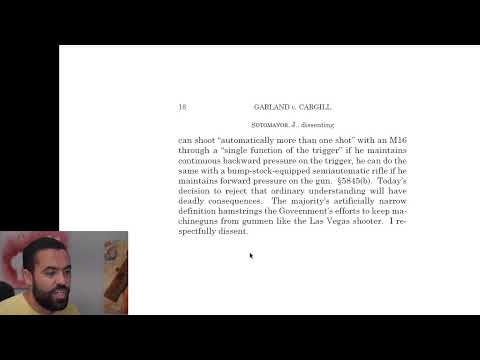
The Supreme Court ruled in Garland v. Cargill that bump stocks are not machine guns under the National Firearms Act. The court's majority opinion, delivered by Justice Thomas, emphasized that a semi-automatic rifle equipped with a bump stock does not fire more than one shot by a single function of the trigger, nor does it do so automatically. The decision found that the ATF exceeded its statutory authority by reclassifying bump stocks as machine guns, highlighting the importance of adhering to the precise language of the statute.
Gun Laws by State
Read firearms regulations for all 50 states + D.C.
Find Gun Dealers
Search licensed FFL dealers near you.