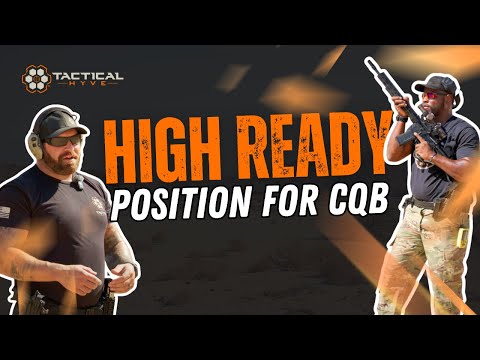
This video details the high ready firearm position, emphasizing its utility in CQB scenarios and for navigating obstacles. Instructor Dave Harris and Matt Kaos demonstrate key principles, including buttstock placement under the armpit for clearance and rapid presentation. A drill is presented to practice presenting the firearm, engaging targets, and returning to the ready position efficiently.
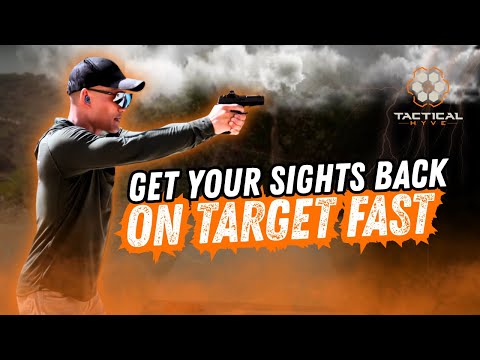
This video from Tactical Hive focuses on improving sight tracking and grip consistency for faster, more accurate shooting at an indoor range. Instructor Miles demonstrates drills to help shooters diagnose grip issues by observing how their sights return to the point of aim after each shot. The exercises progress from single shots to multiple shots, emphasizing consistent sight movement and return, with optional advanced drills including drawing from a holster.
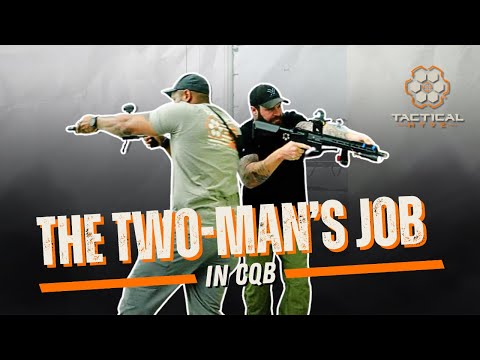
This video demonstrates two-man Close Quarters Battle (CQB) entry tactics, focusing on effective sector clearing. Instructors Matthew Cage and Dave from Tactical Hive explain how the second man entering a room should immediately secure their critical corner, then collapse their sector of fire to cover the area around the first man, maintaining visual awareness and avoiding wide angles to prevent friendly fire.
Matthew Goss of Tactical Hive details one-man Close Quarters Battle (CQB) entry tactics, emphasizing sector clearing. The technique involves immediately securing a critical corner, collapsing a primary sector to a safe distance from teammates, and then transitioning to a secondary sector to clear the room's far corner or 'point of domination'. This method prioritizes speed and threat mitigation in dynamic entry scenarios.
The House Test Drill, developed decades ago, serves as a cold-start warm-up for Close Quarters Battle (CQB) training. It assesses a shooter's baseline performance by engaging a human-sized target from varying distances (3, 5, 7, 10 yards and beyond) with a standard shot count (e.g., two to the chest, one to the head). The drill emphasizes combat accuracy over precision, acknowledging that real-life scenarios begin without a warm-up.
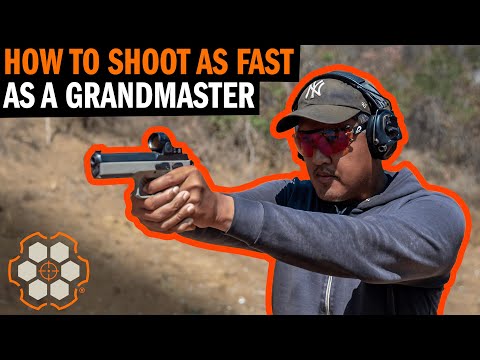
Grandmaster shooter John Bautista shares techniques for increasing shooting speed, focusing on three key areas: establishing a proper grip on the holster for a faster draw, managing grip pressure to maintain trigger finger control and sensitivity, and executing a precise trigger pull by minimizing slack and avoiding pinning the trigger after the shot. These techniques are crucial for competitive shooting and overall firearm proficiency.
This video demonstrates an efficient technique for moving between shooting positions in competition, as explained by 6X World Speed Shooting Champion Jethro 'Jet' Dionisio. The core principle is to pre-aim and set up your stance while approaching the next shooting box, rather than waiting until you are fully in position. This method can save significant time, estimated at 0.20 seconds per transition, which accumulates over a course.
Private Security Specialist Byron Rodgers emphasizes the critical importance of establishing a 'cold position' for personal protection. This involves pre-determining a safe rendezvous point for family or co-workers in case of forced evacuation, ensuring a headcount and a secure location away from the immediate threat. The cold position should ideally be outside the structure and offer a terrain feature for concealment against potential human threats.
You've reached the end! 8 videos loaded.
Gun Laws by State
Read firearms regulations for all 50 states + D.C.
Find Gun Dealers
Search licensed FFL dealers near you.