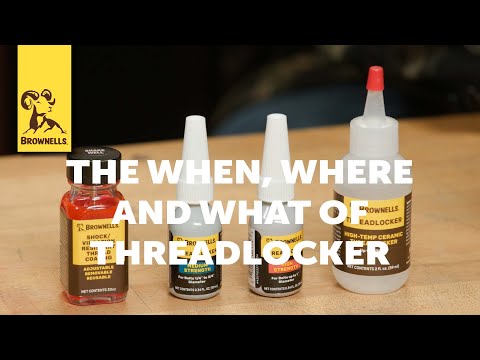
This guide explains the proper use of threadlocker on firearm accessories. It emphasizes using threadlocker on fasteners for items like optics and flashlights to prevent them from loosening due to recoil and vibration. The video recommends using blue Loctite for most applications, as it provides a secure hold while allowing for disassembly with basic tools. Red Loctite is noted as requiring heat for removal, and purple is suggested for very small screws.
This guide, presented by Steve and Caleb from Brownells, details the correct application of different threadlockers on firearms. It emphasizes selecting the right strength for the job, from vibration-resistant coatings to high-temperature ceramic compounds, and highlights the importance of proper degreasing for adhesion. The instruction covers common firearm components like scope mounts, muzzle devices, and bolt-action receivers, offering practical advice to prevent common mistakes.
This guide, presented by 1st Shot Tactical, details the process of installing a pistol red dot optic and performing initial bore sighting. It emphasizes using blue threadlocker and a torque driver for secure mounting, followed by using a bore sighter like the Tactical Elites Sight Right 2.0 to get the optic 'on paper' before heading to the range. This method saves significant time and effort during the zeroing process.
This video provides an unboxing of the GBRS Group Leg Strap Screw Kit. The kit contains all the necessary mounting hardware to attach the GBRS Group Leg Strap. Detailed specifications of the included screws (8-32 x .500 and 8-32 x .375 Philips Flat Head Truss Screws), rubber spacers, threaded binding posts, and Vibra-Tite Threadlocker are provided. The description also highlights compatibility with both the GBRS Group Leg Strap and specific components from True North Concepts (RHP and MHA). The screws are made of steel with a black oxide coating and weigh minimally.
This entry details an experiment where Loctite 243, a threadlocker, was used as a firearm lubricant on a Beretta 92FS-style pistol. The adhesive caused a complete malfunction after a short period, jamming the action. The key takeaway is that adhesives should never be substituted for proper firearm lubricants, as they will cause the weapon to seize, necessitating professional gunsmithing.
This guide details an experimental test conducted by Civilian Tactical to assess the functionality of a Beretta-style pistol when lubricated with Loctite 243 threadlocker. The experiment involved applying the threadlocker to internal components, allowing it to set, and then attempting to fire the weapon. The results indicated a complete failure to cycle, rendering the firearm inoperable due to the adhesive properties of the threadlocker. This highlights the critical importance of using appropriate firearm-specific lubricants.
This guide details the professional installation of the Trijicon RCR optic onto a Glock pistol equipped with the MOS system. It emphasizes critical steps such as proper firearm clearing, meticulous cleaning, the correct application of threadlocker, and precise torque specifications using specialized tools. The process includes applying witness marks for screw security and a mandatory curing period for the threadlocker, ensuring a reliable optic mount for demanding use.
This video's title, 'Do you know how Loctite works? Neither do we...', suggests a technical exploration, possibly related to firearm maintenance or modification where Loctite (threadlocker) is commonly used. Given the lack of a transcript and the title's ambiguity, it's difficult to ascertain the specific firearm models or calibers discussed. However, the context of Loctite implies a focus on gunsmithing, custom builds, or general firearm upkeep, where precise assembly and securing of components are crucial. The content likely aims to educate or entertain viewers interested in the practical aspects of firearm care and modification.
This guide details the process of mounting a red dot optic to a pistol slide, contrasting direct milling with Glock's MOS system. It emphasizes the benefits of direct milling for reliability and cost-effectiveness, including the use of indexing bosses for secure optic placement. The process involves applying threadlocker, proper screw tightening, and witness marking for long-term reliability, as explained by Lucas Botkin of T.Rex Arms.
This video features a unique torture test where a Riley Defense AK-47 is subjected to excessive Loctite Threadlocker Blue 242 in its action. The host, a firearms influencer with expertise in maintenance products and safe handling, demonstrates the application and then tests the rifle's ability to fire and cycle despite the seized components. The AK-47 successfully clears the Loctite and functions, passing the test.
This video, titled 'Loctite Everything,' focuses on the application of Loctite products, a strong adhesive often used in various mechanical and DIY projects. While the title and description do not explicitly mention firearms, the widespread use of Loctite in gunsmithing, firearm maintenance, and custom builds makes it highly relevant to the firearms community. Enthusiasts commonly use Loctite to secure screws, prevent parts from loosening due to recoil or vibration, and in other assembly processes for firearms and related accessories.
This video by Iraqveteran8888 delves into the crucial topic of threadlocker application on firearm components and accessories. It emphasizes that using the wrong type or amount of threadlocker can be detrimental to firearm function and maintenance. The content aims to educate viewers on proper usage to avoid potential issues, highlighting the importance of understanding the specific needs of different firearm parts.
Gun Laws by State
Read firearms regulations for all 50 states + D.C.
Find Gun Dealers
Search licensed FFL dealers near you.