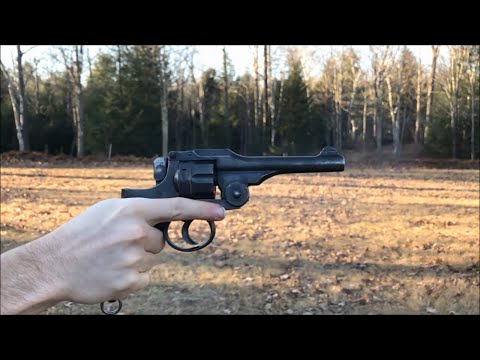
The Japanese Type 26 is Japan's first domestically produced military handgun, a double-action-only revolver chambered in a proprietary 9mm rimmed cartridge. While considered a decent last-defense weapon, it features a heavy trigger, uncomfortable metal backstrap, and requires a deliberate action to eject spent casings. Its tall steeple sights were advanced for its time.
Japan's first military revolver was the Smith & Wesson No. 3 New Model, adopted in 1878. Despite later adopting the domestic Type 26, Japan continued importing S&W No. 3 revolvers until 1908. These firearms saw service in conflicts like the Russo-Japanese War and remained in use through WWII.
This video features a shooting demonstration of a Japanese Type 26 Revolver. The content focuses on the firearm itself, likely showcasing its operation and handling. The provided hashtags indicate a focus on collectible firearms and revolvers from around the world.
This video provides a detailed look at three significant Japanese handguns from World War 2: the Type 26 revolver, the Type 14 Nambu, and the Type 94 Nambu. It covers their historical context, operational mechanics, and unique features, including live-fire demonstrations. The content highlights the evolution of Japanese sidearms and specific design quirks, such as the Type 94's external sear bar.
The Japanese Type 26 revolver, adopted in 1893, was Japan's first domestically produced military sidearm, replacing the Smith & Wesson No. 3. It features a unique tool-less disassembly mechanism by swinging the trigger guard forward. Chambered in a proprietary 9x23mm rimmed cartridge, it operates in double-action only with a free-spinning cylinder that indexes upon trigger pull. While comfortable to shoot due to low recoil and a smooth DA trigger, its cartridge is considered underpowered compared to contemporaries.
You've reached the end! 5 videos loaded.
Gun Laws by State
Read firearms regulations for all 50 states + D.C.
Find Gun Dealers
Search licensed FFL dealers near you.