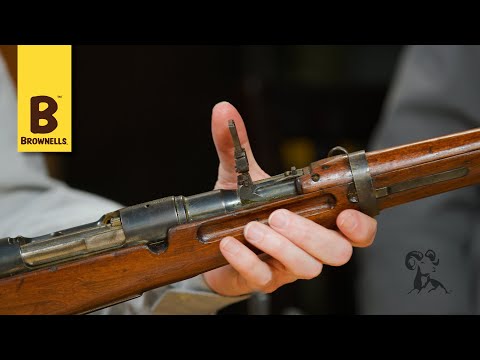
This expert-level overview of the Japanese Type 30 rifle, introduced in 1897, details its historical context, receiver safety features like gas vents, and its sighting system. The guide highlights the Type 30 bayonet lug, the five-round staggered column magazine, and the unique two-piece stock construction. It also explains the cock-on-close bolt action and its service life with the Imperial Japanese Navy, noting its replacement by the Type 38.
This video focuses on the Arisaka Type 99 rifle, a bolt-action firearm used by the Imperial Japanese Army during World War II. The description details its development, stemming from the need for a new rifle cartridge to replace the Type 38's 6.5×50mm round, aligning with the superior 7.7mm cartridge of the Type 92 heavy machine gun. The Type 99 was based on the Type 38 but chambered in 7.7mm and was produced across nine arsenals, including locations in Japan, Manchukuo, and Korea.
This video from Forgotten Weapons delves into Estonian sniper rifles, specifically focusing on Lee-Enfield rifles chambered in 7.62x54R and Arisaka rifles in .303 British. The title suggests a comparison or examination of these pre-war era firearms, likely highlighting their historical context, design features, and potential use in sniping or competition. The description hints at the rifles being heavy barrel variants, implying a focus on accuracy and precision.
This video explores the history and features of the Japanese Type 38 rifle, a bolt-action rifle utilized by Japan during World War II. The description highlights its historical context, contrasting "Samurai spirit" with "European industrial might," and positions it as an "underrated rifle." The video is structured into segments covering its history, identification, features, and a concluding summary, suggesting a comprehensive overview for viewers interested in historical firearms and military equipment.
The Japanese Arisaka Type 38 is a refined bolt-action rifle designed by Kijiro Nambu, emphasizing simplicity, ruggedness, and reliability. It features a distinct action with a round knob safety and a sliding dust cover, and utilizes an updated 6.5x50mm spitzer cartridge. Weighing 9.2 lbs and measuring 50.2 inches, it represents an enhanced evolution of Japanese rifle design.
The Japanese Arisaka Type 35 rifle, weighing 9.3 lbs and measuring 50.1 inches, is a significant evolutionary step between the Type 30 and Type 38 models. It features a 5-round capacity using 6.5x50mm stripper clips and incorporates a unique, though sometimes problematic, sliding dust cover. The rifle offers a smooth action, a semi-pistol grip, and an Austrian-style quadrant rear sight.
This video review focuses on the Japanese Type 38 rifle, highlighting its Mauser action and declaring it one of the best Mauser actions ever produced. The content emphasizes the historical and engineering aspects of this firearm.
This video provides a detailed operational overview of the Type 38 Arisaka rifle, including its visual characteristics and loading procedure. It features live-fire demonstrations from multiple perspectives, showcasing the rifle's performance and the manual bolt-action cycling in slow-motion. The content highlights the rifle's historical significance and its function as a classic bolt-action firearm.
This "From the Vault" episode features Brownells Gun Techs Steve and Keith showcasing the Japanese Arisaka Type 38 Cavalry Carbine from World War II. They highlight its shorter and lighter design compared to infantry rifles, its original intended use for cavalry and rear-echelon troops, and its suitability as a potential "jungle carbine." The discussion delves into its chambering in 6.5x50mm Arisaka, its gentle recoil, and its straightforward action, which is similar to the Type 99. Specific features like the Mauser-style bolt, claw extractor, 5-round internal magazine, reinforcement tangs, side sling swivels, and barrel length are detailed. The episode also touches on the significance of the chrysanthemum stamp on the receiver and its impact on a rifle's value, emphasizing this particular carbine's excellent condition and historical significance.
The Arisaka Type 38, designed by Kijiro Nambu, is a historically significant Japanese bolt-action rifle. It features a simple, rugged design with a 50.2-inch overall length and weighs 9.2 pounds. Key improvements over the Type 30 include a round push-in safety, reduced bolt parts, a sliding dust cover, and an updated 6.5mm spitzer cartridge.
This review details the 1930s Japanese Arisaka 'wire bale' QD sling, a metal loop design predating modern plastic versions. While innovative for rapid sling removal, especially on takedown rifles like the Type 2 Paratrooper, its clips can detach if tension is lost. The sling is distinct from other Japanese QD variants and was used on models like the Type 38 and Type 99.
This video details the historical development and evolution of World War 2 Japanese sniper rifles. It traces the lineage starting from the Type 38 rifle, progressing to the Type 97 sniper variant, and culminating in the Type 99 sniper rifle. The content focuses on the design, technological advancements, and military context surrounding these iconic firearms of the era.
Gun Laws by State
Read firearms regulations for all 50 states + D.C.
Find Gun Dealers
Search licensed FFL dealers near you.