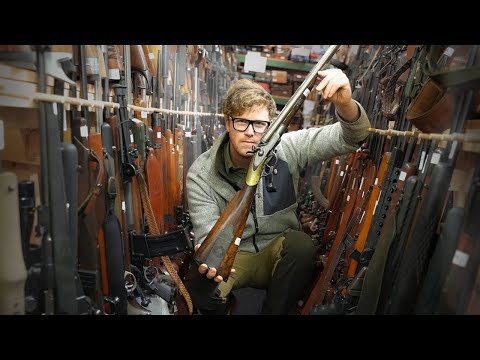
This video, "The Untold Story of the Martini-Henry (Part Two)", delves into the conclusion of the Martini-Henry rifle's history, focusing on the experimental .402 calibre variant. Experts Neil Aspinshaw and Jonathan Ferguson discuss the rifle's promises and problems, rising costs, lessons learned from troop feedback and the Sudan campaigns, and controversies surrounding jamming and cartridge cases. The episode also covers the Enfield-Martini Second Pattern .402", foreign competition, the rise of the Lee rifle, conversions, and details on the Martini-Henry Mk.IV Pattern A and B, concluding with the rifle's legacy. The content is presented by the Royal Armouries.
This video features firearms expert Jonathan Ferguson unboxing and examining a unique Victorian-era percussion pistol, potentially a Reilly model, with a peculiar "Emigrants of the Universe?" label. The episode delves into the pistol's design, its intended purpose, and the historical context of its maker, offering insights into a specific period of British firearms history. The video also includes beauty shots of the firearm and historical background on Reilly.
This video segment from "American Rifleman Television" explores the Lee-Enfield Carbine, a specialized firearm developed for British cavalry at the end of the 19th century. Unlike its infantry counterparts, the carbine featured a shorter, sleeker design optimized to minimize snagging when carried in a saddle scabbard. Key differences include a six-round magazine and specific nose cap configurations. The video touches on its use in the Second Anglo-Boer War, various modifications for different units like the Royal Irish Constabulary and New Zealand troops, and its eventual obsolescence as military design shifted towards more standardized roles by the turn of the 20th century, ultimately being replaced by the Short, Magazine Lee-Enfield.
This C&Rsenal "History Primer" documentary delves into the history, function, and live-fire demonstration of the Webley Pryse No.4 revolver. The video highlights the firearm's historical context, featuring insights from the Royal Armouries and referencing historical publications and gunmaker directories. It also acknowledges contributors for ammunition data and animations, and promotes patron support and merchandise.
This C&Rsenal video provides an in-depth historical documentary on the Martini-Henry MkII rifle. It covers the firearm's history, its operational mechanics, and includes live-fire demonstrations. The series aims to deliver comprehensive small arms history every other week. Support for the channel is encouraged through Patreon and SubscribeStar, with merchandise and Ballistol sponsorship also mentioned. Several books and publications on the Martini-Henry and related firearms are recommended for further reading.
This YouTube video from C&Rsenal's "Primer" series provides a historical documentary on the British Tranter 1868 revolver. The content covers the firearm's history, its functional aspects, and includes a live-fire demonstration. Additional reading suggestions and links for supporting the channel or purchasing merchandise are also provided.
The 1896 Bittner pistol is a beautifully crafted, manually operated ring-trigger handgun from late 19th century Austria. Designed by Gustav Bittner, it refined the Passler & Seidl system for easier manufacturing. Chambered in 7.7mm Bittner and loading via an en-bloc clip, its unique steampunk aesthetic and high build quality make it a rare collector's item.
This video provides an expert examination of a rare mid-1850s cased set of Deane, Adams & Deane over/under percussion pistols. The presentation highlights the intricate craftsmanship, including fine engraving and a unique captive ramrod. It also details the pistols' design for concealed carry, featuring safeties and a hidden percussion cap reservoir, showcasing the ingenuity of historical firearm design.
The Bullard Large-Frame Sporter, produced from 1886-1891, was a high-quality, expensive lever-action rifle known for its strength and smoothness, often exceeding Winchester's. It featured a unique bottom-loading mechanism and a distinctive automatic dust cover. Despite its quality, high production costs led to the company's demise in 1891.
The Martini-Henry I.C.1 Carbine, a significant breech-loading rifle of the British Empire, is explored in detail. Its design aimed for interchangeability between cavalry and artillery variants. Chambered in .577/450, it utilized a falling block action based on Peabody's design with Martini's striker and Henry's rifling. Specific carbine features include a smaller cocking indicator and rounded receiver. Live firing highlights potential issues with vintage Kynoch ammunition.
This video provides a demonstration of the Martini-Henry Mk.II rifle, focusing on its terminal ballistics. It details the effect of the rifle's projectile on a ballistic gel block, explaining concepts like permanent cavity, temporary cavity, and penetration depth. The description compares the Martini-Henry's performance to modern handgun cartridges, noting its reliance on a large permanent cavity for incapacitation due to its lower velocity and harder bullet composition. The video also touches on the historical significance of the Martini-Henry, its role in the film 'Zulu', and its technical specifications as a single-shot, lever-actuated rifle.
You've reached the end! 11 videos loaded.
Gun Laws by State
Read firearms regulations for all 50 states + D.C.
Find Gun Dealers
Search licensed FFL dealers near you.