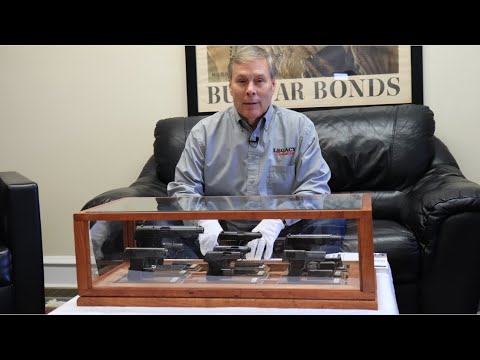
This video provides an overview of a collection of small-caliber semi-automatic pistols, primarily from the interwar and post-WWII European eras. The presenter, while not a collector of these specific firearms, details various models from manufacturers like Walther, Colt, Czech Duo, Beretta, Mauser, and others. Key discussion points include the intended use of these pistols as concealed carry or last-line-of-defense weapons, common calibers like .25 ACP and .22 LR, and notable design differences between models such as the Walther TP and TPH.
This video provides a detailed look at the Walther Model 4, a significant early semi-automatic pistol designed by Fritz Walther. It highlights the pistol's unique recoil spring system, its adoption by the German military during WWI, and its popularity in the civilian market. The discussion also touches on the historical context of Walther's entry into handgun manufacturing and its eventual succession by the PP series.
This video presents a virtual gun show walkthrough by a retired firearms expert, showcasing a diverse collection of vintage firearms and high-end holsters. The expert details specific models like Lugers, Walthers (PPK, PP), Mauser HSc, Colt 1911 A1, Beretta P38, and Walther Model 4, highlighting their historical context, condition, markings, and unique features. He also reviews various WWII-era holsters for Lugers and PPKs, providing price ranges and condition assessments.
This video showcases a diverse collection of German and European firearms, primarily focusing on Walther P38 variants, Lugers, and other pistols from the pre-war and WWII eras. The presenter, drawing on extensive knowledge, details various production codes, dates, finishes, and collectible variations, offering insights into their historical context and market value. The collection includes common shooter-grade examples alongside rare variations, providing a comprehensive overview for firearms collectors and enthusiasts.
This video features a significant World War II veteran's story about how he captured a Belgian FN Browning Model 1922 pistol. Beyond the FN Browning, the content showcases an impressive collection of rare and notable firearms, including a Duraluminum Sauer 38h, a privately sourced Walther PPK, an RJ Walther PP, a Krieghoff Luger, a 1914 Erfurt Artillery Luger, and a mint condition Walther Model 4. The description also promotes the channel's Patreon, podcast "Flak & Fubar", and Twitter presence.
This video showcases a beautiful presentation box containing Walther Models 1 through 9. The description highlights early access to videos and a Patreon raffle as incentives for support. It also promotes their podcast, "Flak & Fubar."
The Walther Model 4 is a compact, blowback-operated pistol chambered in 8.32 ACP, featuring a detachable box magazine and prominent slide texturing for grip. Despite its small size, it exhibits snappy recoil, though its forward balance offers slight assistance. The trigger pull is noted as smooth due to a long transfer bar, and while the safety is operable one-handed, it's not quick. The rear V-notch sight is functional, and the magazine release is considered adequate.
The Walther Model 6, developed in 1915, was Walther's attempt to create a 9mm Parabellum pistol for the German military, building on the success of the Model 4. Its simple blowback action required a significantly heavier slide and frame (34 oz vs. 19 oz for the Model 4) to safely handle the powerful cartridge. The German military ultimately rejected this design in favor of locked-breech systems, resulting in a low production run of only about 1,000 units, making it a rare historical firearm.
This video, part of the "WWI Primer" series, provides an in-depth explanation of how the German Walther Model 4 pistol works. It highlights its single-stack magazine, blowback action, and internal hammer fire mechanism. The video aims to educate viewers on the technical aspects of this historical firearm.
The Walther Model 4, chambered in .32 ACP, was a robust sidearm developed for military and police use. Its design incorporated unique features like a barrel jacket extension for cost-effective manufacturing. Despite wartime production challenges and the use of subcontractors, the Model 4 proved reliable and accurate, with its simple blowback, single-action mechanism emphasizing ease of use and maintenance.
You've reached the end! 10 videos loaded.
Gun Laws by State
Read firearms regulations for all 50 states + D.C.
Find Gun Dealers
Search licensed FFL dealers near you.