The Winchester 1897, often called the "Trench Gun," is examined for its effectiveness in combat. The video highlights its slam-fire capability, allowing for rapid firing by holding the trigger, and discusses its historical use in World War I, where its effectiveness in trench warfare led to the Germans deeming it inhumane. Differences between WWI and WWII models, particularly regarding takedown features, are also noted.
Historian Professor David Olusoga visited the Royal Armouries Museum, highlighting the Lee Enfield rifle, a significant firearm used by the British Army in both World Wars. He discussed its production scale and its impact on generations of soldiers, emphasizing the museum's extensive collection spanning centuries.
This video provides an in-depth look at the evolution of the M1911 pistol, comparing the original World War I variant with the subsequent M1911A1. It details minor ergonomic and functional changes made to the A1 model, such as trigger length, grip texture, backstrap shape, and front sight size, while emphasizing that the core design remained remarkably consistent. The discussion also extends to the evolution of accessories like holsters and magazine pouches, highlighting their enduring functionality.
Dragonman's Museum is opening on April 25th and 26th, offering two-hour tours at 10:00 AM for $20 cash per person. The museum features extensive displays covering various historical conflicts, including World War II, World War I, the Vietnam War, the Korean War, the American Revolutionary War, and the Civil War. It also includes specialized exhibits on Nazi Germany, the Soviet Union, Iraq, and Afghanistan, showcasing weapons, uniforms, and historical artifacts.
This video from the Shawn Ryan Show explores the surprising origins of the tank, revealing that it was invented by the Royal Navy, not the Army. Winston Churchill played a pivotal role as First Lord of the Navy, conceptualizing the 'land ship' due to the Navy's existing shipbuilding capabilities. The content highlights the initial skepticism from the British Army, who relied on cavalry, and contrasts early WWI tanks with modern armored vehicles like the M1 Abrams and T-90.
This expert review from C&Rsenal details the German Reichsrevolver M1879, highlighting its significant size, slow 6-round gate-loading mechanism, and 10.6x25mmR caliber. The presenter, Mae, discusses its manageable recoil due to mass but criticizes its poor ergonomics and stiff single-action trigger, concluding it was likely difficult for soldiers in World War I despite being entertaining to shoot today.
This video from Forgotten Weapons details the extensive journey of a single Arisaka rifle, tracing its path from Meiji-era Japan through Britain, Russia, and Finland, before its eventual import into the United States. The expert presenter uses specific markings on the rifle, including the Imperial Chrysanthemum, to authenticate its historical movements and usage across multiple empires and conflicts. The narrative highlights the rifle's role in trade, particularly Finland's exchange of Arisakas for Mosin-Nagant parts, and its survival through significant historical events.
This video from Legacy Collectibles provides an expert look at the rare French RSC Model 1917 rifle. It highlights the rifle's historical significance as one of the first WWI battle rifles produced in quantity and notes its limited popularity with soldiers due to weight and maintenance requirements. The discussion also touches upon the less common Model 1918 variant.
This video provides an expert-level examination of several historical firearms, including a Walther Party Leader PPK rig, Police Department Munich (PDM) Walthers, a 1934 Navy Mauser, a 1940 Luger, a commercial 1941 Mauser, World War I and early World War II Lugers, a commercial Luger, and a Swedish P38. The presenter, with clear expertise, details specific markings, features, and historical context for each piece, highlighting their rarity and condition.
This lecture explores how museums exhibit arms, weapons, and technologies from the World Wars, focusing on the challenges of contextualization, narrative, and visitor experience. Dr. Stefan Jagger discusses various exhibition strategies, from technical displays to symbolic representations, and analyzes how different museums approach complex themes like the V2 rocket, gas warfare, and the nuclear bomb. The talk highlights the tension between celebrating technological advancement and acknowledging the destructive human cost, emphasizing the concept of 'entangled memory' in contemporary museum practice.
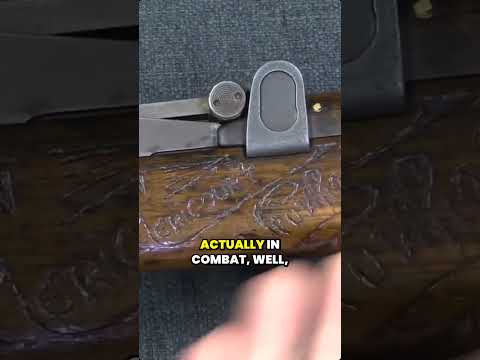
This video details a veteran's reunion with his engraved Lee-Enfield SMLE No. 1 Mk III* rifle after decades. Expert analysis highlights the rifle's unique carvings, military regulations regarding equipment modification, and the veteran's remarkable memory in proving ownership via serial number.
This video provides an in-depth look at a World War I Erfurt P08 Luger pistol and personal items belonging to Major Charles Frederick Ashdown. Firearms Curator Lisa Traynor details the pistol's markings, modifications, and historical context, alongside a silver cigarette case engraved with battle locations and a Norfolk Regiment matchbox holder. The discussion highlights the provenance of the Luger as a potential trophy of war and analyzes its specific features and accompanying accessories.
Gun Laws by State
Read firearms regulations for all 50 states + D.C.
Find Gun Dealers
Search licensed FFL dealers near you.