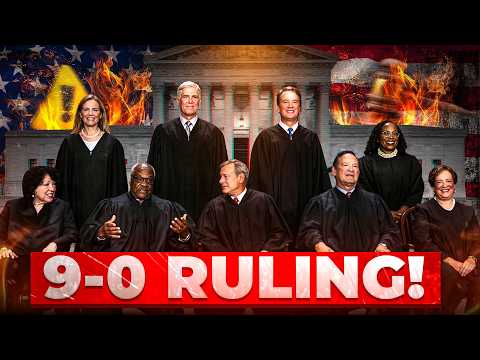
This video details the Supreme Court's unanimous 9-0 decision in favor of the Martin family, who were victims of an FBI wrong-house raid. The ruling clarified that law enforcement does not automatically gain immunity simply by exercising judgment; decisions must be grounded in actual policy considerations, not mere mistakes. The case has returned to the 11th Circuit, where judges are scrutinizing the line between policy discretion and operational failures, particularly regarding the fundamental duty to execute warrants at the correct address. The lack of a request for further briefing suggests the 11th Circuit is moving towards a decision, likely allowing the Martins' case to proceed and potentially drawing a clearer distinction between protected policy decisions and basic operational negligence.
This video analyzes a 9-0 Supreme Court decision impacting government immunity in cases of law enforcement error, specifically a wrong-house FBI raid. The Supreme Court ruled that law enforcement does not automatically gain immunity simply by exercising judgment, requiring them to demonstrate policy considerations rather than mere mistakes. The case has returned to the 11th Circuit, where judges are scrutinizing the line between policy discretion and operational failures, questioning how executing a warrant at the wrong address could be a protected policy decision. The outcome could significantly affect the ability to sue the government for operational errors.
This video discusses the Supreme Court's 9-0 unanimous decision in a case involving an FBI wrong-house raid and its implications for government immunity. The case, which returned to the 11th Circuit, centers on the discretionary function exception to the Federal Tort Claims Act. The speaker highlights the 11th Circuit's oral arguments, focusing on the distinction between policy discretion and operational failures, and anticipates a forthcoming decision on whether additional briefing is required.
This video discusses the Supreme Court's unanimous 9-0 decision in a case involving the Martins, who were victims of an FBI wrong-house raid. The core issue revolves around the discretionary function exception under the Federal Tort Claims Act, which the government uses to claim immunity. The Supreme Court's ruling clarified that simply exercising judgment does not automatically grant immunity, and the government must demonstrate that decisions were grounded in actual policy considerations, not mere mistakes. The 11th Circuit is now rehearing arguments in light of this precedent, with judges appearing skeptical of the government's broad claims of immunity for operational failures.
This video details a critical incident where Grand Prairie police responded to the wrong house, leading to an officer-involved shooting of homeowner Thomas Simpson. The narrative focuses on the legal ramifications, including potential charges against Simpson and the homeowner's rights under Texas's Castle Doctrine and broader self-defense laws. It highlights the importance of proper police procedure, the concept of objective reasonableness in use-of-force cases, and the legal complexities surrounding officer-involved shootings.
This video breaks down the Supreme Court's unanimous 9-0 ruling in Martin v. United States, which strengthens citizens' ability to sue the federal government for wrongful actions by law enforcement. The ruling clarifies that the government cannot automatically claim immunity through the discretionary function exception when law enforcement officers make mistakes, such as raiding the wrong house. The decision emphasizes that liability under the Federal Tort Claims Act is judged by state laws, requiring courts to consider how a private person would be liable under similar circumstances. This ruling is significant for gun owners as it enhances accountability for government overreach and potential mistakes during raids.
This video discusses a Supreme Court case where a family is suing the government after the FBI raided their home by mistake. The courts have previously ruled that individuals cannot sue the government for bad judgment, even in cases of wrongful raids, citing the Federal Tort Claims Act and the Supremacy Clause. The Supreme Court's decision in this case could significantly impact law enforcement accountability and the conduct of federal raids.
This video discusses a controversial police raid where officers allegedly entered the wrong house and deployed a grenade into a nursery. It also touches upon topics like cocaine residue on Hunter Biden's gun case, the Sig Brace letter, and studies suggesting a drop in gun crimes after permitless carry laws in Ohio and Florida. The creator urges viewers to contact Florida officials regarding legislative action (HB 1619).
This video by Colion Noir critically examines the dangers of no-knock warrants, using the tragic Amir Locke shooting as a primary example. Noir argues that these warrants unnecessarily endanger both citizens and law enforcement by creating high-stress, life-or-death situations, particularly when raids are executed on the wrong addresses. He advocates for a re-evaluation of their use in the United States, considering the high rate of civilian gun ownership and existing self-defense laws like the Castle Doctrine.
You've reached the end! 9 videos loaded.
Gun Laws by State
Read firearms regulations for all 50 states + D.C.
Find Gun Dealers
Search licensed FFL dealers near you.