Federal Court DESTROYS ATF In Striking Down Bumpstock Ban!!

Published on January 7, 2023
Duration: 17:29

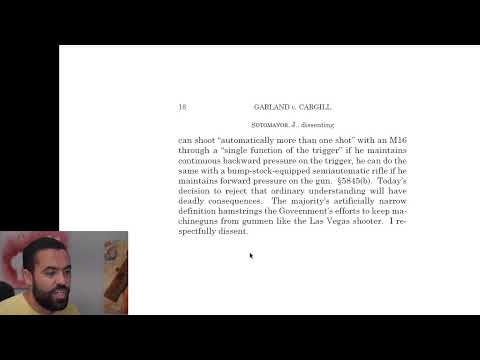
This video analyzes the Fifth Circuit Court of Appeals' decision in Cargill v. Garland, which struck down the ATF's ban on bump stocks. The court found that bump stocks do not meet the statutory definition of a machine gun under federal law, emphasizing that the law prohibits machine guns based on how they fire, not how quickly. The decision highlights the ATF's reversal of its long-standing position and the importance of statutory interpretation over agency regulation, particularly when criminal penalties are involved. The analysis suggests this ruling could have implications for other ATF regulations.

Quick Summary

The Fifth Circuit Court of Appeals struck down the ATF's ban on bump stocks in Cargill v. Garland, ruling they are not machine guns under federal law. The court emphasized that the definition hinges on the firing mechanism, not the rate of fire, and cited the ATF's prior stance and the rule of lenity. This decision challenges the ATF's regulatory authority.

Chapters

  1. 00:00Introduction: Bump Stock Ban Struck Down
  2. 00:17Analysis of the Court's Decision
  3. 01:31Case: Cargill v. Garland
  4. 01:44Administrative Procedure Act Explained
  5. 01:55History of Machine Gun Regulation
  6. 02:27ATF Regulation on Bump Stocks
  7. 02:36What is a Bump Stock?
  8. 03:04ATF Reverses Position in 2018
  9. 03:15Context: Las Vegas Shooting
  10. 03:46Michael Cargill's Challenge
  11. 04:08Court's Ruling: Bump Stocks Not Machine Guns
  12. 04:27Rule of Lenity Applied
  13. 05:02ATF's Long-Standing Position
  14. 05:30Implications for Other ATF Rules
  15. 05:56Definition of Machine Gun
  16. 06:08Device Converting Firearm to Machine Gun
  17. 06:19Is a Bump Stock Such a Device?
  18. 06:27Bump Firing Technique
  19. 07:01ATF's Prior Classifications
  20. 07:34Court Rejects ATF's Stance
  21. 07:37Senator Dianne Feinstein's Concern
  22. 08:25Dubious Analysis of Regulation
  23. 09:08Previous Bump Stock Cases
  24. 09:17Sister Circuit Decisions
  25. 09:43DC Circuit and Chevron Deference
  26. 10:23Tenth Circuit Decision
  27. 11:06Sixth Circuit Ruling (GOA Case)
  28. 11:17Navy-Marine Corps Court Decision
  29. 11:44Government Declines Chevron
  30. 11:59Traditional Statutory Interpretation
  31. 12:06Grammar and Definition Analysis
  32. 12:26Government's 'Common Sense' Argument
  33. 12:40Court's Rebuttal on Common Sense
  34. 13:07Absurd Results of Government's Position
  35. 13:14Meaningful Difference: Ease of Use
  36. 13:37Congress Did Not Prohibit Rate of Fire
  37. 13:59Chevron Deference Not Applicable
  38. 14:05Judgment Reversed and Remanded
  39. 14:13Scope of Relief
  40. 15:07Decision Precisely Worded
  41. 15:53ATF Cannot Make Law
  42. 16:08Semi-Automatic Rifles Can Be Bump Fired
  43. 16:12Implications for Individuals in the Circuit
  44. 16:33Conclusion and Call to Action

Frequently Asked Questions

What was the outcome of the Cargill v. Garland case regarding the ATF's bump stock ban?

The Fifth Circuit Court of Appeals ruled in Cargill v. Garland that the ATF's ban on bump stocks was unlawful. The court found that bump stocks do not meet the statutory definition of a machine gun under federal law, emphasizing the distinction between how a firearm fires and how quickly it can fire.

Why did the court rule that bump stocks are not machine guns?

The court determined that a plain reading of the National Firearms Act and Gun Control Act defines machine guns by their firing mechanism, not by the rate of fire achievable through techniques like bump firing. The court also noted the ATF's prior consistent interpretation that bump stocks were not machine guns.

What legal principles were applied in the bump stock ban ruling?

The court applied traditional statutory interpretation tools and the rule of lenity, which dictates that penal statutes should be construed strictly in favor of the defendant when ambiguity exists. The court also found that the ATF exceeded its authority under the Administrative Procedure Act.

What are the potential implications of the Fifth Circuit's bump stock ban decision?

This ruling could have significant implications for other ATF regulations that attempt to redefine existing firearm components or accessories through administrative rules rather than legislative action. It reinforces the idea that agencies cannot create law where Congress has not explicitly acted.

Related News

All News →

More 2nd Amendment & Law Videos You Might Like

More from Guns & Gadgets 2nd Amendment News

View all →